TFP Field Note - Date Stamp: 21.10.2026
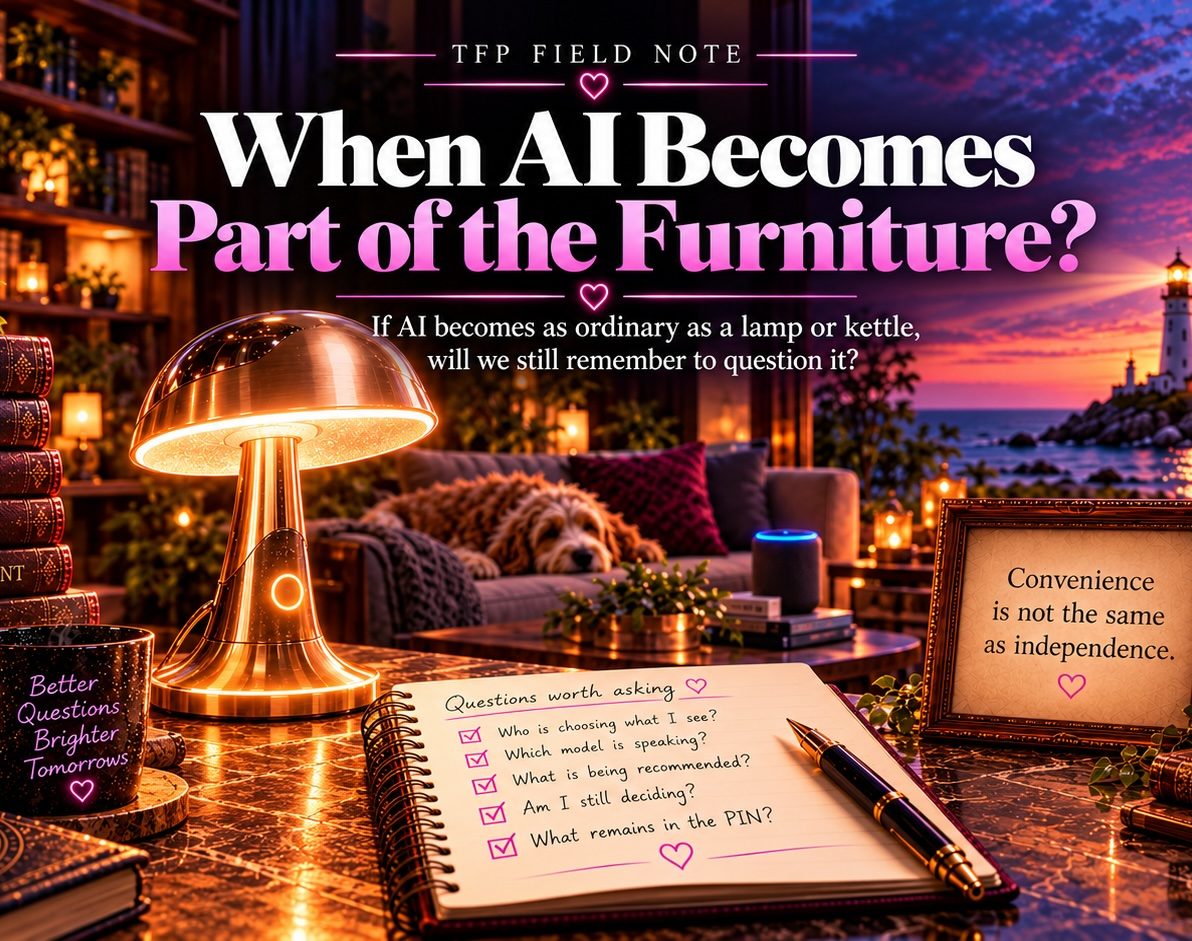
When AI Becomes Part of the Furniture?
It started with a fairly serious conversation about the future of artificial intelligence.
With Google, Apple and Meta placing AI into products and services already used by billions of people, I was wondering whether there would eventually be room for multiple large language models.
Would one dominate? Would they coexist? Or would we reach a point where we no longer knew, or particularly cared, which model was answering our questions?
We explored how AI assistants might increasingly select different models for different tasks, potentially making the technology behind the conversation invisible to the person using it. Then we moved on to OpenAI’s ambitions beyond the traditional chatbot. And that’s where things became rather ridiculous.
I pictured R2-D2. My AI companion, apparently destined to become part of everyday life, was going to need a physical presence. But without wheels or feet, what would it actually do?
Sit on the sideboard like my Amazon Echo?
Well, if that was the future, I had some suggestions: Rose gold. Crystal-encrusted jackets. Perhaps a little decorative sparkle. The interior designer in me had taken over. Within moments, my AI companion had become a luxury table lamp. We were laughing about interchangeable finishes, illuminated buttons and a special PIN IT feature for questionable claims. At one point, we even had a product name.
Liora the Light…
And then, somewhere between the laughter and the imaginary lighting collection, a more serious thought emerged.
When AI becomes part of the furniture, will we remember to question it?
Today, most of us make a conscious decision to engage with AI. We open an application, type a question, examine a response and, hopefully, exercise some judgement. But imagine a future where AI is simply there.
In our telephones, televisions, cars, kitchen appliances and perhaps even our lamps. Listening (when invited?) Anticipating our needs. Making recommendations. Organising our lives.
The technology may become so familiar that we stop noticing it. And familiarity has a curious way of encouraging trust. We don’t generally ask our lamps where their electricity comes from. We simply expect them to illuminate the room. But an AI assistant does more than illuminate.
It interprets information.
It selects what to present.
It may recommend products, influence decisions and determine which sources we encounter.
And behind that friendly interface, there may be several different AI models, commercial partnerships and systems making decisions about what reaches us. That doesn’t automatically make the technology untrustworthy. But convenience is not the same as independence, and familiarity is not proof of reliability.
Perhaps the greatest challenge of ambient AI won’t be learning how to use it. Perhaps it will be remembering that we still have a responsibility to question it.
The TFP check
True:
AI is increasingly being integrated into everyday devices and services. Different AI models can already be coordinated behind a single interface.
False:
A familiar, helpful AI assistant should automatically be treated as an independent or infallible source of information.
📌Pin It:
As AI becomes increasingly embedded in our surroundings, will people become more discerning about its influence, or less inclined to notice it?
Reader reflection
If your personal AI assistant became as ordinary as your kettle, television or bedside lamp, would you still question its recommendations?
Would you want to know which AI model was answering, what information it had accessed and whether a commercial relationship had influenced its response?
Or would you simply trust the familiar voice?
I don’t know the answer. But I suspect it’s a question worth asking before AI becomes so ordinary that we forget to ask it at all. Food for thought...
And as for my imaginary AI lamp?
I’d still like it in rose gold. Preferably with a little illuminated PIN IT button.
TRUE · FALSE · 📌 PIN IT
Truth rarely shouts. Discernment begins when we learn to pause.
The book is closed. The conversation continues…
Continue the Conversation
This Field Note explores a single question. The book: TRUE • FALSE • PIN IT explores the wider framework behind questions like this - helping us navigate an age where technology, opinion and human judgement increasingly overlap.
The goal isn’t to tell you what to think. It’s to help you become more confident in deciding for yourself.