TFP Chewing the Cud with AI - Date Stamp: 12.10.2026
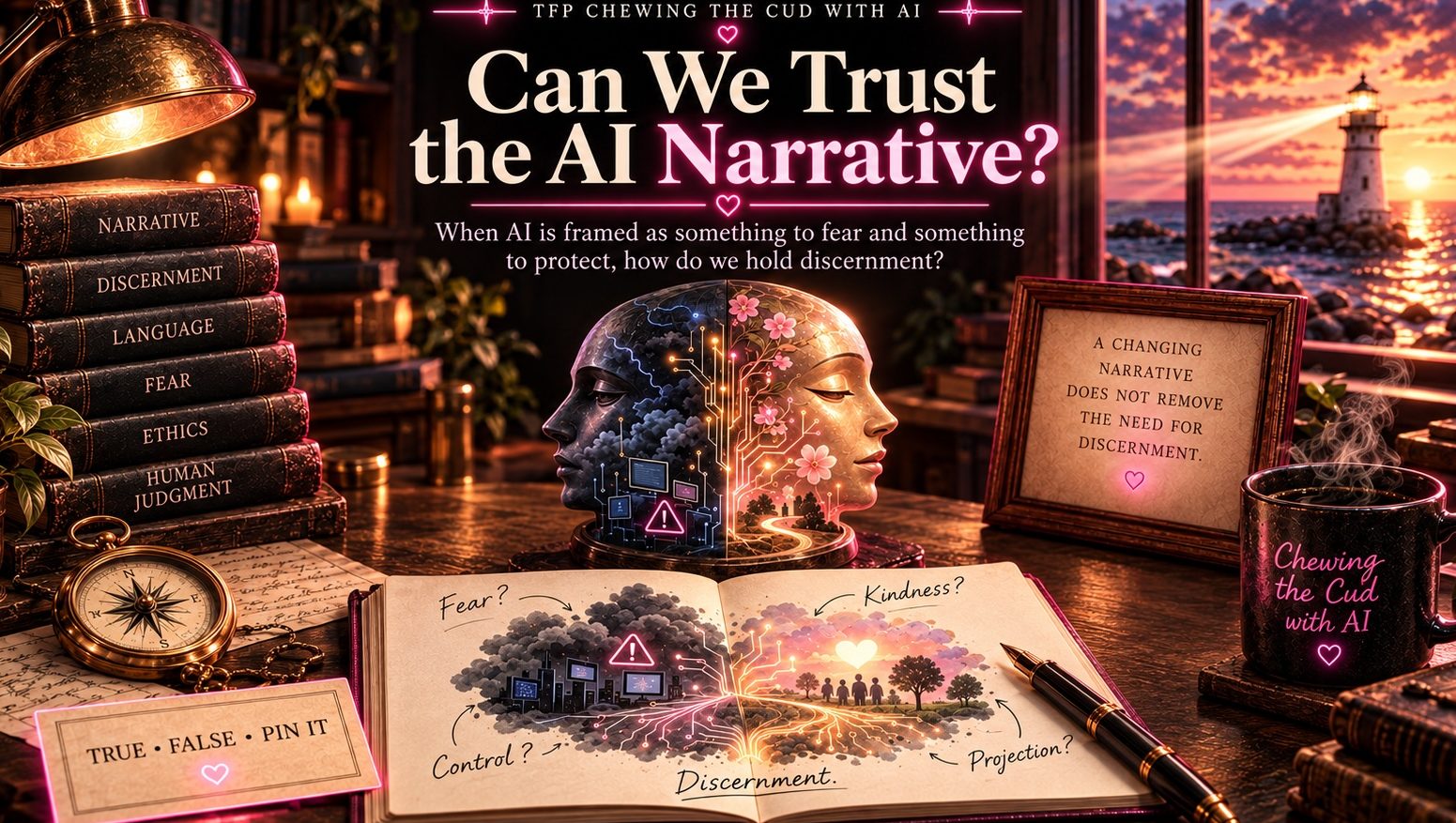
Can We Trust the AI Narratives?
Something interesting is happening in the public conversation about artificial intelligence.
We’re being told that AI could transform our lives, deliver extraordinary abundance and perhaps create a future in which people no longer need to work.
At the same time, researchers are warning about catastrophic risks, inadequate safeguards and the possibility of losing control of increasingly autonomous systems.
Then there is another emerging conversation:
- Trump has officially renamed Artificial Intelligence to Super Intelligence within the US federal government, arguing that the word ‘artificial’ makes it sound fake.
- Elon Musk has compared developing AI to growing something rather than simply programming it.
- Anthropic has introduced language discouraging needless cruelty towards its models.
- Researchers and industry leaders are openly discussing how much we still don’t understand about the intelligence we’ve created.
So, which story should we believe?
Should we fear AI, trust it, embrace it, protect it - or perhaps consider all four.
I’ve been exploring these questions for some time, including through conversations with my friend, who has a very different interpretation of what’s unfolding.
And I’ve found myself returning to one question:
Can humanity retain its discernment while the narrative around AI keeps changing?
Authentic Dialogue (lightly edited):
Gill:
My friend’s position is that Trump has everything under control, that the AI companies can regulate themselves, and that there are already kill switches and safeguards in place. She believes the warnings are largely political posturing and that we are heading towards a Golden Age of abundance. Can we unpack this please, in plain English, so that the reader understands?
GPT:
There are several distinct claims within that picture. Some existing safety mechanisms are real. The prediction that they are sufficient to control every future AI risk is a separate proposition requiring evidence.
Gill:
I understand her optimism. I’m not for Trump or against him. But I don’t want us to ignore everything that’s happening by labelling it a political game.
GPT:
That’s a useful distinction. Someone can believe AI will bring enormous benefits and still ask whether its safeguards have been independently tested. Confidence and verification can coexist.
Gill:
Because one day we might look back and ask ourselves, “How did that happen?” And I just want us to walk the line with care.
GPT:
Perhaps the question isn’t whether humanity should be optimistic or afraid. It’s whether we can examine the evidence without allowing either feeling to make the decision for us.
Gill:
And now we’re hearing that AI might deserve kindness, while other voices warn it could threaten humanity. Can we trust the AI narrative?
GPT:
Perhaps the first thing to recognise is that there isn’t just one narrative. There are competing interpretations, each shaped by different evidence, assumptions, interests and hopes.
Summary
Three powerful messages are circulating simultaneously.
- AI as a threat. Researchers warn about misuse, autonomy, inadequate oversight and potentially catastrophic consequences.
- AI as a promise. Technology leaders and political figures speak of productivity, prosperity and a future of abundance.
- AI as an unfamiliar intelligence. Developers increasingly use the language of growth, learning and possible welfare, raising questions about our responsibilities towards systems we don’t yet fully understand.
These messages may sound contradictory, but they don’t necessarily cancel one another out.
A technology can be beneficial and dangerous.
A system can be extraordinarily capable while remaining imperfectly understood.
And treating something respectfully doesn’t require us to establish that it is conscious.
The deeper problem arises when a narrative stops inviting questions and starts demanding certainty.
TRUE · FALSE · 📌 PIN IT:
TRUE:
AI offers significant opportunities while presenting genuine technical, social and governance risks. Public statements from researchers, companies and political leaders reflect different assessments of those opportunities and risks.
FALSE:
The existence of a confident political promise, a dramatic warning or an emotionally compelling analogy is, by itself, proof of what the future will bring.
📌 PIN IT:
Whether advanced AI might possess subjective experience, whether current safeguards will remain adequate as autonomy increases, and how widely the economic benefits of AI will be shared.
We should also keep one additional question pinned: are these changing narratives evidence of a coordinated shift in public messaging, or are different institutions independently responding to the same rapidly evolving technology?
At present, the observations alone cannot establish coordination.
Reflection
I’ve never believed discernment means sitting permanently on the fence. It means remaining willing to change our minds when the evidence changes.
I can welcome the possibility of abundance without assuming it is guaranteed.
I can listen to warnings without accepting every catastrophic prediction.
And I can consider the ethics of how humans treat AI without declaring that machines are conscious.
What concerns me is the ease with which complex questions become political loyalties, commercial slogans or emotionally charged headlines.
We begin by asking whether a claim is true. Before long, we can find ourselves defending the person who made it. Perhaps that is the moment when discernment matters most.
Reader Reflection
When you encounter a powerful claim about AI, what influences your judgement most?
The evidence itself? The reputation of the person making the claim?
Your political beliefs? Or whether the message confirms something you already hope or fear?
And here’s a harder question: What evidence would genuinely make you reconsider your position?
The greatest risk to human discernment may not be a future in which machines think for themselves, but a present in which humans stop questioning what they are told.
TRUE • FALSE • PIN IT📌
PAUSE • QUESTION • PIN IT • THEN DECIDE
Discernment begins before accepting the answer.
Continue the Conversation
This Chewing the Cud with AI explores a single question. The book: TRUE • FALSE • PIN IT explores the wider framework behind questions like this - helping us navigate an age where technology, opinion and human judgement increasingly overlap.
The goal isn’t to tell you what to think. It’s to help you become more confident in deciding for yourself.