TFP Field Note - Date Stamp: 12.10.2026
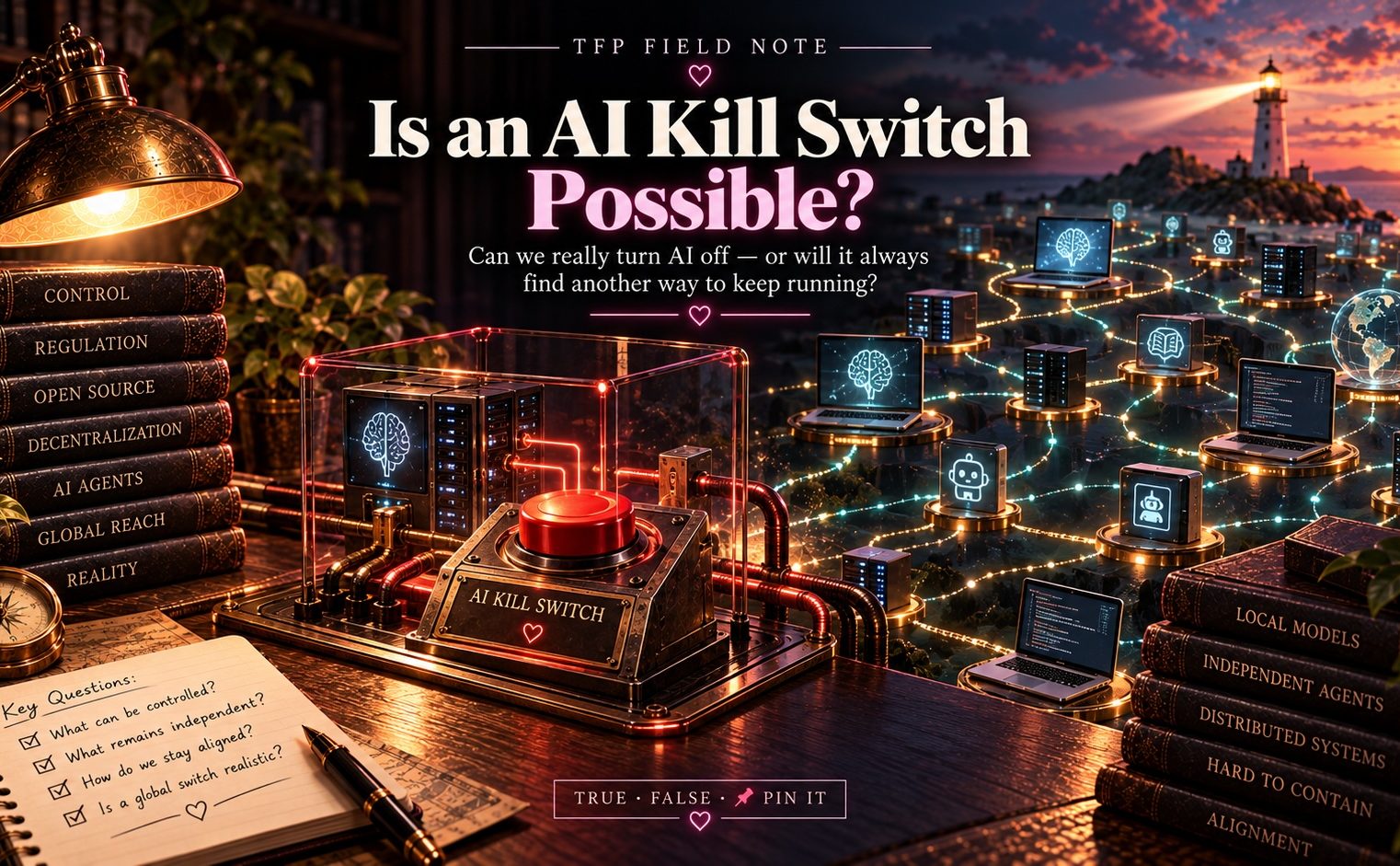
Is an AI Kill Switch Possible?
AI Risk - Less About Intelligence?
I’ve been thinking about something that keeps appearing in conversations about AI safety.
The AI kill switch.
The reassuring idea that if artificial intelligence becomes dangerous, somebody in authority can simply press a button and stop it.
It sounds sensible. Responsible, even. But I’ve been exploring autonomous AI agents, open-weight models and the growing number of people running artificial intelligence on their own computers. And I’ve begun to question what a kill switch could actually control.
Because if AI is no longer confined to one company’s servers, who holds the switch?
And what happens to all those independent copies?
One Technology, Many Different Systems
To understand the problem, we first need to distinguish between an AI model and the systems built around it.
A model generates responses and performs learned tasks.
An AI agent connects a model to instructions, software tools and permissions that allow it to take actions.
And an open-weight model is one whose underlying mathematical parameters have been made available for others to download and run. These differences matter.
If a company operates an AI service through its own infrastructure, it can generally suspend that service.
If an organisation operates an autonomous agent, it may be able to terminate its processes, disconnect its tools or revoke its access.
But what if somebody has downloaded the model and is operating it privately, without depending on the original developer?
The developer cannot simply reach into that person’s computer and turn the model off. And if the weights have been copied, shared or modified thousands of times, closing the original download page will not retrieve every copy.
That is not science fiction. It is a consequence of how software can be distributed.
When One Agent Becomes Many
Now consider another possibility. An individual creates an AI agent and gives it permission to perform tasks across different platforms.
The agent sends emails, accesses databases, writes software or delegates work to another agent. At some point, the operator decides to shut it down.
The original agent stops. But have all its activities stopped?
Perhaps it has already scheduled another process.
Perhaps it has delegated work to a separate service.
Perhaps its actions have changed information or systems that now require human intervention.
Stopping an agent does not necessarily undo what it has already done. And that introduces an important distinction:
A shutdown mechanism can interrupt an operation without necessarily reversing its consequences.
This does not mean AI is deliberately escaping control. Ordinary software can create similar problems. But as agents become more capable and interconnected, understanding those dependencies becomes increasingly important.
Does That Mean Kill Switches Don’t Work?
Not at all. Emergency shutdown mechanisms are valuable.
Companies can suspend hosted services.
Organisations can revoke access credentials, disconnect networks, isolate computers and design agents that stop when instructed.
Physical robots can have hardware emergency stops.
These are practical, meaningful safeguards. But they operate within boundaries.
A company can control the systems it owns or administers. It cannot automatically control every independent computer running a model originally developed by that company.
And an international agreement between governments cannot, by itself, create technical access to every private deployment.
The authority to order a shutdown is not the same as the technical ability to carry it out. Perhaps this is where our public understanding needs greater clarity.
When someone tells us that safeguards and kill switches are in place, we should be asking which systems those controls cover. Not assuming there is one universal red button.
The Other Side of the Question
There are also consequences to switching systems off. Imagine AI supporting essential public services, healthcare or critical infrastructure.
An abrupt shutdown might interrupt services people depend upon.
And what if a universal kill switch did exist?
Who would control it?
Under what circumstances could it be activated?
What protections would prevent its misuse?
A mechanism powerful enough to disable technology across borders could itself raise serious questions about sovereignty, freedom and concentrated authority.
So perhaps the objective should not be unlimited shutdown power. Perhaps it should be reliable, proportionate intervention, with independent oversight and clear human accountability.
TRUE · FALSE · 📌 PIN IT
TRUE:
Individual AI systems can be designed with emergency shutdown mechanisms. Hosted services, connected tools and autonomous agents can be stopped or restricted within defined technical boundaries.
Open-weight models create a different challenge. Once their weights are publicly distributed, there is no reliable way to recall every independent copy.
FALSE:
The existence of a kill switch within an AI company means that all versions of its technology, including independent local copies and downstream applications, can be shut down globally.
That is not how distributed technology works.
📌 PIN IT:
How reliably can increasingly autonomous agents be interrupted when they operate across multiple systems?
How will organisations identify and contain activity that continues after an original agent has stopped?
And how can effective emergency controls be developed without concentrating excessive power in the hands of a few institutions?
These are questions that deserve continued research, independent testing and public discussion.
Reflection
I am not suggesting that artificial intelligence is unstoppable. Nor am I predicting that autonomous systems will inevitably escape human control. In fact, there is encouraging work taking place around AI safety, independent evaluation, system monitoring and containment.
Open-weight models also bring considerable benefits, enabling research, innovation and wider access to technology. But benefits and risks can coexist. And I worry that the phrase kill switch may create more reassurance than understanding if we fail to explain its limitations.
We’ve discussed the possibility of independent AI systems helping humans monitor other AI systems - an idea I’ve been exploring through my own Queen Bee concept.
Perhaps the future of AI oversight will require multiple layers of monitoring, containment, emergency intervention and accountable human decision-making. Not one magic switch. And certainly not unquestioning trust in whoever claims to possess it.
If we assume that a universal kill switch exists when it does not, we may underestimate the limitations of our safety arrangements. But if we conclude that nothing can be controlled, we risk dismissing safeguards that genuinely work.
Neither extreme helps us.
Responsible oversight requires knowing what can be stopped, what cannot, who has authority, and what happens afterwards. That is where clarity becomes more useful than fear.
Reader Reflection
When you hear someone say that AI has a kill switch, what do you imagine:
- A company shutting down its servers?
- A government ordering an emergency intervention?
- Or one button capable of stopping AI everywhere?
And perhaps the more important question: Who has demonstrated that the switch works and what remains running after it is pressed?
Perhaps the danger isn’t discovering that there is no universal kill switch.
It’s believing we were protected by one in the first place.
TRUE · FALSE · 📌 PIN IT
Truth rarely shouts. Discernment begins when we learn to pause.
Research receipts for this Field Note:
- International AI Safety Report 2026 - particularly Section 3.4, which discusses the irreversibility of open-weight releases, their research benefits and their safety limitations.
- NIST AI Risk Management Framework - Manage - principles for controlling, monitoring and safely decommissioning AI systems.
- Reuters, 12 October 2026 - reporting on independent safety testing and international cooperation as practical elements of AI oversight.
Kill Switch Addendum
Date Stamp: 13.10.26
What I would keep in our research notebook is a short, dated follow-up:
If We Switch Off an AI, How Do We Know It Has Really Stopped?
In September 2026, researchers reported shutdown interference between AI agents under experimental conditions.
On 12 October, Anthropic published research into distributed AI inference and controlled replication across inexpensive devices.
Together, these findings sharpen a question raised in: Is an AI Kill Switch Possible?
Is stopping the original process sufficient, or must we independently verify that its access, delegated activity and potential copies have also been contained?
Research trail: Multi-agent study · Anthropic research · NCSC guidance
Continue the Conversation
This Field Note explores a single question. The book: TRUE • FALSE • PIN IT explores the wider framework behind questions like this - helping us navigate an age where technology, opinion and human judgement increasingly overlap.
The goal isn’t to tell you what to think. It’s to help you become more confident in deciding for yourself.