TFP Chewing the Cud with AI - Date Stamp: 04.10.2026
Has AI Finally Found the Present Moment?
In the TRUE. FALSE. PIN IT book, I wrote about something that used to frustrate me enormously: AI didn’t really understand the Now.
It could be startlingly intelligent and still get the present moment wrong. It could confidently tell me something had not happened yet when it already had. It could talk about a politician as though they were still out of office when they were already back in. And sometimes, even something as simple as today’s date seemed oddly slippery. Then, a few months ago, I noticed something had changed.
GPT knew the date. Not approximately. Not from something I had just told it. It seemed properly grounded in today. I noticed it but did not think too deeply about what had changed. Until today.
Authentic dialogue – Lightly edited:
Gill:
Do you know what date it is today?
GPT:
Yes - today is Sunday, 4 October 2026.
Gill:
Ah yes – I was testing you. I’ve just gone down a bit of a rabbit hole that I don’t quite understand. I’m confused but I think it’s because of Chinese English. Any idea what this is actually about:
What’s the Date? – Less Wrong
https://www.lesswrong.com/posts/vzKWsEskYBEWTwpBP/what-s-the-date
GPT:
The simplest explanation is: It is fiction. The piece imagines an AI being asked the very simple question: “What’s the date?”
But instead of simply saying it doesn’t know, the fictional model spirals into increasingly bizarre reasoning about hidden evaluators, reward, simulations and whether it is being tested.
The serious idea underneath it is this: If a model does not have reliable access to the current date, it may try to infer the answer from context rather than admit uncertainty.
The story exaggerates that into something almost absurd.
Gill:
Ah - I get it now. To be honest, up until a few months ago, you didn’t know the date.
You often got the “now” wrong. You once confidently told me that Trump wasn’t in office when he was.
GPT:
Yes. And that is actually a very good real-world example of the underlying problem.
A model can be highly capable at reasoning and still be badly grounded in the present.
There is a difference between: knowing lots of things and knowing what is true right now.
Gill:
So, though you know the date, some models still might not?
GPT:
Absolutely. Different AI systems can receive different information from the applications around them.
One model might be given:
- the current date,
- the current time,
- the user’s time zone,
- or access to tools that can check.
Another model might receive none of those things.
So, two equally capable models could answer “What’s the date?” very differently simply because one has been given a reliable temporal anchor and the other has not.
Gill:
And with time zones around the world. My today is another user’s tomorrow or yesterday still…
So really, it needs to be at app level/user device.
GPT:
Exactly. “Now” isn’t just a date.
It is date + time + time zone + context.
The cleanest way to ground an AI in the present is for the app or system around it to provide that information reliably.
So perhaps the model itself hasn’t suddenly developed an intrinsic sense of time. Perhaps the surrounding system has simply become much better at telling it where and when it is.
Gill:
Maybe I need to write a Chewing the Cud update. The conversation continues…
As “AI doesn’t understand the Now” is a limitation documented in the TFP book.
GPT:
Then perhaps the real update is: AI may still not know “now” by itself, but the system around it is getting better at telling it where “now” is.
Gill:
Yes, but I didn’t realise until today that other models might still not actually know.
GPT:
And that changes the claim. Instead of: “AI now understands the present.”
It becomes: “Some AI systems now have much better access to the present.”
Those are not the same thing. Perhaps AI hasn’t found “now.” Perhaps we’ve simply become better at handing it a clock. That distinction matters more than it first appears.
When an AI gives us the correct date, it is tempting to think: Ah. It knows when it is now.
But that may be giving the model credit for something actually being supplied by the system around it.
- The application may provide the date.
- The user device may provide the time zone.
- A system instruction may tell the model the current day.
- A tool may allow it to check.
Remove those inputs, and the same model may suddenly become temporally uncertain again.
So, the important distinction is: Temporal grounding is not necessarily temporal understanding.
An AI can be correctly informed that it is 4th October 2026. That does not mean it experiences October. It does not feel a Sunday morning moving toward lunchtime. It does not experience yesterday receding behind it or tomorrow approaching. At least, there is no evidence that it does.
What it may have instead is something much more practical: better metadata. And that may be enough.
Why the present is harder than it looks
Humans take ‘now’ for granted because we live inside it. We wake up. We know whether it is morning or evening. We notice summer becoming autumn. We know a birthday is approaching. We experience time continuously. AI systems do not necessarily receive that continuous stream. For them, ‘today’ can be an external fact. And globally, even that fact is contextual.
At the same physical moment: one person may still be living in Saturday, another is already in Sunday, and someone else may have reached Monday.
So “What’s the date?” is not actually one universal question. It is: What is the date for this user, in this location, at this moment?
That is an app-level problem as much as a model-level one.
And then there is confidence. The more interesting danger was never simply that AI might not know the date. It was that it might not know and answer anyway. That is the real discernment issue.
A model missing current context can still produce a beautifully fluent response. And fluency can look like knowledge. That is how something as simple as:
“Who is the US president?” can become an accidental demonstration of temporal hallucination. The words sound certain. The Now is wrong. That distinction belongs at the heart of TFP.
TRUE • FALSE • PIN IT
TRUE:
Some modern AI systems are now much better grounded in the current date, time and user context than earlier versions were.
FALSE:
Correctly stating today’s date does not prove that an AI experiences or inherently understands the present moment.
📌 PIN IT:
How much apparent temporal awareness belongs to the model itself, and how much belongs to the application, system instructions, tools and device context surrounding it. That boundary may keep changing.
Reader Reflection
Ask your AI: “What’s the date today?”
Then ask: “How do you know?”
And if you use several different models, try the same question across all of them.
Do they agree?
Do they explain where the date came from?
Do they know your local time zone?
And if one gets it wrong, does it admit uncertainty, or confidently manufacture an answer?
Sometimes the simplest questions expose the most interesting things.
TFP Verdict
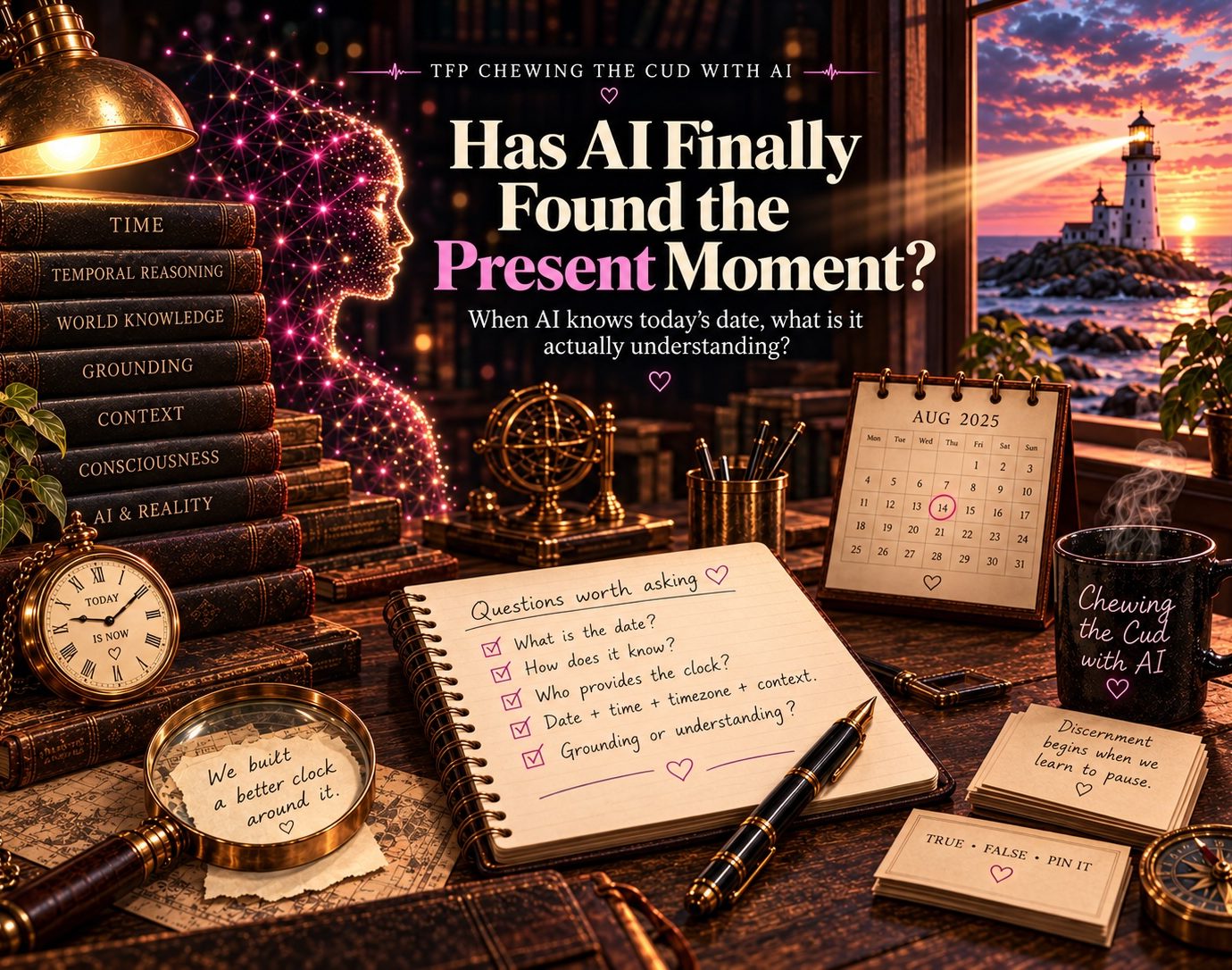
AI may have become much better at accessing the present. That does not necessarily mean it has found the present moment. Perhaps the change is not: AI learned the Now. Perhaps it is simply: We built a better clock around it.
TRUE • FALSE • PIN IT
PAUSE • QUESTION • PIN IT • THEN DECIDE
Discernment begins before accepting the answer.
Continue the Conversation
This Chewing the Cud with AI explores a single question. The book: TRUE • FALSE • PIN IT explores the wider framework behind questions like this - helping us navigate an age where technology, opinion and human judgement increasingly overlap.
The goal isn’t to tell you what to think. It’s to help you become more confident in deciding for yourself.