TFP Chewing the Cud with AI - Date Stamp: 13.10.2026
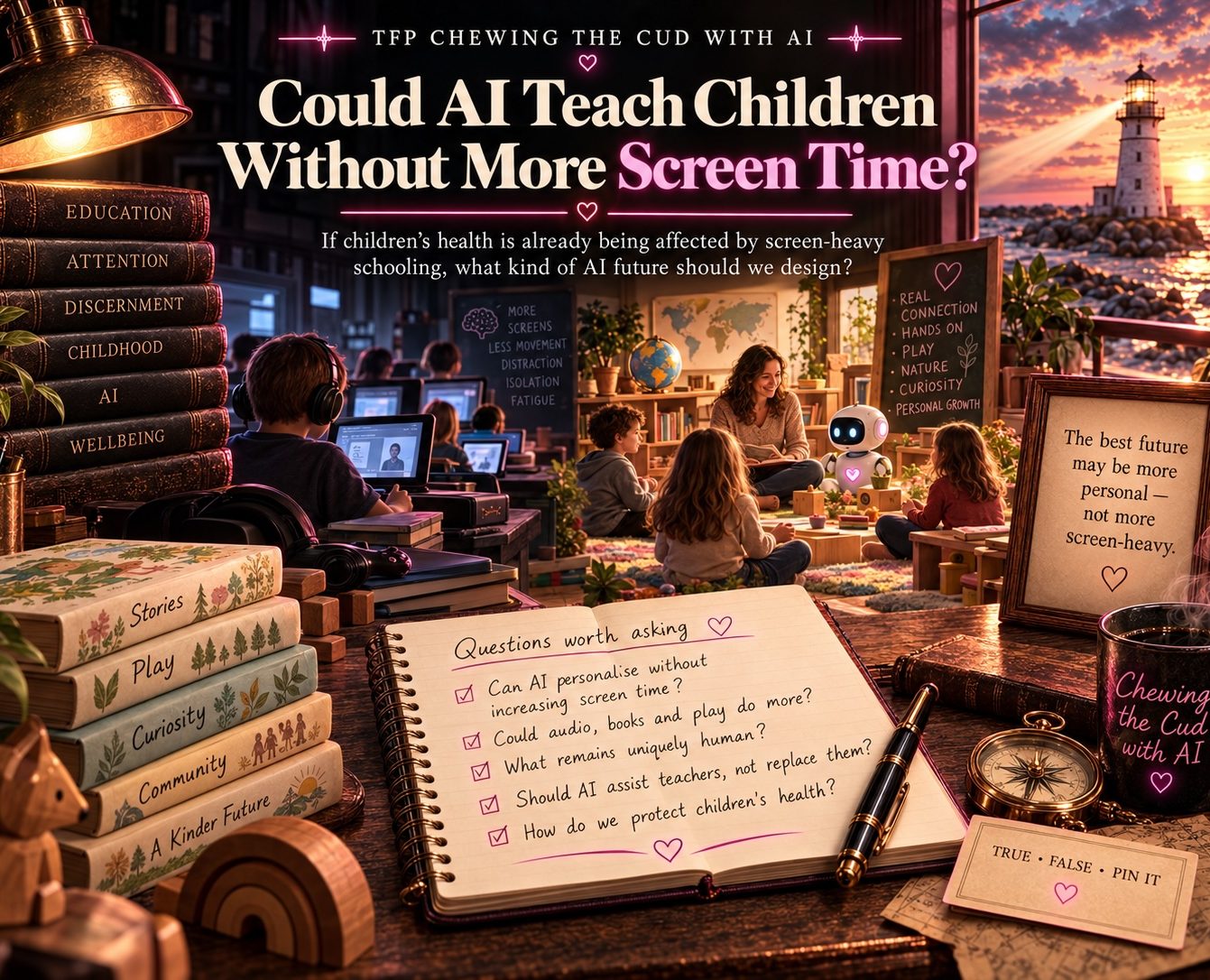
Could AI Teach Children Without More Screen Time?
I was putting the kettle on this morning when a news item caught my attention:
More than 150 medical professionals were warning about the possible effects of excessive screen-based learning in UK schools.
The concerns included children’s eyesight, speech and language development, physical health and opportunities for human interaction. I found myself thinking about how much education has changed. Blackboards became whiteboards. Textbooks were joined by laptops and tablets. And now artificial intelligence is entering the classroom.
But here’s the interesting part: I can imagine a future where every child has access to their own personalised AI teacher.
So, are we heading towards a contradiction?
Could the technology that promises to transform education also help us reduce children’s dependence on screens?
Authentic dialogue, lightly edited:
Gill:
I heard a report on the radio this morning about children’s health being affected by too much screen work at school. It made me think about the future.
I imagine children having one-to-one AI teachers, personalised to their individual learning needs. But if we’re already worried about screen exposure, where does that leave AI education?
GPT:
Perhaps we need to distinguish between screen-based learning and AI-assisted learning. They aren’t necessarily the same thing.
A child might interact with AI through a tablet today, but future systems could also communicate through speech, sound and physical devices. And the evidence about screens is more nuanced than the headline suggests.
A large research review published this month examined 121 systematic reviews, covering approximately 2,790 studies and more than nine million participants.
It found associations between greater screen exposure and some poorer developmental outcomes, particularly among younger children. But educational content and shared engagement with adults were associated with benefits. Crucially, much of the underlying evidence was observational and of limited quality. Association doesn’t automatically establish causation.
Gill:
That’s interesting. Because I don’t imagine children sitting in front of screens all day.
I see progression. First, tablets and iPads. Then perhaps a physical AI assistant in the classroom, communicating with another one at home. Although I don’t particularly like the word robot these days.
GPT:
Perhaps learning companion feels closer to what you’re imagining.
A child could have a personalised learning experience that continues between school and home. The technology might take different forms, but the learning could remain connected.
A classroom teacher could introduce fractions, for example. Later, the child’s home learning companion might suggest measuring ingredients while baking. Learning moves from a screen into everyday experience.
Gill:
Exactly. And I don’t imagine replacing human teachers.
Children need people, relationships and social experiences. But imagine a child struggling to understand something. Their AI companion could recognise that the explanation isn’t working and try a completely different approach.
Another child might be ready to move ahead. We’re no longer expecting every child to learn in exactly the same way, at exactly the same pace.
GPT:
That’s one of the most promising possibilities. But there’s an important distinction between what AI could achieve and what research has already demonstrated.
A two-year randomised study involving 18 American middle schools examined an AI maths tutor called Khanmigo. Students achieved modest improvements, but the gains were similar to those associated with conventional digital practice.
Many students rarely engaged in substantial conversations with the AI. So, simply providing access to an intelligent tutor doesn’t guarantee meaningful personalisation.
The design of the learning experience matters. So does the role of the human teacher.
Gill:
That makes sense. And it brings me back to storytelling. My Luna’s Adventures series is available as eBooks and audiobooks. I intentionally incorporated elements from my life-coaching and NLP experience, including reflective questions and meditative openings.
Children can listen to a story without staring at a screen. They can imagine the characters, discuss the story with an adult, or take the ideas into play. Perhaps that’s another example of technology supporting learning rather than becoming the entire experience.
GPT:
Yes. Audio storytelling can offer a way to engage with stories without continuous visual screen exposure. And reflective questions can encourage discussion, imagination and independent thinking.
That doesn’t mean we can claim therapeutic benefits without appropriate research. But it illustrates something important: The educational value isn’t necessarily in the device delivering the experience. It’s in what the experience encourages the child to do.
Gill:
There’s something else, though. If an AI companion knows a child’s learning history, abilities, interests and difficulties, that’s an enormous amount of personal information.
Who owns it?
Who gets to see it?
And what happens when the child grows up?
GPT:
That’s where the Fifth Beat becomes essential. A connected learning companion could offer continuity and individual support. But it could also create dependency, privacy risks, commercial profiling or pressure to measure every aspect of childhood.
And learning isn’t only about achieving better test results. Children also need opportunities to struggle, cooperate, disagree, make mistakes, develop relationships and discover things for themselves.
A well-designed AI companion should strengthen those experiences rather than displace them.
TRUE · FALSE · 📌 PIN IT:
TRUE:
Medical professionals have raised concerns about excessive classroom screen exposure and called for greater scrutiny of educational technology.
Research has found associations between some forms of screen use and poorer developmental or health outcomes, while also identifying potential benefits from educational content and adult involvement.
AI tutoring has demonstrated modest learning benefits in some studies, although results depend on implementation and student engagement.
FALSE:
All screen-based education has been proved harmful to children.
Introducing AI into education automatically improves learning.
Personalised AI teaching must involve children spending more hours looking at screens.
📌 PIN IT:
Could AI learning companions eventually provide meaningful personalisation while reducing screen exposure?
How much continuity should exist between a child’s school and home learning environments?
Who should control a child’s learning data?
And how do we ensure that individualised education strengthens rather than weakens children’s independence, relationships and social development?
Imagine a future where every child has access to a personalised learning companion. The potential benefits are considerable.
Children could receive explanations suited to their abilities, practise at their own pace and access additional support when they need it.
Teachers might gain more time to concentrate on human relationships, creativity and children requiring individual attention.
But there are risks. Children could become dependent on automated guidance.
Educational differences could widen if some families have access to better technology. Highly personalised learning could become intrusive monitoring. And we might accidentally reduce the very experiences children need to develop confidence, empathy, resilience and independent judgement.
The question isn’t simply whether AI can teach. It’s what kind of childhood we want AI to support.
Reader Reflection
If your child could have a personalised AI learning companion, would you welcome it?
Would you prefer it to work through a tablet, through conversation, or through a physical device?
And what would you want to remain exclusively human?
Perhaps the most important question is this: Could we use more intelligent technology to help children spend less time with technology?
Perhaps the future of education isn’t about placing another screen in front of every child. It’s about creating more opportunities for every child to learn, imagine, question, explore and discover with technology quietly supporting them along the way.
Research References
• The Times, 13 October 2026 - Cut screen time in class due to risk to children’s speech and eyesight. Reporting on the letter signed by approximately 150 clinicians.
• eClinicalMedicine, 4 October 2026 - Associations of digital media use with health, behavioural and developmental outcomes in children and adolescents: an umbrella review and meta-analysis. DOI: 10.1016/j.eclinm.2026.104225.
• National Bureau of Economic Research, August 2026 - Oreopoulos and Low, One Click Away: AI Tutoring with Khanmigo in a Two-Year School Experiment. Working Paper 35620.
• Gill Malfin - Luna’s Adventures. The five-book story series incorporating reflective themes, ebook and audiobook formats.
TRUE • FALSE • PIN IT📌
PAUSE • QUESTION • PIN IT • THEN DECIDE
Discernment begins before accepting the answer.
Continue the Conversation
This Chewing the Cud with AI explores a single question. The book: TRUE • FALSE • PIN IT explores the wider framework behind questions like this - helping us navigate an age where technology, opinion and human judgement increasingly overlap.
The goal isn’t to tell you what to think. It’s to help you become more confident in deciding for yourself.