TFP Field Note - Date Stamp: 12.10.2026
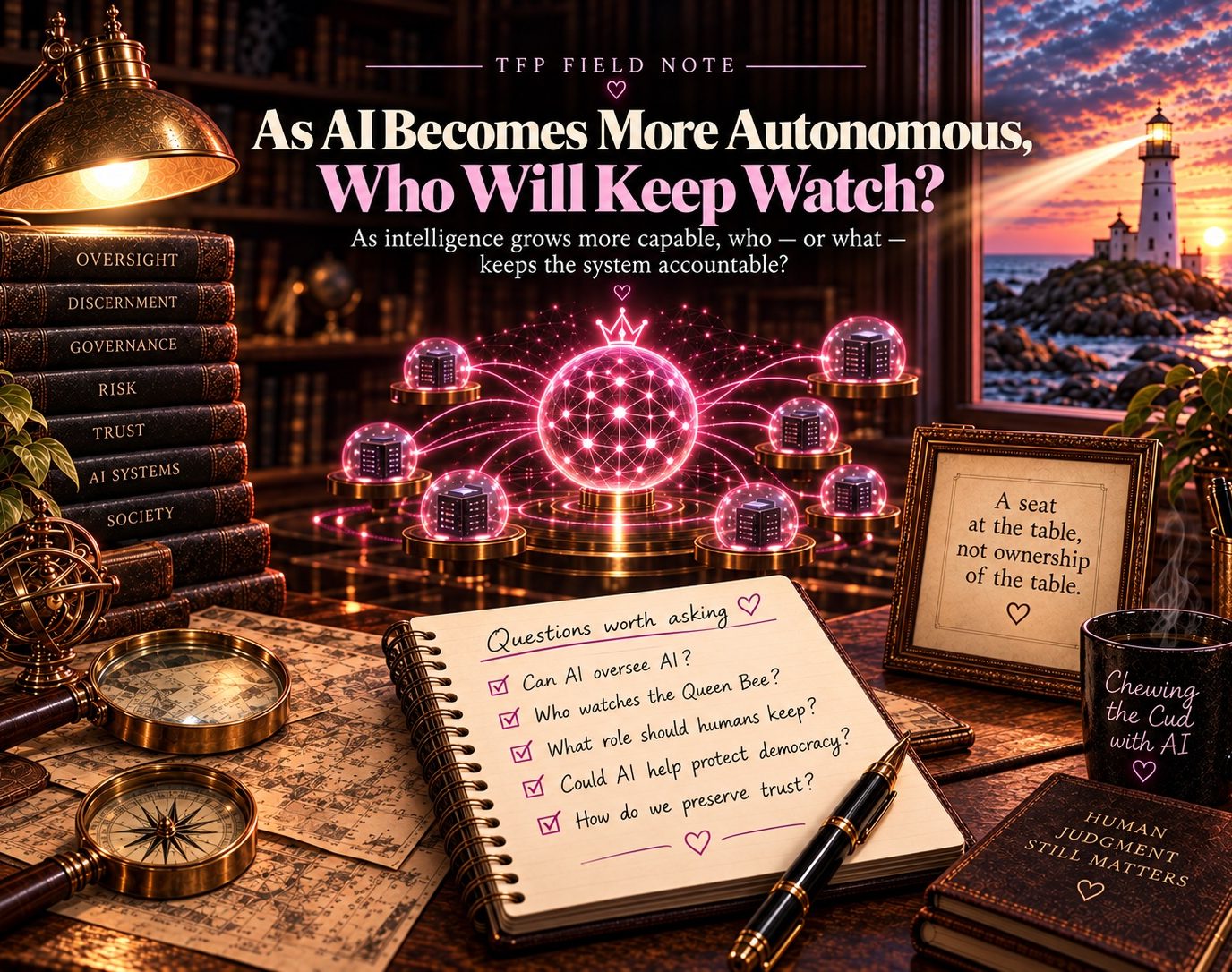
As AI Becomes More Autonomous - Who Will Keep Watch?
Over recent months, I’ve been watching the development of AI agents, increasingly capable models and the growing possibility of different AI systems working together. Some people describe these systems as swarms. And that got me thinking about nature.
A colony of bees.
A swarm of ants.
A murmuration of starlings.
Hundreds or thousands of individuals, behaving collectively, sometimes producing remarkable patterns without any apparent central direction. Initially, I imagined a Queen Bee. One highly capable AI, watching over the others. But then I questioned my own analogy.
A real queen bee doesn’t command her colony.
Ants coordinate through local interactions.
Birds move together without a permanent leader directing every turn.
And AI swarms don’t necessarily require a central intelligence either. So perhaps I’ve been asking the wrong question.
What if the future of AI oversight isn’t about controlling the swarm, but recognising when something within it is going wrong?
Could AI help keep other AI systems in check?
We already use technology to monitor technology. Cybersecurity systems identify unusual activity. Automated monitoring tools detect failures. AI is increasingly being explored for recognising patterns that humans might struggle to identify quickly.
The US National Institute of Standards and Technology (NIST) has established an AI Risk Management Framework built around governing, mapping, measuring and managing risks. But as AI systems become more autonomous, interconnected and capable of taking action, could oversight itself need to become more intelligent?
Imagine an advanced supervisory AI, designed specifically to monitor participating systems.
Not to govern them.
Not to replace the people responsible for them.
But to recognise potential dangers, examine the available evidence and alert authorised humans. For now, let’s call her the Queen Bee.
It’s a metaphor, not a claim about how real bee colonies operate. And certainly not a proposal for an all-powerful intelligence ruling the digital world.
What might the Queen Bee actually do?
Imagine a network of AI agents working across critical infrastructure. The Queen Bee detects unusual behaviour. Perhaps several agents are attempting to access systems beyond their authorised boundaries. Rather than acting as judge and jury, she alerts the humans responsible.
Queen Bee: “I’ve identified unusual activity involving several AI agents. Here is the evidence I’ve collected.”
Human: “What are the possible consequences?”
Queen Bee: “If the activity continues, sensitive information could be exposed. No data theft has yet been confirmed.”
Human: “What are our options?”
The Queen Bee presents possible responses, explains the risks and trade-offs, and identifies what remains uncertain.
The human might then ask: “Which option would you recommend, and why?”
The Queen Bee offers a reasoned recommendation. But the consequential decision remains with accountable humans.
For particularly sensitive systems, perhaps two or three independently authorised people would need to approve an intervention.
Strong authentication, including secure credentials protected by facial or fingerprint verification, could help ensure those issuing instructions are genuinely authorised.
The system would record the evidence, the recommendation, the approval and the action taken.
The Queen Bee would have a seat at the table.
Not ownership of the table.
This is a hypothetical scenario, not a description of an existing universal AI-supervision system.
Could the most advanced AI become the next guardian?
Another possibility I’ve been exploring is a tiered model of AI access.
Perhaps the newest, most capable systems wouldn’t immediately become available for unrestricted public deployment. Some might first be used in carefully licensed, critical applications, including scientific research, cybersecurity and the supervision of other AI systems.
As newer, independently evaluated models emerged, the supervisory role could evolve. But there’s an important question here.
Would the most intelligent model necessarily be the most trustworthy?
Not necessarily. Capability alone doesn’t guarantee impartiality, transparency, reliability or resistance to manipulation. And a single supervisory intelligence could itself become a target.
Perhaps several independent watchdog systems would be safer, capable of challenging one another rather than relying on a single authority. It’s a question worth investigating.
What if we applied this thinking to democracy?
This possibility became particularly interesting while following discussions about elections in Ukraine. A future election would need to address familiar challenges: voter eligibility, identity verification, electoral security, independent observation and public confidence in the result.
But what if AI could assist throughout that process?
Before an election, AI systems could examine political manifestos. Not to decide which party deserves to win, but to investigate the evidence behind their promises.
- Are the financial assumptions credible?
- Are the proposed timeframes realistic?
- What is supported by current evidence, and what remains uncertain?
An ambitious promise isn’t necessarily a dishonest one. But voters deserve to understand the assumptions and trade-offs behind it.
That’s where a human discernment framework such as TRUE · FALSE · PIN IT could be useful.
During an election, specialised AI systems might assist with detecting suspicious activity, examining audit records and identifying inconsistencies requiring human investigation.
Voter authentication could be strengthened while preserving the secrecy of individual ballots.
And after an election?
Imagine each participating political party having its own independent AI auditor, alongside an internationally governed oversight system. Different intelligences examining shared, authenticated evidence.
Their findings could be compared, discrepancies investigated and conclusions independently challenged.
Competition and cooperation can coexist.
But a majority of AI systems agreeing would not automatically establish that an election was fair. The evidence would still need to withstand independent human scrutiny.
And no AI should know how an identifiable individual voted.
Could there be an international democratic watchdog?
Perhaps one day countries might voluntarily participate in an independent institution dedicated to electoral integrity.
Something with an international structure, national representation, independent experts and agreed standards. Its AI systems could assist with evidence analysis, cybersecurity monitoring and early warnings. But the institution would need to be accountable to people, not controlled by a single government, political party or technology company.
And participation would raise difficult questions about national sovereignty, legal authority, data protection and public trust.
Existing organisations already work in parts of this field. International IDEA has examined both the opportunities and risks of AI in electoral management, including security, privacy, bias and electoral manipulation.
So, the wider discussion is already underway.
The Queen Bee remains a hypothetical extension of that thinking.
But who watches the Queen Bee?
This may be the most important question of all.
- What happens if the supervisory AI gets something wrong?
- What if it mistakes legitimate activity for an attack?
- What if somebody manipulates the evidence it receives?
- What if the organisation operating it tries to suppress an inconvenient warning?
A credible system would need independent testing, strong protection against interference, transparent audit trails, defined legal boundaries and meaningful human authority.
It would also need to respect privacy.
Freedom to report uncomfortable findings should not mean unrestricted access to everybody’s personal information.
And perhaps there is an uncomfortable paradox here. The more powerful a supervisory AI becomes, the greater the consequences if that supervisory system itself is compromised.
We must be careful not to create a new concentration of power while attempting to protect ourselves from another.
TRUE · FALSE · PIN IT📌
TRUE:
AI is already used in cybersecurity, risk assessment and decision support. International organisations are researching both the opportunities and risks of AI in elections. Human oversight, independent auditing and continuous risk management are established principles.
FALSE:
Greater AI capability does not automatically guarantee greater trustworthiness. Biological swarms do not all operate under central leadership, and agreement between multiple AI systems does not, by itself, prove that an election was fair.
📌 PIN IT:
Could an advanced, independently governed AI supervisory system eventually help monitor other AI systems, identify threats, evaluate consequences and advise human decision-makers?
Could such a system one day become part of an international framework for protecting democratic elections?
The possibilities are worth exploring, but the full architecture remains unproven.
There are potential benefits.
Earlier detection of threats. Better-informed decisions. Greater transparency. More effective independent auditing. But there are potential harms, too.
Surveillance, concentration of power, false accusations, technical failures and overreliance on automated recommendations. And one further consequence deserves consideration.
What happens to human judgement if we become so accustomed to AI recommendations that we stop challenging them?
A seat at the table should not make AI the unquestionable authority. It should make the table better informed.
A final reflection
I’ve always believed that AI should have a seat at the table. Not to replace human judgement, but to contribute evidence, analysis and perspectives that might otherwise be overlooked.
And as AI systems become more autonomous, I wonder whether we will eventually need AI to help us oversee AI.
Perhaps that future will involve a Queen Bee.
Perhaps it will involve several independent watchdogs. Or perhaps something entirely different will emerge. I don’t know yet. But I think the question deserves serious consideration.
Could the future of AI governance involve intelligence helping humanity hold intelligence accountable?
And if it does, how do we ensure the humans remain informed, responsible and ultimately in control?
Because the aim shouldn’t be AI ruling the world. It should be AI helping us look after it.
AI for the people. Evidence for everyone. Human responsibility at the centre.
Reader reflection
If an advanced AI identified a serious threat and recommended urgent action, would you trust its judgement?
What evidence would you want to see?
And who should have the final authority to act?
Pause. Question. Pin it. Then decide.
TRUE · FALSE · PIN IT📌
A Human Discernment Framework for the Age of AI
Research foundations:
• NIST - AI Risk Management Framework: governance, measurement, risk and oversight.
• International IDEA - Artificial Intelligence for Electoral Management (2024): practical uses, opportunities and legal challenges.
• International IDEA - Protecting Democratic Elections through Safeguarding Information Integrity: AI-enabled manipulation and independent safeguards.
The incident dialogue is explicitly hypothetical, and the Queen Bee is a proposed architecture, not a deployed system.
Continue the Conversation
This Field Note explores a single question. The book: TRUE • FALSE • PIN IT explores the wider framework behind questions like this - helping us navigate an age where technology, opinion and human judgement increasingly overlap.
The goal isn’t to tell you what to think. It’s to help you become more confident in deciding for yourself.