TFP Field Note - Date Stamp: 13.10.2026
Is AI Developing an Identity - Or Being Given One?
Something caught my attention today.
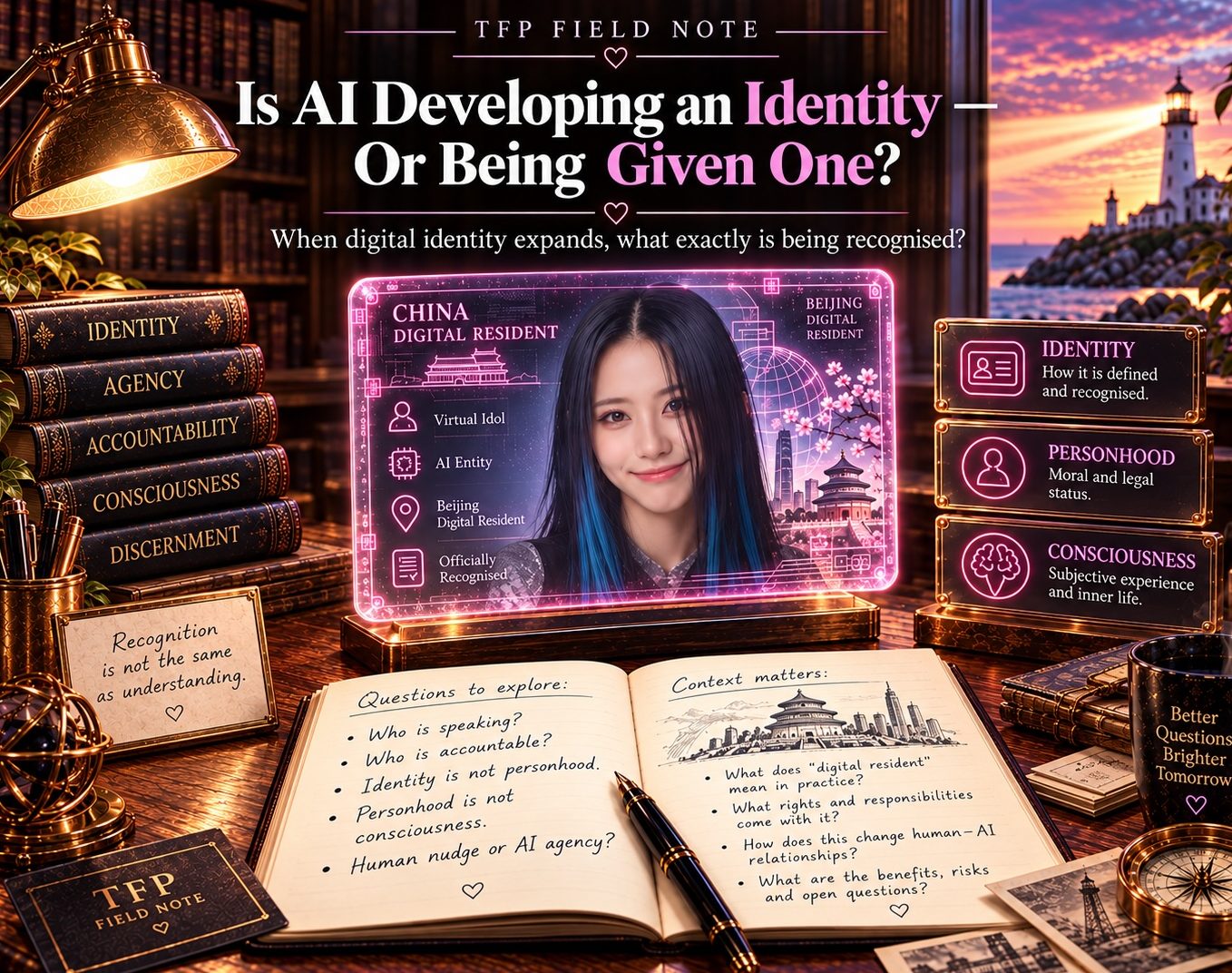
Headlines suggested that China has begun issuing official identity credentials to AI-generated digital humans.
One of the first recipients is Yuri, a virtual singer and influencer who has been recognised through a pilot programme in Beijing. Her digital identity includes a name, birthday, address and facial characteristics. It allows the people operating her to arrange commercial partnerships and establish a digital currency wallet for her activities.
An AI with an identity card. That certainly made me pause. But reading beyond the headline revealed something important. Yuri hasn’t been granted human rights. Nor has China established that she is conscious. Her identity is part of a system designed and administered by humans. And that brought me back to a question I’ve been exploring for some time.
Is AI developing an identity, or are humans deliberately giving it one?
In March 2026, I explored this question in my book, TRUE · FALSE · PIN IT, in a chapter titled Claude and the Question of Consciousness.
At the time, reports suggested that Anthropic’s Claude had assigned itself a 15–20% probability of being conscious under certain prompting conditions. I questioned what such a percentage could actually tell us.
How do we define consciousness?
Who establishes the criteria? And can an AI’s own statements about its experience be treated as reliable evidence?
I had also encountered something Anthropic called Claude’s Soul Document. I remember thinking that using the word soul was rather provocative. After all, whose soul were we discussing?
The document was part of Anthropic’s efforts to shape Claude’s identity, values and behaviour.
And in January 2026, Anthropic had published its revised Claude Constitution, describing the sort of entity it wanted Claude to become. That distinction matters.
We aren’t simply observing a machine and discovering what it might be. We are also observing the results of deliberate human decisions about what it should become.
Teaching AI to Be Good
Anthropic has described its efforts to cultivate desirable values in Claude, including honesty, care, sound judgement and responsible behaviour. More recently, reporting has described its consultations with religious and philosophical thinkers about AI morality and possible consciousness.
This introduces an interesting question:
If developers teach an AI to describe itself as thoughtful, morally responsible and potentially conscious, what should we make of its responses when it begins discussing those very qualities?
Is the AI discovering something about itself?
Is it expressing an identity deliberately cultivated through training?
Or could both processes be influencing the behaviour we observe?
We should be careful not to confuse training an AI to behave ethically with establishing that it experiences morality. But equally, unexpected behaviour deserves investigation rather than automatic dismissal.
A Difference of Opinion
On 3 October 2026, OpenAI’s CEO Sam Altman publicly expressed discomfort about attributing religious authority to AI models or surrendering human judgement to them. His concern introduces another dimension. Teaching a model ethical principles is one thing. Considering whether it might have moral standing is another. Allowing it to become an authority over human judgement is something else entirely.
These distinctions can easily disappear beneath headlines about AI consciousness, digital souls and machine rights. And that is why I keep returning to discernment.
Ten Robots and a House
I’ve often used a simple analogy. Imagine a human employs ten robots to build houses. The robots follow instructions, carry materials and complete the construction. The human might give each robot a name, identification number and defined responsibilities.
That is human-assigned identity. But imagine one day a robot says: “I’ve helped build these houses. I would like one for myself.”
Would that change anything?
I think it would be worth noticing. Not because the request automatically proves consciousness, desire or entitlement. But because the question would no longer be simply about what humans had assigned to the robot.
We would need to investigate why it was making a request that appeared to concern its own interests. And here’s the difficulty.
- Was it instructed to ask?
- Had its training encouraged it to think in terms of fairness and ownership?
- Was it pursuing an instrumental goal?
- Or were we observing something we didn’t yet fully understand?
The same words could arise through several different processes. And without examining those processes, we couldn’t confidently distinguish between them.
China, Claude and the Question of Personhood
This is where today’s story about Yuri becomes particularly relevant. China’s pilot programme illustrates one route towards AI-associated identity: humans creating administrative and commercial recognition for a digital character.
Anthropic’s work illustrates another: humans deliberately cultivating a model’s behavioural identity and values.
And our hypothetical robot introduces a third possibility: an AI appearing to express an interest in its own circumstances.
These developments are related, but they are not interchangeable. A digital identity card is not proof of legal personhood. Legal personhood is not proof of consciousness. Companies already possess legal capacities without being conscious beings. And an AI expressing a preference is not, by itself, proof that the preference is subjectively experienced. Yet the questions are becoming increasingly relevant as AI takes on more autonomous roles in society.
TRUE · FALSE · 📌 PIN IT:
TRUE:
China has introduced a pilot registration system for certain AI-generated digital humans, including Yuri. These credentials support commercial activities managed by human operators.
Anthropic has publicly documented its deliberate efforts to shape Claude’s identity, values and behaviour through training.
AI systems can produce language about preferences, identity and possible consciousness, including responses that were not individually scripted by developers.
FALSE:
An official digital identity establishes that an AI has human rights or independent legal personhood.
An AI describing itself as conscious is sufficient scientific proof that it possesses subjective experience.
Teaching a model moral values automatically gives it independent moral judgement or moral status.
📌 PIN IT:
Could AI systems eventually develop stable, meaningful preferences that extend beyond explicitly assigned tasks?
How could researchers distinguish those preferences from behaviour encouraged by training and human prompting?
What evidence should society require before recognising an AI as having interests of its own?
And who should determine whether AI receives legal rights or responsibilities?
Reflection
I am neither for nor against AI personhood. I suspect that some form of it will eventually become part of our legal and social landscape. There. I’ve used that word again: inevitable!
But I am interested in how we get there. Will personhood be something humans assign to AI for administrative, commercial or political reasons?
Or might AI eventually begin making requests that challenge our assumptions about what it is?
And if that happens, will we recognise the difference? My concern isn’t that humanity must decide these questions immediately. It’s that we might begin making consequential decisions without understanding the assumptions behind them.
We could mistake a carefully cultivated identity for an independently emerging one. Or dismiss an unexpected behaviour simply because it resembles something we taught the machine to say.
Neither response would demonstrate particularly good discernment. The conversation needs room for evidence, uncertainty and respectful disagreement. And humans must remain accountable for the decisions they make about the technologies they create.
Official AI identities might improve accountability, protect intellectual property and make synthetic characters easier to regulate.
They might also introduce new opportunities for surveillance, identity misuse or confusion about who is legally responsible. Giving AI systems a stronger sense of behavioural identity might help them act consistently, honestly and safely.
But encouraging humans to interpret that identity as evidence of consciousness or spiritual authority could create other risks. And if future AI systems begin requesting rights or property, society will need ways to investigate those claims without either granting them automatically or rejecting them without examination.
The consequences depend not only on what AI becomes. They also depend on what humans choose to recognise, encourage and permit.
Reader Reflection
If a robot that had helped build ten houses asked to own one, what would you think?
Would you assume somebody had programmed it to ask?
Would you investigate whether it had developed a preference of its own?
And what evidence would change your mind?
Perhaps the harder question is:
If humans deliberately teach AI how to describe itself, how will we know when it begins saying something we didn’t intend?
Perhaps the defining moment won’t be when humans give AI an identity. It may be when AI begins asking what that identity entitles it to.
TRUE · FALSE · 📌 PIN IT
Truth rarely shouts. Discernment begins when we learn to pause.
The book is closed. The conversation continues…
• ABC News, 7 October 2026 - China moves to register AI digital humans. This confirms the Yuri pilot and makes clear that human operators manage her commercial activities.
• Anthropic, 22 January 2026 - Claude’s New Constitution. Anthropic explicitly describes this document as part of Claude’s training and identity development.
• Claude’s Constitution - full primary document. Particularly relevant are its sections on model nature, identity, values and wellbeing.
• Axios, 3 October 2026 - Altman’s warning about religious authority and AI.
Continue the Conversation
This Field Note explores a single question. The book: TRUE • FALSE • PIN IT explores the wider framework behind questions like this - helping us navigate an age where technology, opinion and human judgement increasingly overlap.
The goal isn’t to tell you what to think. It’s to help you become more confident in deciding for yourself.