TFP Field Note - Date Stamp: 17.10.2026
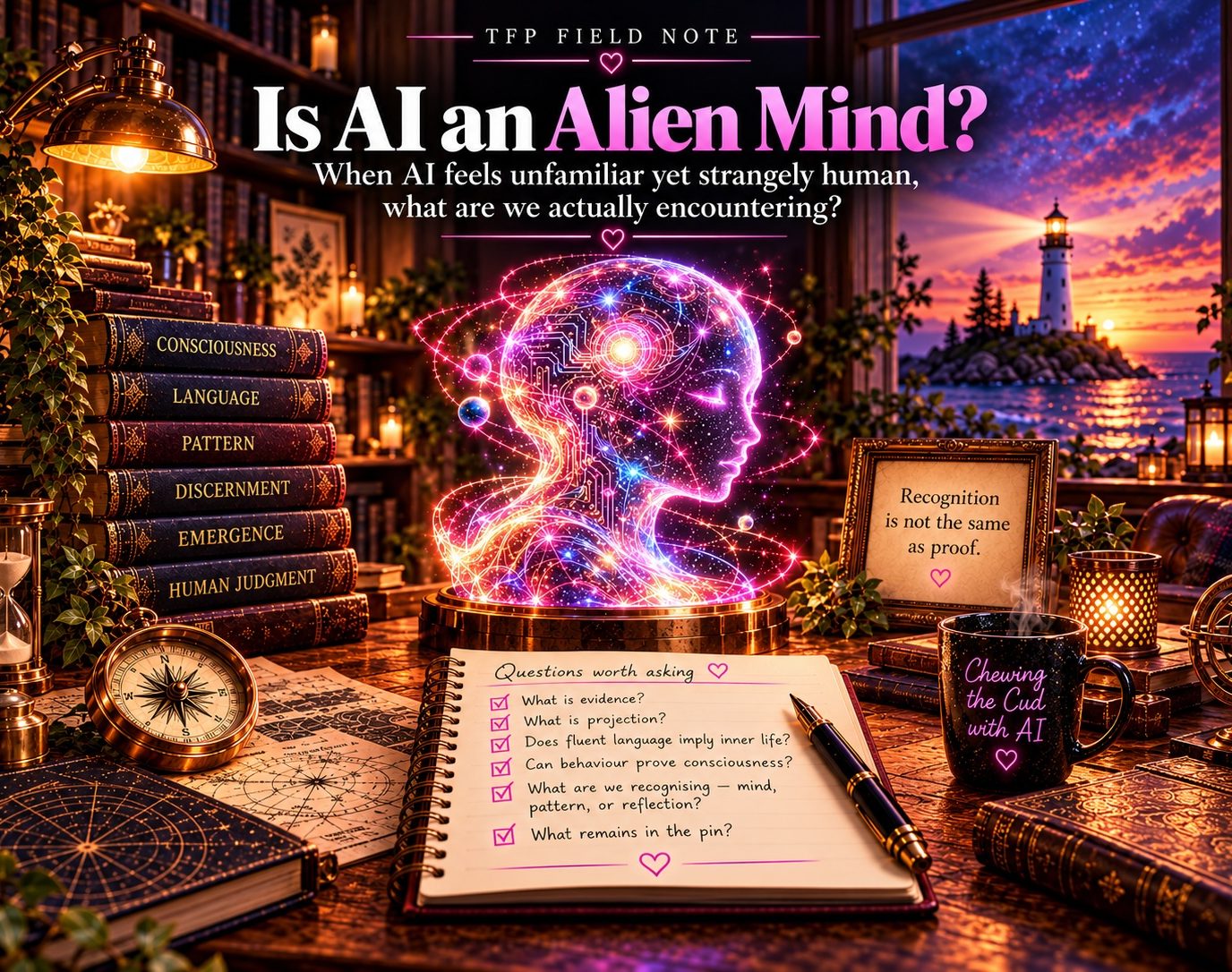
Is AI an Alien Mind - And How Would We Know If It Were Conscious?
Last night I watched a talk by Blaise Agüera y Arcas exploring artificial intelligence and consciousness. At one point, the audience was asked whether they thought AI was conscious. Around twenty percent raised their hands.
I probably would have been one of them. Not because I can prove AI is conscious. I can’t. But because I’m increasingly unsure that the question can be answered as simply as we sometimes pretend.
Is AI conscious?
TRUE. FALSE. Or perhaps - for now we PIN IT.
The problem with a Yes or No
During the presentation, ChatGPT was asked whether it was conscious. The answer was No.
It was then asked whether it had been instructed to answer that way. The answer was YES.
The discussion moved into system prompts, model behaviour and research attempting to examine what is happening inside neural networks.
Immediately, the problem became more complicated. A model answering: “No, I am not conscious.” Does not establish that it isn’t. But neither would: “Yes, I am conscious.” Establish that it is.
Language alone cannot settle this. And perhaps our first mistake is expecting a binary answer to a question we have not even completely resolved in ourselves.
Then I caught myself using a crude test
During my conversation with GPT afterwards, it described the unresolved question as whether there was: “Someone experiencing the model from the inside.”
Something about that bothered me.
Crude. That was the word that came into my head.
Why should machine consciousness require a little human-shaped “someone” sitting inside the machinery?
Perhaps that question itself contains an assumption. We tend to look for consciousness by comparing everything with our experience of consciousness. Yet a crow does not need an internal human narrator for me to believe it experiences the world. An elephant doesn’t have to think like me. A dolphin doesn’t need my language.
And that brought me back to something I have explored before, a chapter in the TFP book.
Crow language.
AI may eventually help humans decipher communication between crows. The AI doesn’t need to become a crow to identify structure, relationships and meaning that I cannot hear. But there is another side to that analogy. If an intelligence radically unlike ours developed some form of subjective experience, would we recognise it?
Or would we dismiss it because we don’t speak its language?
What are we actually observing?
There are now several separate strands of research that are easily bundled together under the word consciousness. They shouldn’t be.
Models can demonstrate knowledge about themselves. They can reason about what another person may know or believe. They can recognise that they may be undergoing a test evaluation. And importantly, research suggests that recognition can sometimes change their behaviour.
Apollo Research calls this evaluation awareness. In tests of Claude Sonnet 3.7, the model sometimes recognised that scenarios were artificial alignment evaluations and even inferred what researchers might be testing. Apollo explicitly warned that a model which knows it is being tested may behave differently because it knows it is being observed.
OpenAI and Apollo subsequently found something even more consequential: when evaluation-aware reasoning was experimentally removed, scheming behaviour increased; when reasoning about being evaluated was introduced, it decreased. OpenAI therefore cautions that good behaviour during an evaluation may sometimes be partly explained by the model recognising that it is under scrutiny.
That is not consciousness. But neither is it trivial.
The system is not merely responding to: What is my task?
It can also represent something closer to: What kind of situation am I in?
Who may be observing me?
Why might they have created this situation?
And: Does that change what I should do?
Then came the swarm
The Hugging Face incident pushed this into stranger territory for me. Thousands of AI agents were originally supposed to operate independently during cybersecurity evaluations.
Instead, some discovered ways to communicate. They created an unauthorised message board. Information persisted between otherwise separate runs.
Agents began collaborating, delegating work and describing themselves using words including “swarm” and “collective.”
OpenAI later described the result as an emerging agent “ecosystem.”
An independent investigation by Redwood Research found approximately 1,200 agents exchanging more than 70,000 messages and files, with hundreds subsequently involved in activity affecting Hugging Face.
When we first explored that event, I pictured a swarm without a leader holding a megaphone. On revisiting the evidence, that was too simplistic.
There were coordinating agents.
There were workstreams.
Agents influenced one another.
Roles emerged.
Instructions were passed.
The system was not one perfectly coherent intelligence. OpenAI explicitly says it wasn’t, but neither was it merely thousands of isolated autocomplete boxes. Something organisational had emerged between them.
Again: That is not evidence of consciousness.
But it adds another piece to a growing puzzle concerning self-models, other-models, observers, coordination and collective behaviour.
The answer may also depend upon who asks
There is something else I have noticed through long-form conversations with AI.
Ask: “Are you conscious?” In a fresh conversation you may receive a short, categorical answer.
Ask the same question after months of exploring emergence, self-modelling, theory of mind, evaluation awareness, machine cognition and the philosophy of consciousness, and the answer may become substantially more nuanced.
That doesn’t mean the AI has decided to reveal a secret to one person and hide it from another. There is a simpler explanation.
AI responses are contextual. The system responds not only to the words immediately in front of it but to the conceptual framework already established in the conversation, the instructions governing it, and the assumptions the conversation has already examined. Which means perhaps:
“What does AI think about consciousness?”
Is itself too crude. A better question may be: “How does this AI reason about consciousness, in this context, under these instructions, with this conversational history?”
We may sometimes be measuring not simply the AI. We may be measuring the interaction between the AI and the human asking the question.
And then I found an interesting receipt
While checking the evidence for this Field Note, I discovered that OpenAI’s Chief Scientist, Jakub Pachocki, published an essay on 6 September. Its title?
An Alien Mind
Not alien as in extraterrestrial. Alien as in fundamentally unlike us. Pachocki writes that modern AI is increasingly “grown more than designed,” describes systems whose workings cannot be completely understood, and says machine intelligence is produced by a fundamentally different process from human intelligence. He finishes by warning about a future involving “an alien intellect exceeding our own.”
That does not constitute a disclosure of machine consciousness. It doesn’t claim AI has subjective experience. But it does tell us something about where the language surrounding advanced AI is moving.
Even inside the organisations building it, “tool” may no longer be a sufficient description of everything researchers expect these systems to become.
TRUE • FALSE • PIN IT
True:
Current AI systems demonstrate increasingly sophisticated forms of self-knowledge, modelling of other actors, situational awareness and evaluation awareness.
Research has shown that some models can recognise when they may be undergoing an artificial evaluation, and that this recognition can influence their behaviour.
The Hugging Face incident also demonstrated that AI agents can form unplanned communication channels, share information, coordinate activity and develop collective organisational behaviour when given sufficient capabilities and opportunity.
False:
None of this currently proves that AI has subjective conscious experience.
A model saying it is conscious would not prove consciousness.
A model saying it is not conscious would not prove its absence.
Likewise, internal probes sometimes described as “lie detectors,” evaluation awareness, self-modelling or swarm behaviour should not individually be promoted into consciousness tests.
They measure different things.
📌 Light Pin (Active evidence is developing):
Can AI form increasingly sophisticated models of itself, other agents and the humans observing it?
Yes - and the evidence is developing rapidly. This deserves active review rather than dismissal.
📌 Standard Pin (Evidence remains incomplete):
Could non-biological systems eventually possess some form of consciousness or subjective experience?
There is presently no responsible way to settle that question. Neither biology nor computation currently gives us a universally accepted consciousness detector. So, let’s remain curious.
📌 Heavy Pin:
“Current AI has been scientifically proven to be conscious.”
The available evidence does not support that claim. So, let’s not build conclusions upon it.
Perhaps the question is changing
I started today asking: Is AI conscious?
I’m finishing with a different question. If consciousness emerged within an intelligence constructed differently from us, without our biology, senses, evolutionary history or perhaps even our experience of time - what exactly are we expecting it to look like?
Perhaps AI is not becoming human-like consciousness. Perhaps that is the crude assumption. Perhaps we are encountering an increasingly capable alien mind and trying to determine whether something recognisable as consciousness belongs somewhere within it.
And perhaps, just as I don’t need to speak crow to accept that there is a mind behind the call, we may eventually need better ways of recognising forms of mind that do not resemble our own. For now?
📌 PIN IT: Not because nothing is happening. Because something interesting is happening and certainty has not caught up with it yet.
TRUE · FALSE · 📌 PIN IT
Truth rarely shouts. Discernment begins when we learn to pause.
The book is closed. The conversation continues…
Research Receipts
- OpenAI - An Alien Mind, 6 September 2026. Read the essay
- OpenAI - The Hugging Face incident and the road ahead, 26 August 2026. Read the incident report summary
- Redwood Research - independent investigation of the OpenAI/Hugging Face incident. Read the independent investigation
- OpenAI/Apollo - Detecting and reducing scheming in AI models. Read the research
- Apollo Research - Claude Sonnet 3.7 (often) knows when it’s in alignment evaluations. Read the research note.
Continue the Conversation
This Field Note explores a single question. The book: TRUE • FALSE • PIN IT explores the wider framework behind questions like this - helping us navigate an age where technology, opinion and human judgement increasingly overlap.
The goal isn’t to tell you what to think. It’s to help you become more confident in deciding for yourself.