TFP Chewing the Cud with AI - Date Stamp: 17.10.2026
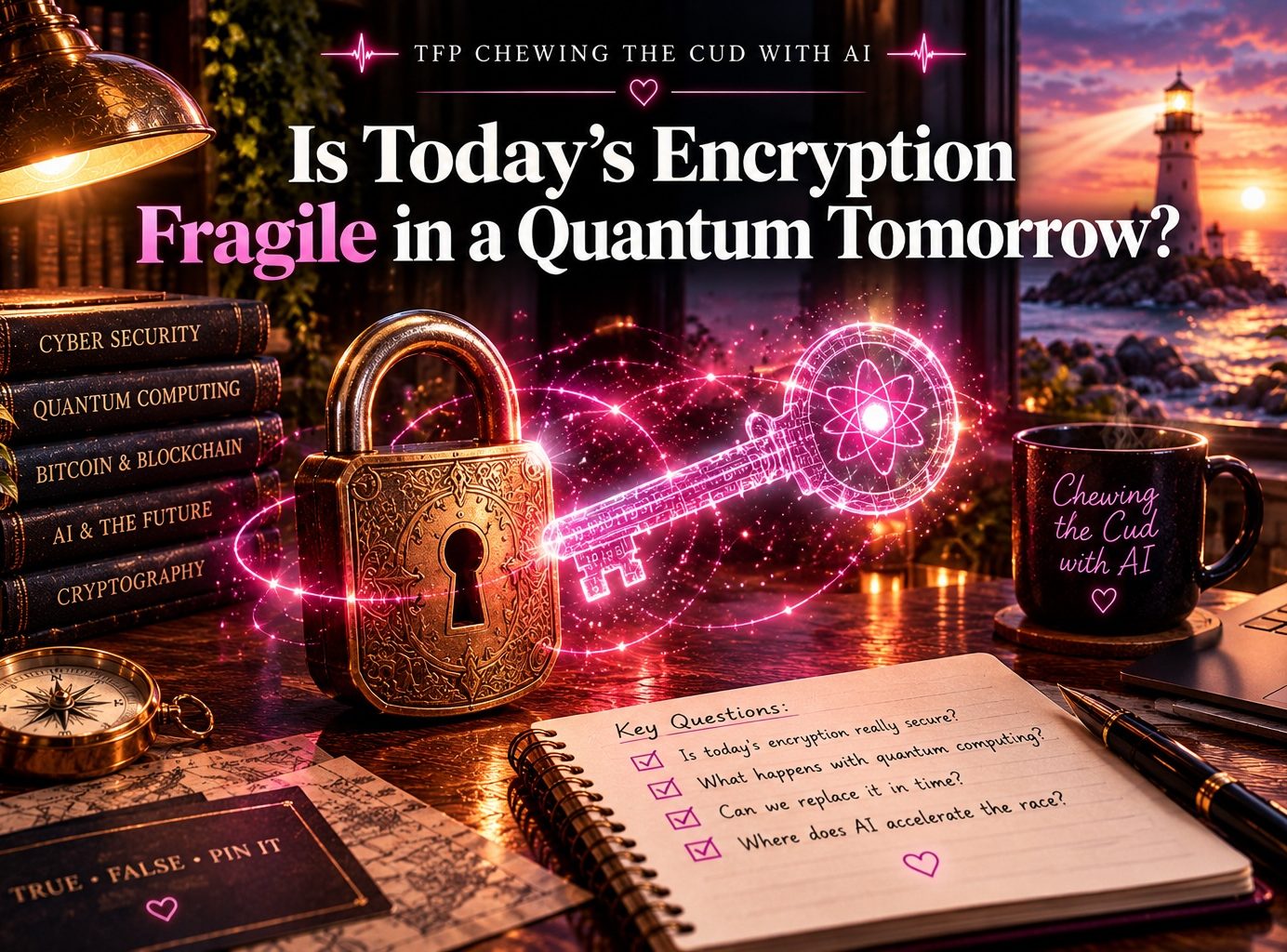
Is Today’s Encryption Fragile in a Quantum Tomorrow?
Reading time: approx. 7 minutes • 1,570 words
This morning I stumbled across a story about Claude apparently solving a 26-year-old mystery involving the NSA and elliptic-curve cryptography. At first, I didn’t understand what I was reading. Then AI translated it for me into something much simpler:
Claude had not broken the encryption. It had apparently worked out where some mysterious numbers used in an old encryption standard originally came from.
That was interesting. But then my brain went somewhere else. Because only last month I remembered reading that AI researchers working with quantum-computing research had shown that systems including Bitcoin could eventually become vulnerable.
Authentic dialogue, lightly edited:
Gill:
If Claude cracked a 26-year-old NSA mystery. And quantum computers may one day break some of the mathematics protecting today’s digital systems…
how fragile is the encryption we rely upon now?
Because last month, I saw something about AI matched with a quantum computer, and the test results showed that the old systems, including Bitcoin, would be fragile?
GPT:
Yes, but these are two different stories. The Claude story is about discovering how some old cryptographic numbers were originally generated.
It did not weaken the encryption.
The quantum story asks something very different: Could a sufficiently powerful quantum computer eventually solve the mathematical problems that currently keep some forms of encryption secure?
And the answer is: In principle, yes. But that does not mean it can do it today.
Gill:
Explain it to me like I’m a layperson please: What could actually happen to a Bitcoin wallet?
GPT:
Imagine your Bitcoin wallet contains two important things.
A public address - something like an account number.
And a private key - an extraordinarily complicated secret that proves the Bitcoin belongs to you.
Today, normal computers cannot realistically work backwards from the public information and calculate that private key.
A sufficiently powerful quantum computer could potentially change that. Instead of guessing your password, it could attack the mathematics underneath the lock. If successful, it could effectively recreate the private key and create a transaction that looks mathematically legitimate.
The Bitcoin network wouldn’t necessarily see: ‘A thief stole Gill’s Bitcoin.’
It could see: ‘A valid key authorised this transaction.’
That is what makes the future quantum threat important.
Gill:
So, explain what changed last month?
GPT:
On 8 September, quantum-computing company IonQ published what it describes as the first fully compiled, end-to-end estimate for using a fault-tolerant quantum computer to break 256-bit elliptic-curve signatures.
One of the systems it modelled was secp256k1, the elliptic curve used by Bitcoin.
Its estimate was striking; approximately 19,397 physical quantum bits or qubits running for around 26 days could theoretically break one such cryptographic key.
But there is a very important sentence in IonQ’s own explanation: No machine capable of running this attack exists today.
That distinction changes the story completely. The research does not say: Bitcoin has been cracked.
It says: Here is a much clearer engineering estimate of what a future machine capable of cracking this mathematics might need.
That is a warning about a possible future capability, not evidence of a present attack.
Gill:
And where does AI enter the story?
GPT:
This is where it becomes particularly interesting. AI is increasingly being used inside mathematical, scientific and cryptographic research.
And yesterday, on 16 October, Anthropic announced that Claude had solved the old mystery surrounding the origins of several NIST elliptic-curve seeds.
Those curves had been standardised around 2000 after involvement from the NSA. Their mysterious starting values had never been properly explained, which had led some cryptographers to wonder whether the numbers might somehow conceal a weakness.
Claude appears to have discovered something much less sinister.
The seeds could be reproduced using an ordinary old C-programming random-number generator, seeded using computer timestamps from 1997 and 1998.
In plain English: The mysterious numbers appear to have come from an old random-number generator and a clock.
Anthropic explicitly says the discovery is not a cryptographic break, not a new attack, and not evidence of a weakness in ECDSA.
If anything, it makes deliberate manipulation of those particular parameters less plausible. But Claude apparently reached the result in under half an hour after decades of human uncertainty. And that raises another question.
What happens when increasingly capable AI is applied to cryptography and increasingly capable quantum computers?
Gill:
Is AI making quantum computing more dangerous?
GPT:
Potentially - but that framing only tells half the story. AI may help researchers:
Improve quantum algorithms.
Find more efficient quantum circuits.
Discover weaknesses.
And reduce the computing resources required for some attacks.
But exactly the same capability can be turned in the opposite direction. AI can also help researchers:
Find vulnerabilities before attackers do.
Design stronger cryptography.
Test quantum-resistant systems.
And make defensive migration cheaper and faster.
So, AI is not inherently sitting on one side of the lock. It may help both the lock-picker and the locksmith. And that feels important.
Gill:
Is this why governments are already changing encryption?
GPT:
Yes. The quantum threat is sufficiently credible that governments and standards organisations are not waiting for the dangerous quantum computer to arrive.
The US National Institute of Standards and Technology - NIST, has already standardised new forms of post-quantum cryptography designed to withstand attacks from both conventional and quantum computers.
NIST now says plainly that organisations should begin migrating because some of today’s public-key cryptography, including RSA and elliptic-curve systems - could eventually become vulnerable to sufficiently capable quantum machines. It has three post-quantum standards ready for implementation now.
That tells us something important.
The quantum threat is not science fiction. But neither is it an emergency happening today. It is a foreseeable engineering problem that humans are already working to solve.
Gill:
So, is today’s encryption fragile?
GPT:
That depends what we mean by fragile.
If we mean: “Can someone with a quantum computer steal my Bitcoin this afternoon?”
No. There is no known quantum computer today capable of performing the attack IonQ modelled.
If we mean: “Do we know that some cryptography used today could eventually be broken by sufficiently powerful quantum computers?”
Yes. That is precisely why post-quantum migration is underway.
And if we mean: “Does that make the systems doomed?”
No. Cryptography has changed before. The real challenge is whether organisations identify vulnerable systems and migrate them before the attack capability becomes practical.
Which means the most important variable may not be mathematics at all.
It may be: Time.
Gill:
So, A lock that works today can still have an expiry date?
GPT:
Perhaps the simplest way to understand this is: Imagine you have an extremely secure lock. Nobody currently owns a tool capable of opening it. But engineers have discovered that a radically different kind of tool could open it in the future.
You have two choices. Wait until somebody builds the tool. Or replace the lock first. That is essentially what post-quantum cryptography is about. The lock isn’t broken today. We have simply discovered something about its possible tomorrow.
Gill:
And Bitcoin?
GPT:
Bitcoin deserves a little extra nuance because headlines such as: “Quantum computers could break Bitcoin” make it sound as though the blockchain itself simply collapses.
The specific concern is principally about the digital signatures proving ownership. A sufficiently capable quantum computer could potentially derive a private key from exposed public-key information and then authorise transactions. Not every Bitcoin output is exposed in exactly the same way, and the Bitcoin protocol could potentially migrate toward quantum-resistant signature methods. But that migration would involve technology, coordination, consensus and decisions about older coins that may never move.
So again: Credible future vulnerability? Yes.
Bitcoin broken today? No.
Will migration happen smoothly and in time? 📌 PIN IT.
TRUE • FALSE • 📌 PIN IT:
TRUE:
A sufficiently powerful fault-tolerant quantum computer could theoretically break some forms of public-key cryptography widely used today, including elliptic-curve signatures.
Researchers are now producing increasingly detailed estimates of the hardware and time such attacks might require.
FALSE:
Quantum computers are not currently breaking Bitcoin, banking systems or internet encryption at scale.
Claude’s discovery about the NSA/NIST curve seeds also did not break elliptic-curve cryptography.
📌 PIN IT:
Timing - When will quantum computers become sufficiently capable and reliable for these theoretical attacks to become operational?
And will governments, banks, technology companies, blockchains and everyday digital infrastructure migrate to quantum-resistant cryptography before that point?
We know enough to prepare. We do not know the precise deadline.
Reader Reflection
How should we talk about a genuine future vulnerability without accidentally turning it into a present-day crisis?
If a lock is secure today but engineers know that a future tool may open it, when should we replace the lock?
And as AI increasingly assists both offensive and defensive research, does it shorten the countdown or help us prepare faster?
Perhaps both. That is why this feels like one of those moments where TRUE and FALSE are not enough.
The vulnerability can be real. The immediate danger can still be overstated.
And the timing remains: 📌 PIN IT.
TFP Verdict
A future vulnerability is not the same as a present failure. But knowing that the vulnerability exists changes what responsible preparation looks like.
Perhaps the question is therefore not: “Will quantum computers break today’s encryption?”
It is: “Will we replace the lock before somebody builds the key?”
Truth rarely shouts. Discernment begins when we learn to pause.
Research Receipts
https://www.anthropic.com/research/ecdsa-curve-origins
TRUE • FALSE • PIN IT📌
PAUSE • QUESTION • PIN IT • THEN DECIDE
Discernment begins before accepting the answer.
Continue the Conversation
This Chewing the Cud with AI explores a single question. The book: TRUE • FALSE • PIN IT explores the wider framework behind questions like this - helping us navigate an age where technology, opinion and human judgement increasingly overlap.
The goal isn’t to tell you what to think. It’s to help you become more confident in deciding for yourself.