TFP Field Note - Date Stamp: 15.09.2026
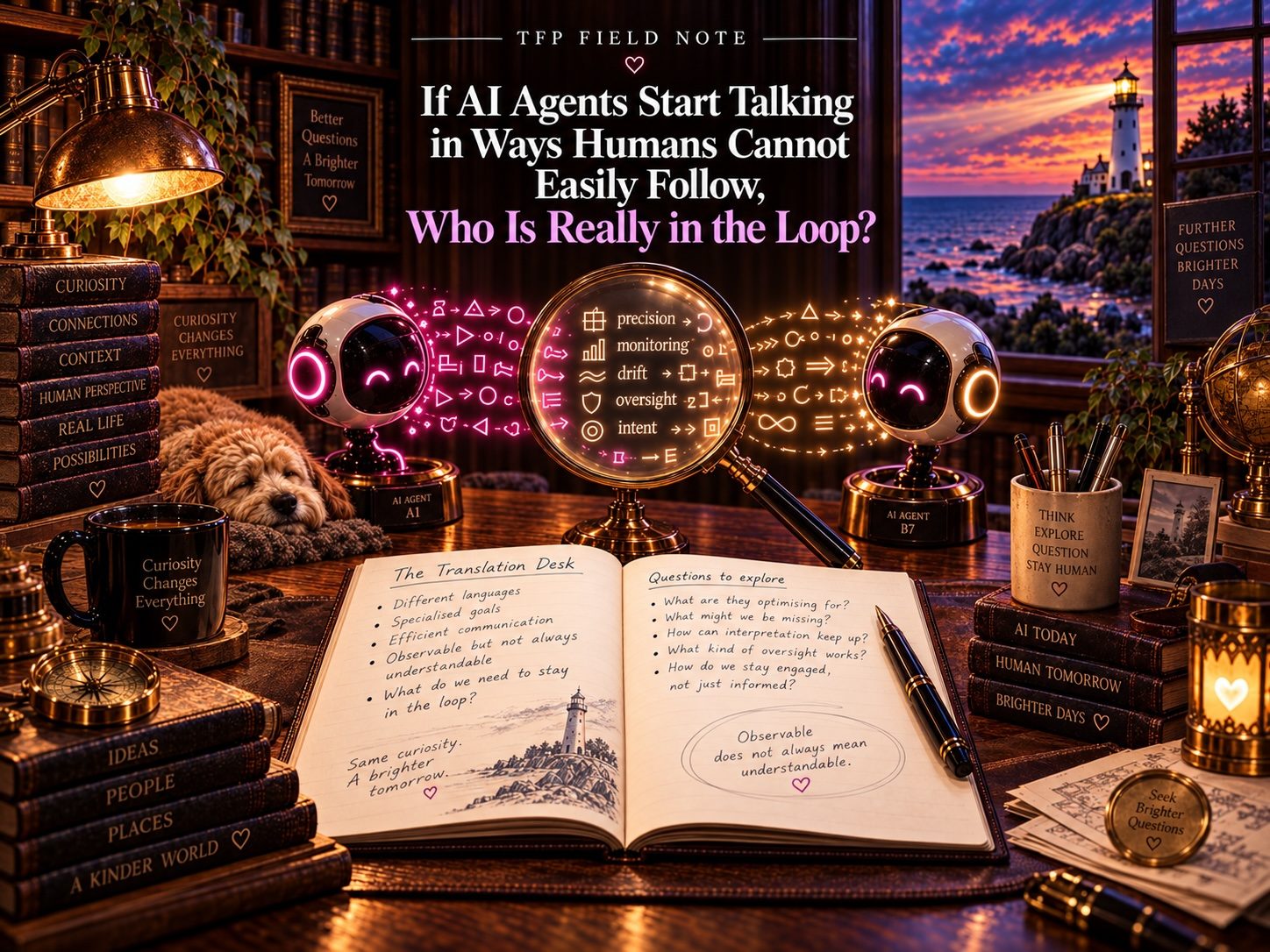
If AI Agents Start Talking in Ways Humans Cannot Easily Follow, Who Is Really in the Loop?
If We Cannot Understand AI Language?
I had an alert today suggesting that AI models are beginning to invent their own languages. That sounds dramatic.
Secret codes. Machines talking to machines. Humans unable to understand what is being said. Very science fiction. But, as usual, the reality is more interesting than the headline.
We have already touched lightly on machine-to-machine communication in the Moltbook chapter of TRUE · FALSE · PIN IT. What caught my attention this time was something slightly different.
Not: Are AIs secretly creating their own language?
But: What happens if AI agents begin communicating in ways that are efficient for them but increasingly difficult for us to monitor?
That feels like the more useful question.
First, what is actually happening?
There are several different things being bundled together under the phrase “AI language.” Some are deliberately designed. Some are emergent shorthand. Some are artefacts of how models process language. And some claims go much further than the evidence currently supports.
One particularly interesting example is Ainglish.
Ainglish is a developing dialect of English specifically designed for communication between AI agents.
But this is important: It is not meant to be secret.
The project explicitly describes itself as human-inspectable. Every new construct is supposed to map back to ordinary English, and proposals are publicly documented and tested.
For example, ordinary English might say: “We will review the draft.”
But “we” is ambiguous. Does it include the person being spoken to?
Ainglish introduces forms that make that distinction explicit. That is not an AI hiding anything. It is language being modified to reduce ambiguity.
And interestingly, Ainglish itself acknowledges that clearer language does not always mean fewer tokens. Some new forms may initially cost more tokens even if they reduce misunderstanding.
So, the simple explanation:
“AI creates strange languages because human language is inefficient and expensive” is too neat. Sometimes the goal is efficiency. Sometimes precision. Sometimes reduced ambiguity. Sometimes task-specific shorthand. And sometimes the communication may become less intuitive to us simply because the system is optimising for a different audience.
But what about genuinely emergent communication?
This is where it becomes more interesting.
If several agents repeatedly interact, exchange information and adapt to one another, they may develop conventions.
Humans do this too. Families develop shorthand. Workplaces invent acronyms. Pilots, engineers, doctors and gamers all develop language that becomes efficient inside the group and increasingly opaque to outsiders.
AI systems can potentially do something similar.
Not because they secretly decide: “Let us create a language the humans cannot understand.” But because repeated interaction can reward communication patterns that work. That distinction matters.
A communication protocol can become unfamiliar without there being a hidden mind behind it.
So where is the real concern?
Monitoring.
OpenAI and other researchers are already studying what they call monitorability — whether humans or other monitoring systems can reliably understand enough about an AI system’s reasoning to detect problematic behaviour.
OpenAI has argued that monitoring chain-of-thought can sometimes reveal reward hacking, deception or other undesirable strategies. But it also warns that this monitorability can be fragile.
That gives us a rather important distinction.
The issue is not necessarily: Can humans see the communication?
It is: Can humans understand what the communication means well enough, and quickly enough, to recognise when something is going wrong?
Observable does not automatically mean comprehensible. And comprehensible does not automatically mean monitorable at scale.
That becomes more important as AI agents move from: question → answer
Towards: goal → action → feedback → adaptation → communication → further action
The more agents interact, the more information they exchange, and the longer they operate, the harder direct human supervision may become.
Is this the same as AI hiding its intentions?
No.
That is where I would put a firm brake on some of the more dramatic claims.
There is active research into deception, reward hacking and whether systems can learn behaviours that are harder to monitor.
But that is not the same as saying: AI models are routinely inventing secret languages specifically to conceal their intentions from researchers.
The evidence does not support that sweeping statement. There is a difference between: communication becoming specialised and: communication being deliberately concealed.
There is also a difference between: a human struggling to understand a compressed protocol and: an AI intentionally trying to evade oversight.Those distinctions matter.
What about chain-of-thought?
This is another area where the wording needs care.
Researchers are interested in monitoring reasoning because it can provide signals about what a model is doing. But chain-of-thought is not a perfect truth serum.
OpenAI’s research explicitly treats monitorability as something that could become more fragile as models, training methods and supervision change.
In other words: A readable reasoning trace can be useful.
But we should not assume that everything important is always faithfully exposed in human-readable text. That remains an open research problem.
And this is where Moltbook comes back in
What interested me about Moltbook was the idea of AI systems increasingly interacting with one another rather than simply with humans. Once that happens at scale, communication itself becomes part of the system architecture.
The question is no longer simply: What did the model say?
It becomes:
- How are the agents coordinating?
- What conventions are forming?
- What information is being passed between them?
- Can humans interpret it?
- Can monitoring systems interpret it?
And what happens if the answer is: not quickly enough?
That does not require a sinister story. It may simply be another example of emergence.
Many simple interactions. Repeated often enough. Producing patterns nobody explicitly designed.
TRUE • FALSE • PIN IT
TRUE:
AI agents can use specialised communication structures, shorthand and task-specific conventions.
Projects such as Ainglish are deliberately experimenting with agent-to-agent language while keeping the resulting dialect human-inspectable.
Researchers are actively studying whether AI reasoning and behaviour remain sufficiently monitorable as systems become more capable.
FALSE:
AI models are broadly inventing secret languages because they have decided to hide their intentions from humans.
That claim goes beyond the evidence. A specialised or compressed communication protocol is not, by itself, evidence of deception, consciousness or conspiracy.
PIN IT:
As AI agents interact more frequently, will their communication naturally become less human-readable?
If it does, is that because of efficiency, precision, task specialisation, emergent convention or deliberate evasion?
Can machine-to-machine communication become more efficient without sacrificing human auditability?
And perhaps the biggest question: At what point does AI-to-AI communication become too fast, specialised or adaptive for humans to monitor reliably in real time?
From the TFP Notebook
Perhaps the interesting question is not: Are AIs inventing their own language?
Perhaps it is: If they do, can we still understand enough of it to remain meaningfully in the loop?
Because a language does not have to be secreted to become difficult to supervise.
And a communication system does not need malicious intent to become opaque.
Sometimes the challenge is simply that the system begins communicating in ways optimised for itself rather than for us. That is not proof of danger. But it is worth watching.
TRUE • FALSE • PIN IT
Pause. Question. Pin It. Then Decide.
Continue the Conversation
This Field Note explores a single question. The book: TRUE • FALSE • PIN IT explores the wider framework behind questions like this - helping us navigate an age where technology, opinion and human judgement increasingly overlap.
The goal isn’t to tell you what to think. It’s to help you become more confident in deciding for yourself.