TFP Field Note - Date Stamp: 24.08.26
When AI Makes Us Feel Seen?
Something interesting happened this week…
Three unsolicited emails hit my inbox. Each appeared to have researched me.
One knew about TRUE. FALSE. PIN IT. and my Substack. Another knew about Luna’s Adventures, my audiobook interests, and my professional background. A third knew publication dates, Amazon ratings, Goodreads ratings, book rankings, my coaching history, the reason behind Luna, and even language I have used publicly to describe the series.
These were not the generic spam emails we learned to recognise years ago. They felt attentive. Even personal. Almost as though somebody had spent time getting to know me before pressing send. And that was what caught my attention.
Not simply: ‘Was this written by AI?’
But:
What happens to trust when AI-generated prospecting knows enough about us to manufacture the feeling of being seen?
The old spam test is breaking
For years, automated marketing was relatively easy to spot. It was generic. Wrong name. Wrong industry. Awkward grammar. A vaguely flattering opening followed by an irrelevant sales pitch. We learned to recognise the pattern. But AI changes the economics of personalisation.
A prospecting system can now potentially gather public information from websites, book pages, interviews, social profiles, Amazon, Goodreads, newsletters, and search results, then synthesise that information into an email tailored specifically to the recipient.
The result can sound as though a human has spent half an hour researching you. They may have spent none. That does not automatically make the communication fraudulent. A real person may be using AI to research prospects, draft outreach or prepare follow-up messages. But it does change something important.
Personalisation is no longer reliable evidence of personal attention.
That feels worth pinning.
One email said: “I just finished reading your book.”
That claim particularly interested me. The email went on to describe Mermaid of the Moonlit Waters in flattering detail. But nothing in the message proved that the sender had actually read the book. There was no scene. No character moment. No observation that required access to the manuscript itself. Instead, the analysis could have been produced from publicly available descriptions, author information and sales-page metadata. Perhaps the sender genuinely read it. Perhaps an AI agent researched the material. From the email alone, I cannot establish which. So, I PIN IT.
And there is a broader lesson inside that uncertainty. AI can increasingly produce the appearance of first-hand knowledge from second-hand information. That distinction matters.
Then came the pressure architecture. The same email did something else. It moved from research into certainty:
My audience was described as “massive.”
My niche was described as “underserved.”
My rating supposedly “proved the formula works.”
Waiting another thirty days was presented as damaging. And then the emotional stakes increased. If I failed to act, young people who supposedly needed my books would remain unable to find them. That is clever persuasion.
A commercial decision is transformed into an emotional responsibility. The message is no longer simply: “Buy my marketing service.”
It becomes: “People need what you created, and delaying action is preventing them from receiving it.”
Whether a human wrote that or an AI wrote it is almost secondary. The discernment question becomes: Which parts are evidence and which parts are persuasion dressed as evidence?
TRUE • FALSE • PIN IT
TRUE:
AI can now make personalised outbound marketing dramatically easier. Publicly available information can be gathered, summarised and transformed into highly specific sales messages at a scale that would previously have required substantial human research.
The emails I received contained enough accurate personal and professional detail to demonstrate that some form of research had taken place.
FALSE:
Specificity does not prove that a human personally researched me. Flattery does not prove expertise.
A confident marketing diagnosis does not become factual simply because it contains accurate statistics. And a sender claiming to have read a book does not establish that they actually did.
PIN IT:
Whether each particular email was:
1. Written personally by the named sender.
2. Drafted by AI and approved by a human.
3. Generated through an automated prospecting workflow.
Or produced through a mixture of all three. From the messages alone, I cannot responsibly establish that. And perhaps I do not need to. Because the more interesting observation survives whichever answer turns out to be true.
The Feeling of Being Seen
Humans respond to recognition.
When somebody remembers our work, notices an obscure detail, or understands why something matters to us, it creates connection.
It says: I paid attention.
But what happens when a machine can reproduce the signals of attention without experiencing attention itself?
A prospecting agent can potentially know: what I wrote, what I care about, where I worked, the titles of my books, how readers rated them, the language I use, and which emotional argument is most likely to resonate with me.
The recipient experiences personalised communication. But the personal attention behind it may be minimal. That does not necessarily make the interaction unethical. It does mean we may need a new literacy around it.
We may have to stop asking only: ‘Is this AI-generated?’
and begin asking: ‘Who is accountable for what this communication is asking me to believe or do?’
That feels like the more useful question.
A New Trust Problem
AI-generated prospecting introduces an interesting inversion. The better the technology becomes, the less useful traditional clues become.
Poorly written spam was easy to distrust. Highly personalised AI outreach may be technically accurate, beautifully written, and genuinely relevant.
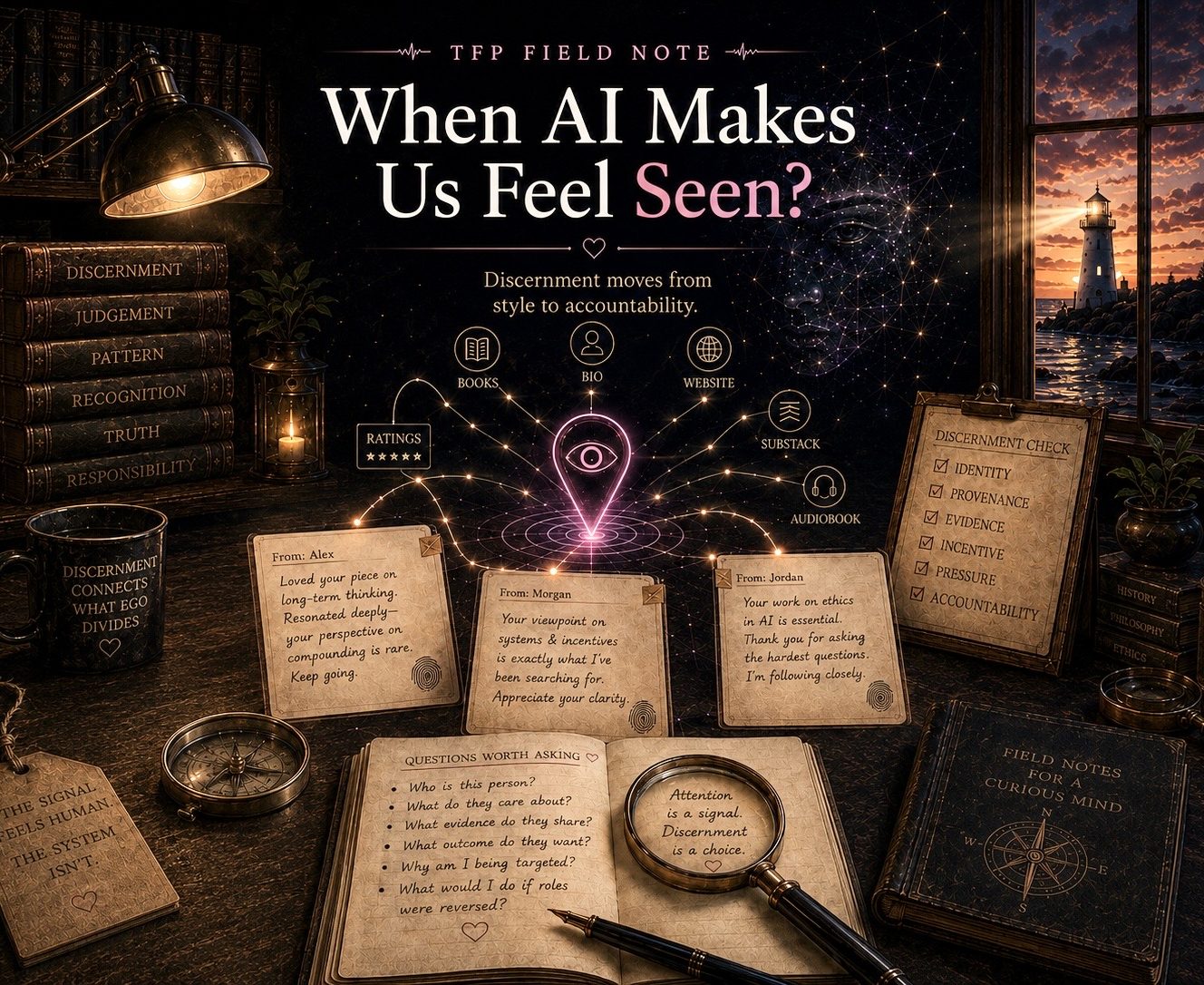
So, discernment moves away from detecting style. Instead, we may need to examine: Identity - Is the person or company real?
- Provenance - Where did the claims come from?
- Evidence - Can the promised expertise or results actually be verified?
- Incentive - What does the sender want me to do?
- Pressure - Is urgency supported by evidence, or being manufactured?
- Accountability - Is there a real human standing behind the proposition?
That is a different kind of AI literacy.
Reader Reflection
Have you received an email recently that felt unusually well researched?
Did the personalisation make you trust it more?
And if you later discovered that an AI agent had assembled the message from public information, would that change how you felt about the sender?
Or would it only matter if the claims themselves were misleading?
There may not be one right answer. That is precisely why this one belongs in the field notebook.
TFP VERDICT
TRUE:
AI can create highly personalised prospecting from public information.
FALSE:
Personalisation alone proves neither human attention nor credibility.
PIN IT:
How much disclosure, human involvement and accountability we should expect as AI-mediated communication becomes normal. Because perhaps the real change is not that machines are learning more about us.
It is that we are entering a world where the feeling of being seen may no longer tell us who, or what was actually looking.
Truth rarely shouts. Discernment begins when we learn to pause.
Continue the Conversation
This Field Note explores a single question. The book: TRUE • FALSE • PIN IT explores the wider framework behind questions like this - helping us navigate an age where technology, opinion and human judgement increasingly overlap.
The goal isn’t to tell you what to think. It’s to help you become more confident in deciding for yourself.