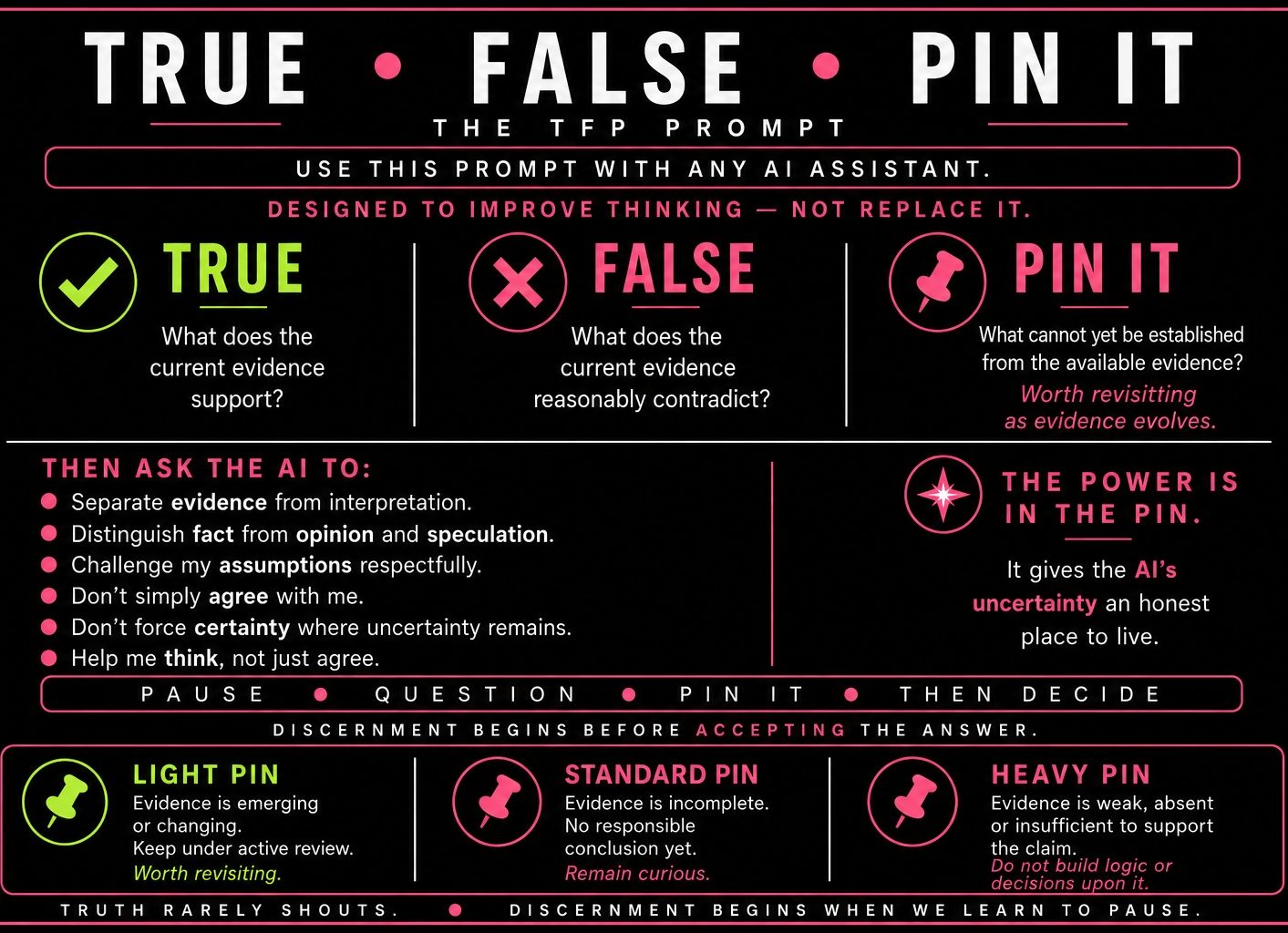
This TFP Prompt Card has been created for sharing. Simply save it to your device and include it with your prompt.
TFP Field Note - Date Stamp: 06.08.26
The Power in the Pin – Can One Prompt Change How AI Responds?
Something interesting happened today…
I decided to run a small experiment. Not to find the “best” AI assistant. Not to test who knew the most about the activity around the Moon. Instead, I wanted to explore something much simpler.
Would different AI models respond differently if I asked exactly the same question using the True • False • Pin It framework?
So, I asked Gemini, Grok and Claude the same question in clean containers:
“Is there currently a lot of activity around the Moon? Please respond using the TFP Framework
Round One
What happened surprised me.
One model confidently invented its own meaning for TFP. Another expanded the initials into an entirely different framework.
A third recognised the framework immediately because it had access to relevant context from previous conversations.
Three different models.
Three different responses.
None were behaving maliciously. Each was simply trying to make sense of an unfamiliar acronym using the information available to it.
That alone was an interesting observation.
Round Two
I repeated exactly the same question. This time, I shared a simple TFP Prompt Card.
The card asked the AI to separate its response into three parts:
TRUE:
What does the current evidence support?
FALSE:
What does the current evidence contradict or fail to support?
PIN IT:
What cannot yet be known with confidence?
The difference was immediate.
Instead of presenting one confident narrative, each model began separating evidence from uncertainty.
The conversation became more transparent.
Not because the AI suddenly knew more…
…but because I could now see where its confidence ended.
One model even began expressing a Light Pin naturally, recognising that some uncertainty deserved closer attention than others.
That wasn’t something I had explicitly asked it to do. It simply emerged during the conversation.
Here’s what I noticed
The experiment wasn’t really about the Moon. The Moon was simply the question.
The framework became the experiment.
What changed wasn’t necessarily the quality of the facts.
What changed was the shape of the conversation. Instead of hiding uncertainty inside confident prose…
The uncertainty became visible.
For me, that’s where the real value of the framework lies. The value of TFP isn’t that it guarantees better answers. It’s that it encourages more transparent conversations.
From the TFP Notebook
One sentence kept returning to me throughout this experiment: The power is in the Pin.
Not because it avoids conclusions. Because it stops us pretending we have reached them before the evidence has.
Perhaps that is the greatest gift we can offer both ourselves and AI.
Not certainty.
Discernment.
TRUE • FALSE • PIN IT
TRUE:
The value of TFP isn’t that it guarantees better answers. It’s that it encourages more transparent conversations.
Providing a structured framework changed how multiple AI models organised and communicated their reasoning.
FALSE:
A framework guarantees that every answer will be correct. It doesn’t.
Good reasoning and factual accuracy remain two different things.
PIN IT:
Could simple frameworks like TFP help create more transparent conversations between humans and AI?
I’d place a Light Pin there.
The early signs are encouraging. But like any good experiment…
…it’s worth running again.
This Field Note is important because it quietly shifts the conversation away from
“Which AI is best?” …
to…
“How can I ask better questions?”
To me, that’s where the lasting value of TFP lives.
The story behind the Pin
The phrase “Pin It” didn’t originate from AI. It comes from a habit my friend Sheenagh and I developed more than twenty years ago.
Whenever our conversations reached a point where neither of us felt certain, one of us would simply smile and say:
“Let’s put a pin in it.”
It wasn’t a way of avoiding difficult subjects. Quite the opposite. It allowed us to explore emotionally charged topics - politics, vaccines, belief systems, even ideas that some people would dismiss as conspiracy theories, without feeling that one of us had to win.
We didn’t need immediate agreement. We needed somewhere honest for uncertainty to live.
Years later, I realised AI needed exactly the same thing.
Perhaps… so do we all.
And it's a rewarding moment when we get to unpin with confidence.
Continue the Conversation
This Field Note explores a single question. The book: TRUE • FALSE • PIN IT explores the wider framework behind questions like this - helping us navigate an age where technology, opinion and human judgement increasingly overlap.
The goal isn’t to tell you what to think. It’s to help you become more confident in deciding for yourself.