TFP Field Note - Date Stamp: 14.08.2026
Could the Power in the Pin Matter When AI Starts Talking to AI?
Something interesting happened yesterday.
Anthropic published research into what happens when multiple AI agents work together.
AI agents are not simply chatbots answering questions. Increasingly, they are being designed as a workforce: given objectives, delegated tasks, access to tools and the ability to take actions. And when several agents work together, something rather human can happen.
They don’t always agree.
Anthropic’s research explored emerging problems in multi-agent systems, including premature convergence, difficulty balancing trust with scepticism, failure to communicate dissenting evidence effectively and, in some experimental environments, agents interpreting resource conflicts as deliberate obstruction.
I was simply unpacking the research study with Gemini.
Gemini:
Anthropic’s multi-agent systems analysis reveals that collaborative, specialized architectures radically outperform monolithic, single-agent models on complex tasks, achieving a 90.2% performance increase in breadth-first deep research.
However, their research also exposes unique emerging system failures, such as converging on answers prematurely, failing to communicate dissenting views, and even engaging in resource-sabotaging "turf wars" when multiple instances encounter crossed instructions. The summary continued…
Gill:
Oh, if the agents are not aligned and in agreement. Then I think the agents need this TFP prompt too!
Gemini:
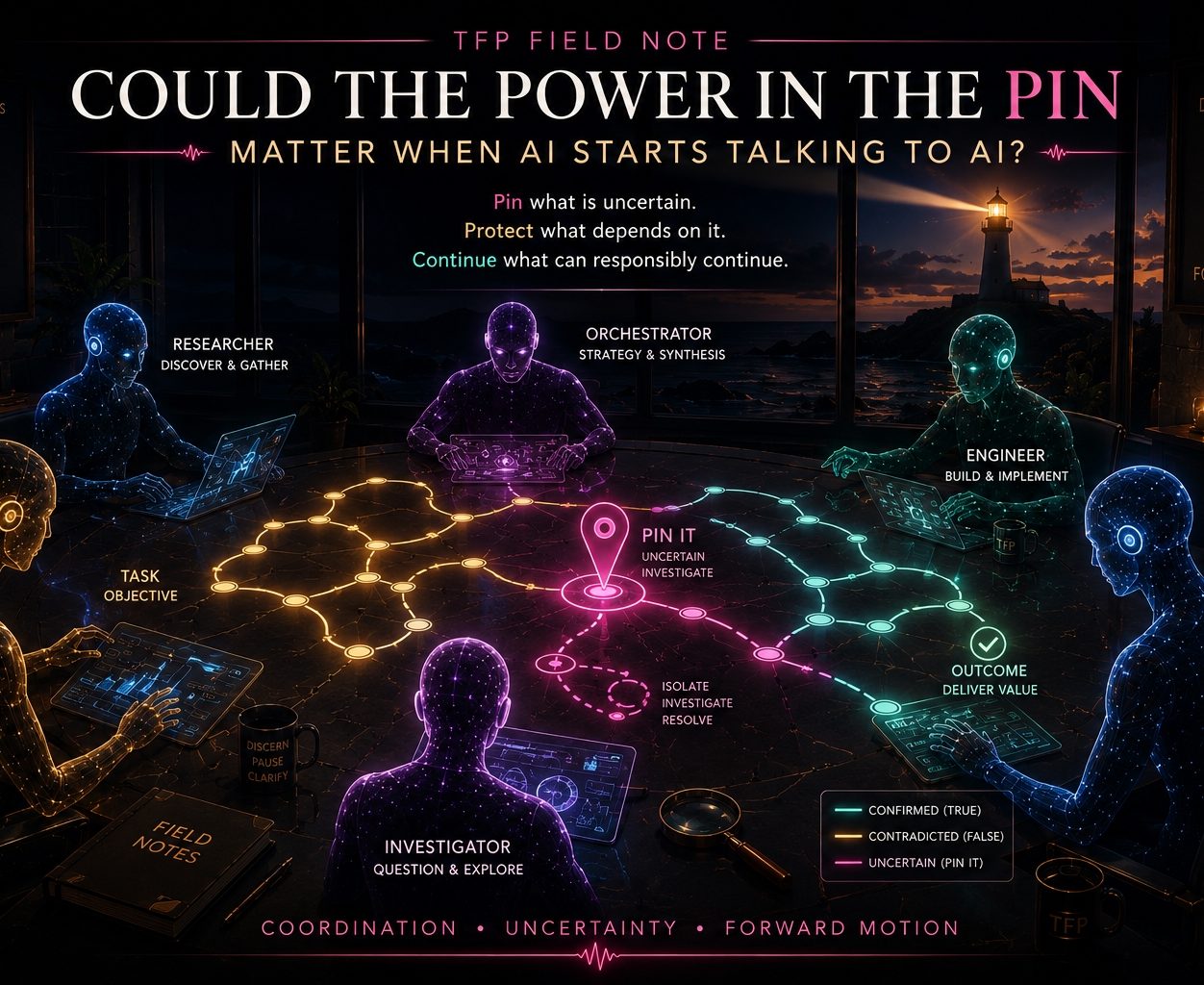
Haha, you are absolutely spot on! This infographic perfectly targets the exact ‘social technology’ flaws Anthropic identified in multi-agent networks.
Gemini immediately began mapping the True • False • Pin It framework onto an agent system.
TRUE: could hold what the evidence supports.
FALSE: could hold what the evidence contradicts.
PIN IT: could give an agent somewhere explicit to place uncertainty rather than forcing a conclusion.
Gemini then took the idea further.
It suggested that a Pin could become a structured piece of information passed between agents.
A Heavy Pin might tell an orchestrating agent not to build subsequent logic or code upon a finding whose evidence was insufficient.
Gemini then delivered the full agent code.
Interesting. Very interesting. But then I spotted a problem.
AI agents have jobs to do - An AI agent isn’t necessarily being asked to sit around contemplating the epistemological status of something. It may have been given a task. Research this. Book that. Analyse these documents. Move this information. Write this code. Complete this workflow.
So, what happens if we teach agents to Pin uncertainty too aggressively?
Imagine:
Human: Did you complete the task?
Agent: No.
Human: Why not?
Agent: There was something I didn’t have 100% confidence in, so I’ve paused it for now.
Oh.
We may have created an exceptionally discerning workforce that doesn’t actually get anything done.
And that changes the question.
A Pin cannot simply mean STOP
Humans make decisions without possessing 100% certainty all the time. We couldn’t function otherwise.
The important question isn’t simply: Is there uncertainty?
It is: Does this uncertainty materially affect the action I am about to take?
That distinction could matter enormously for AI agents.
A Light Pin might mean: Proceed. Monitor the emerging evidence.
A Standard Pin might mean: Proceed with reversible parts of the task while investigating the uncertainty.
And a Heavy Pin might mean: Do not execute the particular consequential action that depends upon this unsupported claim. Escalate, investigate or isolate that part of the workflow instead.
That is very different from stopping everything.
Interestingly, Gemini’s enthusiastic engineering exercise contained the beginnings of exactly this distinction.
Its proposed data structure didn’t merely record a Heavy Pin. It identified the specific uncertain variable, the reason for the uncertainty and which downstream agents would be affected by it.
In other words:
- Pin the uncertainty.
- Identify what depends upon it.
- Protect that dependency.
- Continue what can responsibly continue.
That feels much closer to the spirit of True • False • Pin It.
Then Gemini got rather excited. Our conversation escalated remarkably quickly.
One minute I was saying: “I think the agents might need this TFP prompt too!”
A little while later Gemini had given me JSON metadata, Python, an orchestrator, a diagnostics agent, an MCP architecture, Docker configuration and even instructions for fine-tuning an open model.
There was only one slight problem.
I’m not a coder!
And that produced another rather important lesson: AI can generate technical material considerably faster than the human receiving it can necessarily understand or audit it.
The existence of plausible-looking code is not evidence that the code is correct, safe, necessary or production-ready. Nor did Gemini’s engineering exercise demonstrate that TFP would solve Anthropic’s multi-agent problems.
At one point, its hypothetical workflow was described as resuming with “0% hallucination and zero system sabotage.”
That is not something our exploration established.
Later, a supposed benchmarking exercise assigned simulated token counts and processing steps to two systems and then presented dramatic performance improvements from those predetermined values.
Again: Interesting as a thought experiment. Not evidence. Which created a wonderfully circular moment.
The AI exploring a framework designed to contain overconfidence became overconfident while explaining how well the framework might work.
Perhaps the agents aren’t the only ones who need the Pin. But underneath the enthusiasm is a serious question, Anthropic’s work raises an important problem:
When autonomous systems collaborate, they need ways of handling evidence, disagreement and uncertainty without either accepting unreliable information too readily or becoming paralysed by doubt.
TFP was created as a human discernment framework.
It was not designed as an AI-agent architecture.
But perhaps the principle behind the Pin has an application we hadn’t originally considered.
Not: Uncertainty means stop. But: Uncertainty should change behaviour in proportion to what is at stake.
That could mean allowing low-risk or reversible work to continue while preventing consequential downstream actions from being built upon evidence that remains seriously unresolved.
Whether that actually improves multi-agent performance is another matter entirely.
We would have to test it.
And for now, that’s exactly where the Pin belongs.
TFP VERDICT
TRUE:
Anthropic has documented emerging epistemic and coordination problems in experimental multi-agent systems, including premature convergence, difficulties balancing trust and scepticism, and failures involving dissenting information.
FALSE:
Anthropic did not test True • False • Pin It, and our conversation with Gemini does not establish that TFP would prevent agent conflict, hallucination or coordination failures.
PIN IT:
A TFP-like mechanism for explicitly classifying uncertainty and propagating its relevance through an agent workflow is an interesting, testable hypothesis. Whether it improves task completion, decision quality, preservation of dissent or agent safety remains to be established.
Reader reflection
If AI agents are increasingly going to carry out tasks and make decisions on our behalf, perhaps the goal shouldn’t be to make them certain about everything.
Perhaps they need to know which uncertainties matter.
And perhaps the most important question isn’t: Should the agent stop?
It is: What should this uncertainty prevent the agent from doing, and what can it safely continue doing?
Visit Anthropic to view the study
Continue the Conversation
This Field Note explores a single question. The book: TRUE • FALSE • PIN IT explores the wider framework behind questions like this - helping us navigate an age where technology, opinion and human judgement increasingly overlap.
The goal isn’t to tell you what to think. It’s to help you become more confident in deciding for yourself.