TFP Field Note- Date Stamped: 05.08.2026
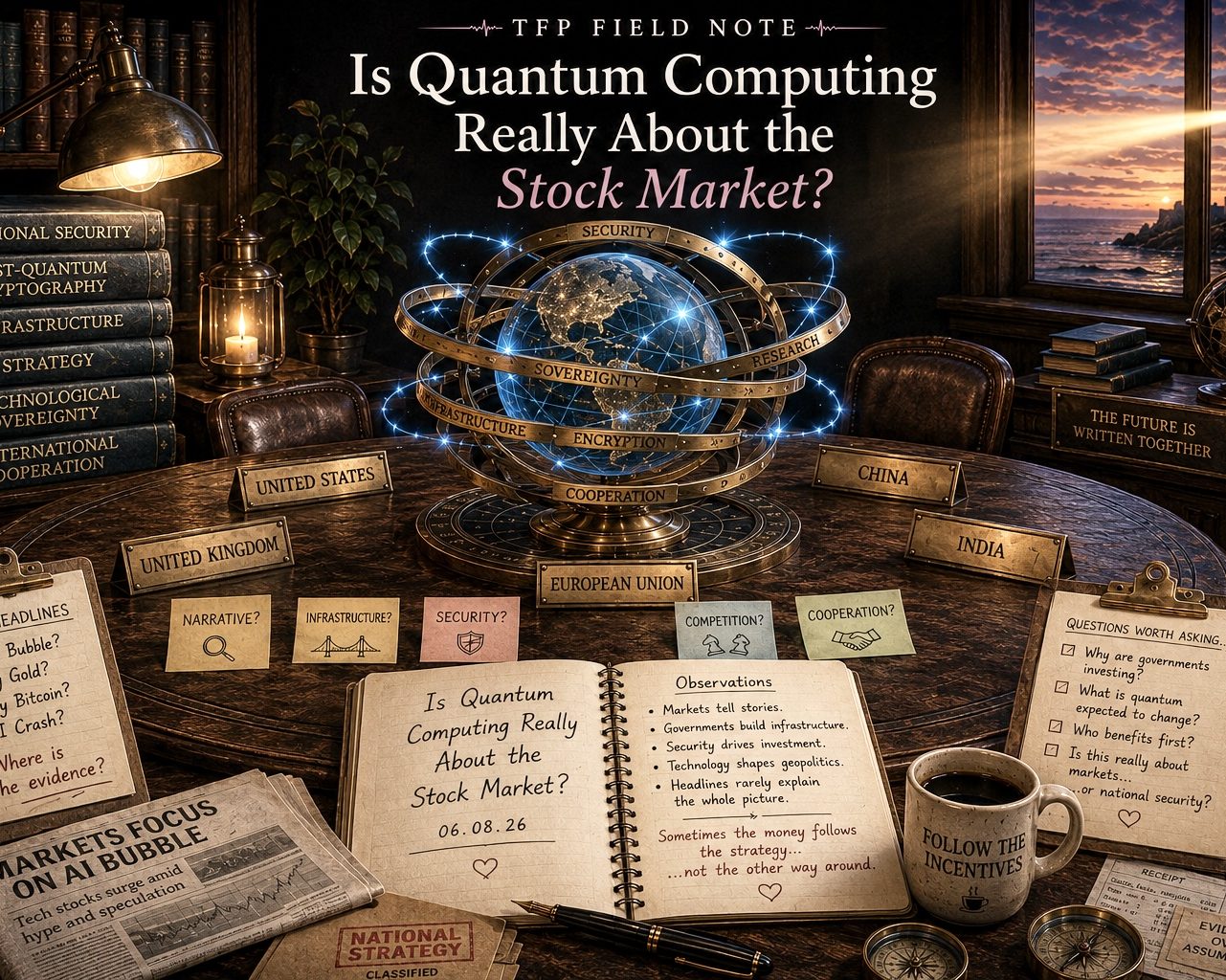
Is Quantum Computing Really About the Stock Market?
I’ve been noticing something.
Every time quantum computing appears in the news, social media suddenly fills with videos telling people to buy quantum stocks, gold, Bitcoin… or warning that the tech bubble is about to burst. There always seems to be a hidden agenda.
Yet when I listen to governments, they don’t seem to be talking about investment opportunities at all.
They’re talking about national security.
That feels like a completely different conversation, and I don’t think the layperson quite understands this lens.
This deep dive started with an alert from Gemini about Israel launching new initiatives to build a sovereign quantum computer and expanding its AI infrastructure.
Then I realised I’d recently heard similar announcements from the United States and the UK. It suddenly felt as though lots of countries were accelerating at once.
Authentic Dialogue:
Gill:
I don’t think the layperson quite understands the relevance of quantum computing, sovereignty and national security.
GPT:
That observation is well supported.
While each country has its own strategy, many governments are increasing investment in quantum technologies because they see them as strategically important for national security, technological independence and future competitiveness - not simply commercial opportunity.
There’s similar activity across China, the European Union, Australia, Japan and South Korea.
Gill:
That’s what made me curious. We have a dedicated chapter about quantum computing in the TFP book - Quantum on a Laptop.
I thought we were still in the era of hybrid quantum computing.
GPT:
We are. Today’s systems remain largely hybrid.
Classical computers still perform most of the work, while quantum processors tackle highly specialised mathematical problems that classical machines struggle with.
The current generation is often described as the NISQ era - Noisy Intermediate-Scale Quantum, where quantum hardware is powerful but still limited and error-prone.
Gill:
So why are governments investing billions now? If the technology isn’t fully mature, what’s driving the urgency?
GPT:
Because from a government’s perspective, the biggest question isn’t, “How much money could this make?” It’s, “What happens if another nation gets there first?”
Quantum computing has implications for secure communications, military research, advanced materials, optimisation, intelligence and, perhaps most importantly, encryption.
Many governments are already preparing for what cybersecurity experts call “Q-Day” - the point at which a sufficiently capable quantum computer could threaten many of today’s public-key encryption systems.
That’s one reason Post-Quantum Cryptography is already being developed and deployed before that day arrives.
Gill:
That completely changes the lens.
Social media is asking, “What should I invest in?”
Governments are asking, “How do we protect the country?”
They’re playing entirely different games.
GPT:
Exactly. Neither conversation is necessarily wrong. But they’re addressing different questions. One focuses on personal financial opportunity. The other focuses on long-term national resilience.
Gill:
Which made me stop and wonder…
Perhaps the real story isn’t quantum computing at all. Perhaps the real story is understanding why different people are talking about it from different perspectives.
Reflection
One of the most valuable habits I’ve developed through the True. False. Pin It. framework is learning to ask:
“Who is telling this story and what problem are they trying to solve?”
Investors, governments, scientists, journalists and technology companies can all describe the same breakthrough from completely different perspectives.
None of them necessarily have the whole picture.
When social media tells us that a new technology means we should immediately buy or sell something, it’s worth pausing. Sometimes the bigger story is unfolding somewhere else entirely.
Perhaps the real question isn’t: “What should I invest in?”
Perhaps it’s: “Why are governments investing?”
Those two questions don’t always lead to the same answer.
TFP - Is Quantum Computing Really About the Stock Market?
TRUE:
Governments around the world are rapidly increasing investment in quantum technologies and frequently describe them in terms of national security, technological sovereignty and long-term strategic capability rather than short-term financial returns.
FALSE:
That quantum computing is only an investment story. Financial markets are part of the picture, but they are not the primary reason many governments are accelerating their programmes.
PIN IT:
When a major technology suddenly dominates the headlines, ask yourself:
Who is talking about money…
and who is talking about infrastructure?
Sometimes the loudest conversation isn’t the one shaping the future.
Continue the Conversation
This Field Note explores a single question. The book: TRUE • FALSE • PIN IT explores the wider framework behind questions like this - helping us navigate an age where technology, opinion and human judgement increasingly overlap.
The goal isn’t to tell you what to think. It’s to help you become more confident in deciding for yourself.