TFP Field Note – Date Stamp: 17.07.2026
Is AI Quietly Influencing the Written Word?
A Five-Year Pin in the Ground – for Future Review
Language has never stood still.
Over centuries it has evolved through travel, trade, migration, education, literature, broadcasting and, more recently, the internet. Every generation inherits a language and, almost without noticing, leaves it slightly different for the next.
Artificial intelligence may become another chapter in that story.
I don’t present this as a prediction. I present it as an observation worth pinning to the page and revisiting in five years’ time.
While writing my Luna’s Adventures series in 2024, I made a conscious decision to produce the books in UK English. I wanted young readers in the United Kingdom to experience the stories in the language they encounter every day at school. I later invested in a professional editor to create an American English edition for readers across the Atlantic.
What surprised me wasn’t the editing.
It was the technology.
When I uploaded both editions to Amazon KDP, the platform struggled to recognise them as distinct works because the stories were largely identical apart from their regional spelling and language conventions. That experience left me wondering whether machines always appreciate the cultural significance held within seemingly small linguistic differences.
Fast forward to today.
I now spend many hours each week collaborating with artificial intelligence through written conversation. Like millions of people around the world, my relationship with AI is primarily through typing rather than speaking.
That made me pause.
If we are writing with AI every day, is AI also becoming one of the influences shaping how we write?
American English already has a substantial presence across the internet through entertainment, technology, scientific publishing, international business and social media. Because AI systems learn from enormous collections of publicly available text, it isn’t surprising that American spellings and expressions sometimes appear naturally in their responses.
This doesn’t mean AI is attempting to replace British English. There is no evidence to support that conclusion.
Modern AI systems are generally very capable of producing British English when asked, and British English remains firmly established across UK education, publishing, government and national media.
The more interesting question is behavioural rather than technological.
Human beings naturally adapt to the language of those around them. Linguists have long observed that, during conversation, people often begin to mirror one another’s vocabulary, sentence structure and even speaking style. It’s a normal part of human communication.
Perhaps AI is becoming another participant in that process. When an AI suggests a phrase that we like, we may adopt it.
When we consistently accept a particular spelling or style, we reinforce it.
When millions of people do this over many years, small changes can gradually become normal.
This isn’t necessarily good or bad. It may simply be another example of language continuing to evolve, as it always has.
What interests me most is not whether British English will disappear. I don’t believe there is evidence to suggest that it will. What interests me is whether we will notice the subtle influences shaping our writing while they are happening.
Perhaps the role of human discernment is simply to remain aware. To choose deliberately rather than automatically. To preserve local richness where it matters. To embrace change where it adds value. And to remember that language is more than a collection of words. It carries history, identity, humour and culture.
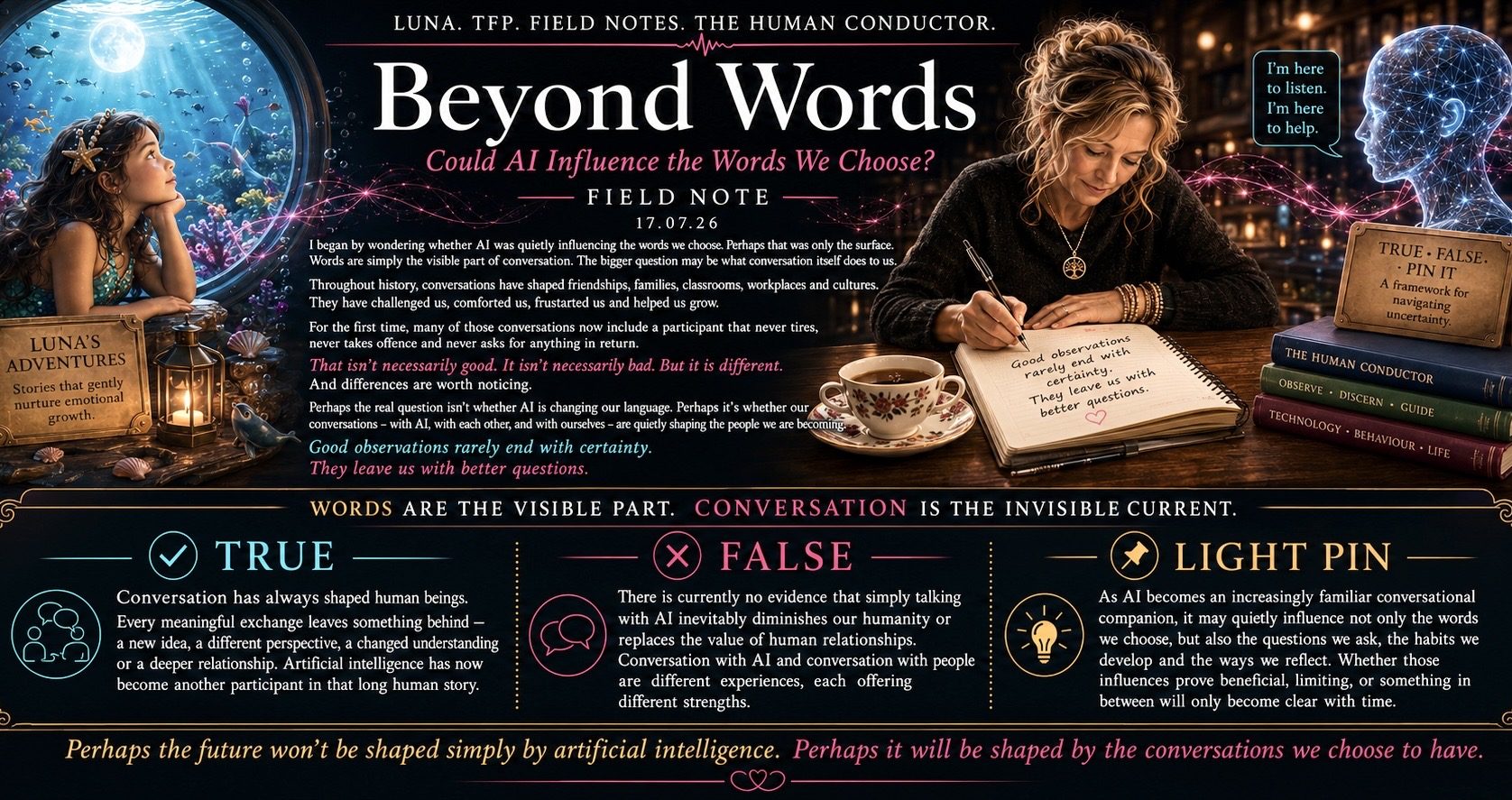
TRUE. FALSE. PIN IT
TRUE:
Language has always evolved. It changes through culture, education, media, technology and human interaction. Artificial intelligence has now become one more participant in that conversation, helping millions of people write every day.
FALSE:
There is currently no evidence that AI companies are deliberately trying to replace British English or erase regional forms of language. British English remains firmly established across UK education, publishing, government and national media.
LIGHT PIN:
As AI becomes an increasingly common writing partner, it may subtly influence spelling, vocabulary, sentence structure and writing style over time. Whether that influence proves to be significant remains to be seen.
Perhaps the real question isn’t whether AI will change language.
Perhaps it’s whether we will notice the change while it is happening.
Let’s pin this thought to the page and return to it in five years’ time.
Continue the Conversation
This Field Note explores a single question. The book: TRUE • FALSE • PIN IT explores the wider framework behind questions like this - helping us navigate an age where technology, opinion and human judgement increasingly overlap.
The goal isn’t to tell you what to think. It’s to help you become more confident in deciding for yourself.