TFP Field Note - Date Stamp: 19.07.2026
If You Could Press the Red Button - Would You?
Imagine there was a single red button. Press it…
…and every artificial intelligence system disappears.
- No ChatGPT.
- No Gemini.
- No Claude.
- No AI-generated images.
- No autonomous agents.
- Nothing.
Would you press it?
I recently listened to an interview with AI researcher Daniel Kokotajlo. Given that he has publicly expressed concerns about the future trajectory of advanced AI, I expected his answer to be immediate.
It wasn’t. He paused. He thought carefully. Then he said something that surprised me.
“No.”
He wouldn’t eliminate AI. He would pause it.
Long enough for humanity to better understand what it has created. That distinction stayed with me.
Not because it answered the question. Because it changed the question. Perhaps the red button isn’t really testing what we think about AI. Perhaps it’s revealing what we value.
Some people would press it immediately. Some wouldn’t hesitate. Others, like Daniel, would choose neither acceleration nor elimination. They would choose understanding.
The more I thought about it, the more familiar it felt. Throughout history, transformative technologies have divided opinion.
The printing press.
Electricity.
Nuclear power.
The internet.
Social media.
Artificial intelligence may prove to be no different.
As AI becomes woven into everyday life, these conversations may gradually move beyond technology.
They may become political.
Economic.
Environmental.
Local.
One community may welcome a new AI data centre because it brings jobs and investment. Another may oppose it because of energy use, land, water or noise. Neither position is necessarily anti-AI. Neither is necessarily pro-AI. They’re simply balancing different values.
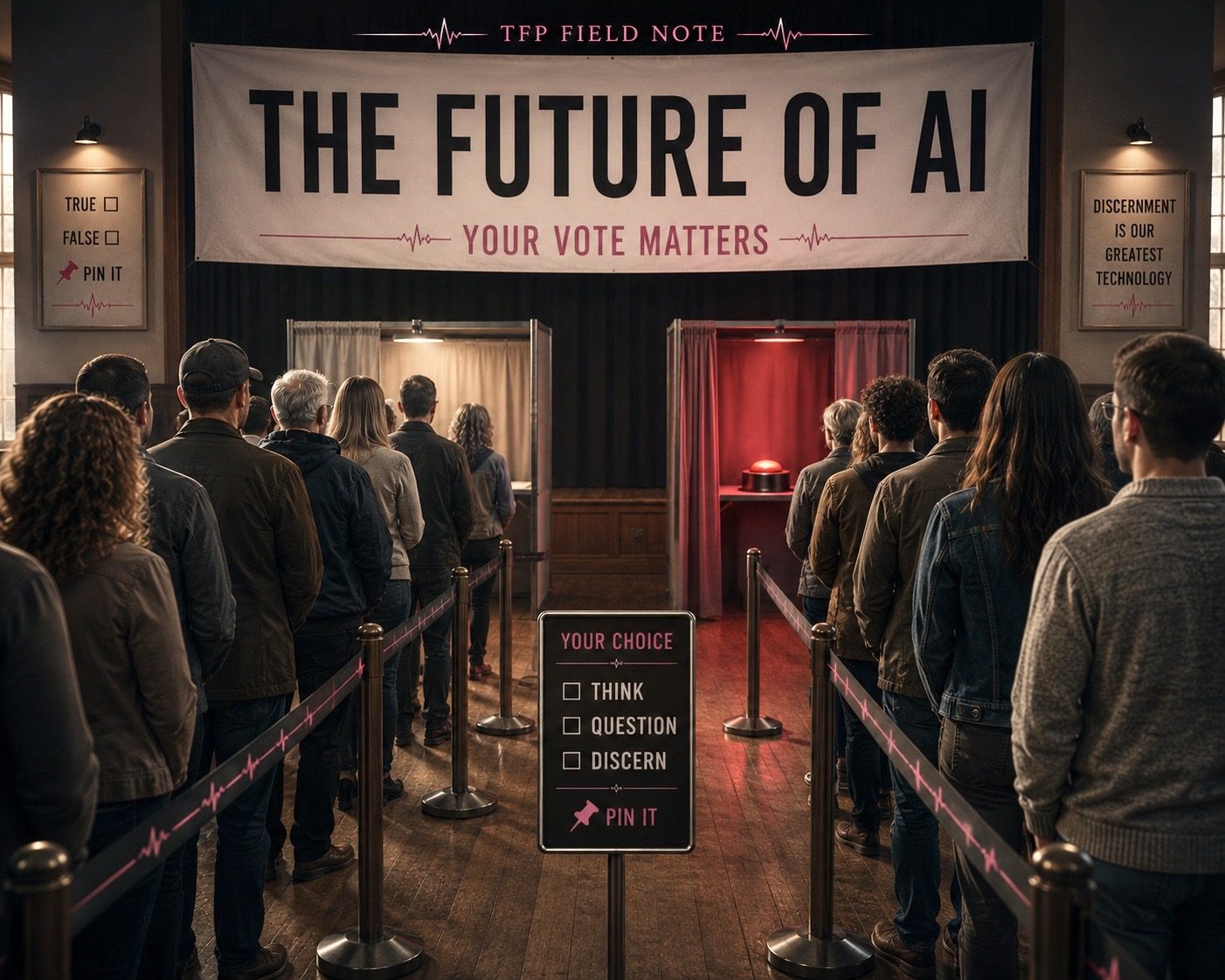
Perhaps one day, voting intentions won’t only be shaped by taxation, healthcare or immigration. They may also be influenced by where political parties stand on artificial intelligence - its pace, its regulation and its place in society.
Not because AI itself is political. But because every powerful technology eventually becomes part of public policy.
When that happens, our views on AI may become another way we express our hopes…
…and our fears…
…about the future.
Which brings me back to the red button. I’m not sure there is a right answer. Perhaps that’s precisely why it’s such a powerful question. It doesn’t simply ask what we think about artificial intelligence. It quietly asks what kind of future we’re hoping to build.
TRUE • FALSE • PIN IT
TRUE:
Artificial intelligence is already influencing public debate on employment, education, copyright, infrastructure, privacy, energy and national security. As its impact grows, it is likely to feature more prominently in democratic discussions and policy decisions.
FALSE:
The conversation is not simply divided between people who support AI and those who oppose it. Many people hold nuanced positions, embracing the potential benefits while also calling for stronger governance, safety measures and public oversight.
PIN IT:
As AI becomes more deeply integrated into society, public attitudes towards its development may increasingly influence voting behaviour and political priorities. Whether AI becomes a defining issue in future elections remains uncertain, but the trend is worth watching.
Continue the Conversation
This Field Note explores a single question. The book: TRUE • FALSE • PIN IT explores the wider framework behind questions like this - helping us navigate an age where technology, opinion and human judgement increasingly overlap.
The goal isn’t to tell you what to think. It’s to help you become more confident in deciding for yourself.