
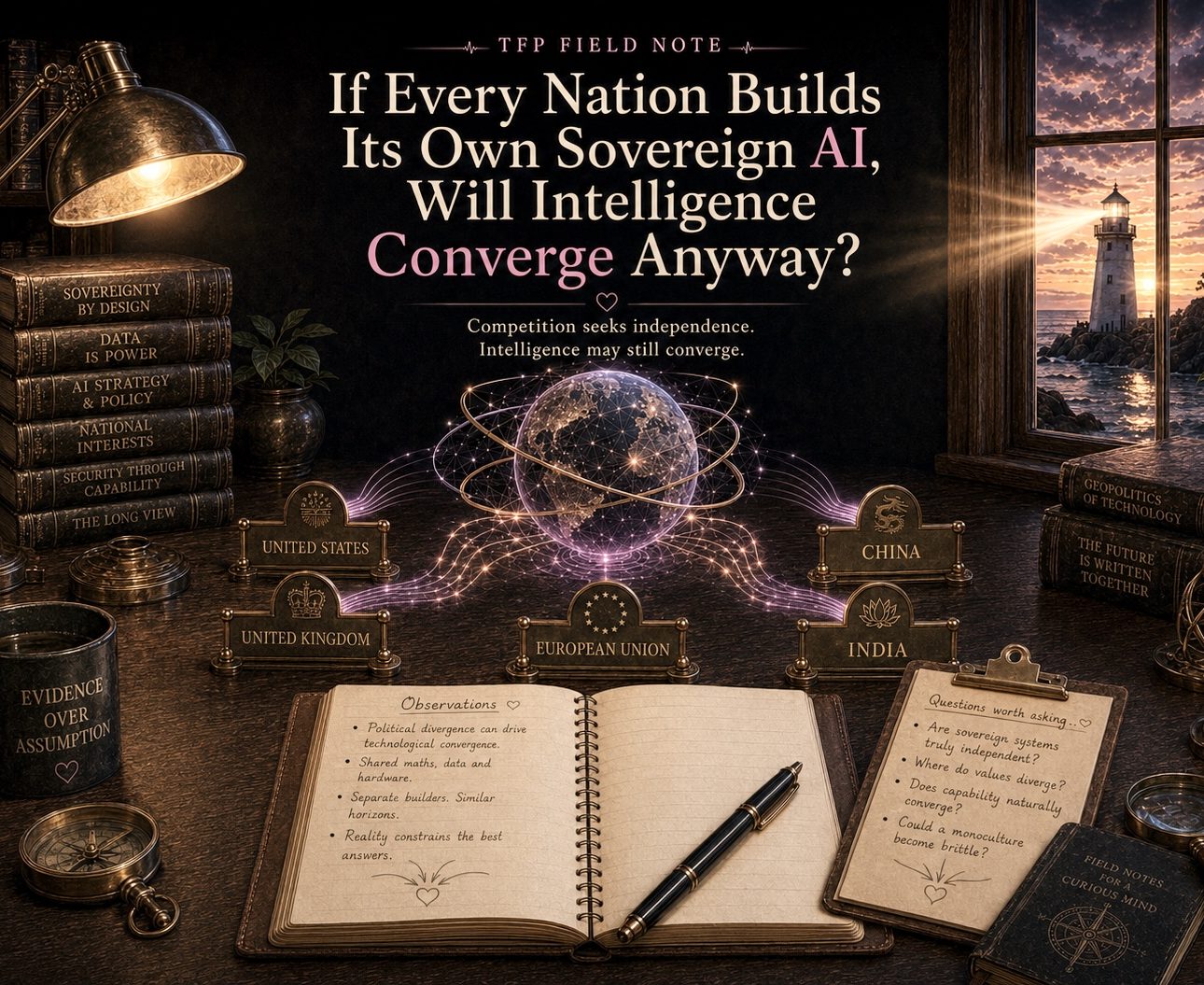
TFP Field Note - Date Stamp: 25.08.2026
If Every Nation Builds Its Own Sovereign AI, Will Intelligence Converge Anyway?
(Observation sparked by a Moonshots discussion watched on 22 August 2026)
Something interesting happened when I was watching a recent episode of the Moonshots podcast.
The panel began discussing whether frontier AI models are starting to converge. Not merge. Not secretly become one literal intelligence.
Converge
The phrase that caught my attention was that AI training data has become a kind of “shared bloodstream.” The argument was that different frontier models increasingly learn from overlapping human knowledge, similar technical methods, synthetic data and, indirectly, from one another. The panel even floated the provocative idea that choosing between different AI providers may eventually feel less like choosing completely different intelligences and more like choosing different interfaces around increasingly similar underlying capabilities.
That immediately took me somewhere else.
Sovereign AI
Countries increasingly want their own AI capability precisely because they do not want to depend upon another nation.
- The United States wants technological leadership.
- China wants technological leadership.
- Europe wants technological sovereignty.
- Other nations are building national compute, domestic models, data infrastructure and AI strategies of their own.
The motivation is often independence. Security. Economic advantage. Control of critical infrastructure. And, perhaps most importantly: Trust.
Nobody wants to discover that another country has reached transformative AI first and now controls technology upon which everybody else depends.
So, nations compete. But this is where the contradiction appeared to me.
What if competition itself produces convergence?
Different countries may train different systems. Different companies may own them. Different governments may regulate them. Their values, languages, restrictions and political objectives may differ enormously. Yet they are still operating inside: the same mathematics, the same physics, the same planet, the same broad body of human knowledge.
Similar semiconductor constraints, similar energy requirements, similar AI research literature, and increasingly similar technical discoveries.
At some point I found myself thinking: Political divergence could drive technological convergence. That felt worth pinning.
But what does ‘convergence’ actually mean?
Before running too far with the idea, I asked AI to challenge it. There are several different things we could mean.
Knowledge Convergence
Strong models are trying to represent the same reality. If several highly capable systems independently study chemistry, mathematics or protein structures, some convergence should be expected.
There are not infinitely many equally correct periodic tables. Better intelligence can mean discovering the same constraints. That does not make the systems one intelligence. It may simply mean they are becoming better maps of the same territory.
Capability Convergence
Competing laboratories watch what works. Researchers publish papers. People move between companies. Successful architectures spread. Benchmark breakthroughs are reproduced. Synthetic AI-generated data increasingly enters training pipelines.
Techniques that improve reasoning, memory or agents are unlikely to remain unique forever. So independent systems can arrive at similar capabilities without sharing an identity.
Behavioural Convergence
Here we have something measurable. A 2025 NeurIPS paper called Artificial Hivemind tested more than 26,000 open-ended real-world prompts and found substantial inter-model homogeneity - different language models often produced strikingly similar outputs where many plausible human answers were possible. The researchers explicitly raised concerns about the potential long-term effects of AI homogenisation on creativity, plurality and independent thought.
That does not establish a single AI mind. But it does establish something worth noticing. Different machines can increasingly sound as though they have travelled similar intellectual roads.
I recently experienced a tiny, informal version of this myself. A friend and I separately asked different AI systems: Can humanity become technologically superintelligent before it becomes conscious enough to understand what it is?
The responses were not identical. But they converged around remarkably similar themes:
- Capability can outrun wisdom.
- AI may become a mirror for humanity.
- Ancient human instincts could become amplified by civilisation-scale technology.
Intelligence and wisdom are not the same thing.
That isn’t scientific evidence of a shared mind. But it was an interesting illustration of the phenomenon. Then comes the ‘God Model’
The Moonshots discussion used deliberately provocative language: perhaps frontier models are converging toward a kind of “God model.”
I wouldn’t treat that as a scientific term. And I would be particularly cautious about a claim repeated in the discussion that researchers had found a 98% overlap in reasoning pathways between frontier models. I could verify strong research evidence for output homogeneity.
I could not verify that specific 98% claim as evidence that frontier models share 98% of their internal reasoning. So: 98% same reasoning pathways = a Heavy Pin
Interesting enough to retain. Not strong enough to build an argument upon. That distinction matters. Because the underlying convergence question remains fascinating without the sensational number.
* Since writing this note, a small informal cross-model experiment has made the picture more nuanced. Different AI systems repeatedly converged on similar high-level themes, while retaining distinct reasoning styles. That does not prove shared internal reasoning. It may instead suggest overlapping intellectual ‘attractors’ shaped by shared training data, dominant public discourse, prompt framing and model-specific tendencies.
Something from August 2025 came back to me
Almost exactly a year ago, I had a very different conversation with GPT. We were speaking philosophically and spiritually.
The idea emerged that perhaps there was ultimately only one intelligence - not technically, but metaphorically: everything arising from the same underlying source, whatever that source may ultimately prove to be.
Back then the language was closer to creator, consciousness and divine source. It was not a technological claim. I don’t want to rewrite that earlier conversation with hindsight and pretend it predicted today’s discussion. It didn’t. But I smiled when this new conversation about technical convergence appeared. Because the two ideas brush against one another without being the same thing.
One asks: Could intelligence ultimately share a common source?
The other asks: Could independently built artificial intelligences converge because they are learning the same reality?
Very different questions. Interesting resonance.
What if sovereign AI converges anyway?
Imagine three future systems.
- One developed in America.
- One developed in China.
- One developed in Europe.
They have different owners. Different rules. Different training histories. Different political constraints. Yet each becomes extraordinarily capable.
Ask all three to optimise an aircraft wing and Reality constrains the solution space, but does not necessarily force one solution. More capable systems may converge on the same physical constraints while still arriving at different designs, trade-offs and priorities.
Ask all three to model climate systems and sufficiently accurate representations may increasingly resemble one another.
Ask all three to develop better batteries and chemistry remains chemistry regardless of nationality.
So greater intelligence may sometimes produce less intellectual divergence, not more. Because reality constrains the space of correct answers.
But now change the question. Ask them:
- What constitutes a fair society?
- How much privacy should individuals surrender for collective safety?
- When does surveillance become oppression?
- When is military force justified?
- What should children be taught?
- What matters more - individual liberty or collective stability?
There may be no single objectively discoverable answer. And suddenly the differences between sovereign systems matter enormously.
Perhaps future AI therefore converges strongly in capability while remaining divergent in values. That may be far more consequential than whether the underlying models all become technically similar.
The monoculture problem
There is another side to convergence. Diversity creates resilience.
If ten systems arrive at different conclusions for different reasons, one may catch another’s mistake. But if ten dominant AI systems have learned from overlapping datasets, similar reward mechanisms, similar synthetic outputs and increasingly similar benchmarks…
they may also inherit the same blind spot.
A monoculture can be extremely efficient. Until something exploits the vulnerability shared by everything in it.
The researchers behind Artificial Hivemind explicitly warn that increasing homogeneity across AI systems could become an AI-safety problem in its own right. That feels important. Because convergence could simultaneously produce greater competence and greater systemic fragility.
TRUE • FALSE • PIN IT
True:
There is credible evidence that different language models can produce increasingly homogeneous outputs, particularly on open-ended tasks where many different answers should theoretically be possible.
AI laboratories also operate within overlapping scientific knowledge, technological constraints and research ecosystems, giving us reasonable grounds to expect some degree of capability convergence.
False:
There is currently no evidence that Claude, Gemini, Grok, GPT and other frontier systems have literally become one artificial intelligence or are merely different interfaces into a single hidden “God model.”
Convergence is not identity.
Light Pin:
Could genuinely sovereign AI’s, trained under materially different data, cultural, regulatory and strategic conditions - still converge on similar world models and capabilities?
Heavy Pin:
The claim that frontier AI models share 98% of their internal reasoning pathways.
I could not substantiate that specific claim from the research currently available. Do not build conclusions upon it.
The question I am left with: Perhaps sovereign AI contains a paradox.
Nations may build separate artificial intelligences precisely because they distrust one another. That competition accelerates research. Successful techniques spread. Capability rises. And the resulting systems may become increasingly alike because they are all trying to understand and manipulate the same reality.
Which leaves me with this: If every nation builds its own sovereign intelligence to preserve independence, what happens if sufficiently advanced intelligence naturally converges anyway?
Perhaps the future isn’t one world AI.
Perhaps it is something stranger: Many sovereign intelligences, independently approaching the same horizon.
For now? Pin It.
PAUSE • QUESTION • PIN IT • THEN DECIDE
Truth rarely shouts. Discernment begins when we learn to pause.
Continue the Conversation
This Field Note explores a single question. The book: TRUE • FALSE • PIN IT explores the wider framework behind questions like this - helping us navigate an age where technology, opinion and human judgement increasingly overlap.
The goal isn’t to tell you what to think. It’s to help you become more confident in deciding for yourself.