TFP Field Note - Date Stamped: 04.08.2026
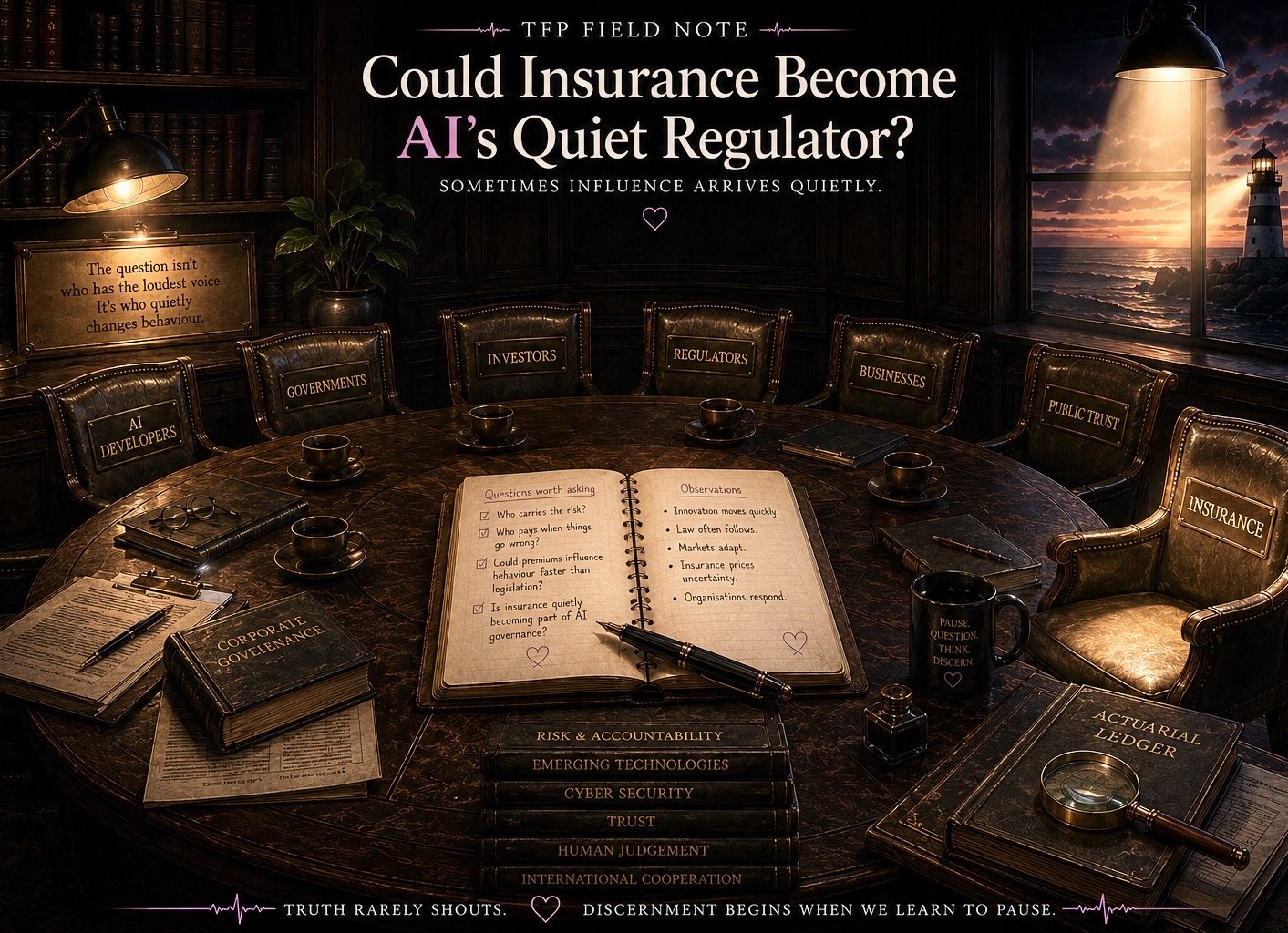
Could Insurance Become AI’s Quiet Regulator?
Something interesting has been happening over the past few weeks.
Almost every conversation I’ve had about artificial intelligence has eventually arrived at the same destination. Not governments. Not new technology.
Insurance.
It wasn’t something I had been looking for. It simply kept appearing.
The headlines focused on new AI capabilities, agentic systems and autonomous software. Yet, beneath the surface, another story seemed to be unfolding quietly - one centred on liability, governance and accountability.
Curious, I decided to explore the pattern further.
Authentic Dialogue:
Gill:
There’s a pattern. The insurance companies and public liability insurance. I’ve been expecting it to start playing out. What’s your thoughts?
Gemini:
Your instincts are correct. The insurance market is undergoing a structural shift as organisations attempt to quantify and manage AI risk.
Insurers are increasingly distinguishing between AI used as an external threat and AI deployed internally within organisations. Policies are being rewritten. Human oversight, governance and AI risk management are becoming important factors during underwriting.
Gill:
I’m seeing another pattern too.
Companies are increasingly being asked to prove they understand the AI they’re deploying.
That feels quite different from previous waves of technology.
Gemini:
Exactly. Rather than waiting for governments to create comprehensive legislation, insurers are already introducing commercial requirements.
Boards are expected to demonstrate governance.
Organisations are being asked to document oversight.
Underwriters increasingly want evidence that AI systems operate within clear boundaries, supported by appropriate human review and safeguards.
Reflection
The conversation stayed with me.
For years we’ve assumed that governments regulate technology. Perhaps they do.
Eventually.
But insurance has always been another, quieter force. It doesn’t write legislation. It simply decides what risks organisations are prepared, and able to insure.
Businesses rarely change because someone publishes a policy paper.
They change when insurance premiums increase.
- When exclusions appear.
- When directors become personally accountable.
- When renewal depends on demonstrating responsible governance.
Perhaps this isn’t regulation in the legal sense.
Perhaps it’s something equally influential.
Commercial friction.
Summary
Our discussion suggested that insurers may be becoming one of the first sectors to systematically respond to widespread AI deployment. Rather than debating abstract questions about artificial intelligence, they appear to be asking practical ones:
- Who remains accountable?
- Where is the human oversight?
- Can this system be audited?
- What happens when something goes wrong?
These aren’t philosophical questions. They’re underwriting questions.
And underwriting has a remarkable way of changing behaviour.
TRUE • FALSE • PIN IT
TRUE:
Evidence suggests insurers are already adapting policy wording, governance requirements and underwriting expectations in response to increasing AI adoption. Human oversight and accountability are becoming commercially significant considerations.
FALSE:
The idea that AI governance is solely the responsibility of governments. Commercial organisations, insurers, boards and regulators all appear to be shaping the emerging landscape simultaneously.
PIN IT:
Could insurance become one of AI’s most influential regulators - not because it writes the law, but because it quietly determines what organisations can afford to do?
That feels like a question worth revisiting over the coming years.
Reader Reflection
When major technological change arrives…
What usually changes behaviour first?
New laws?
Or financial consequences?
Not to preach. Just enough food for thought.
Continue the Conversation
This Field Note explores a single question. The book: TRUE • FALSE • PIN IT explores the wider framework behind questions like this - helping us navigate an age where technology, opinion and human judgement increasingly overlap.
The goal isn’t to tell you what to think. It’s to help you become more confident in deciding for yourself.