
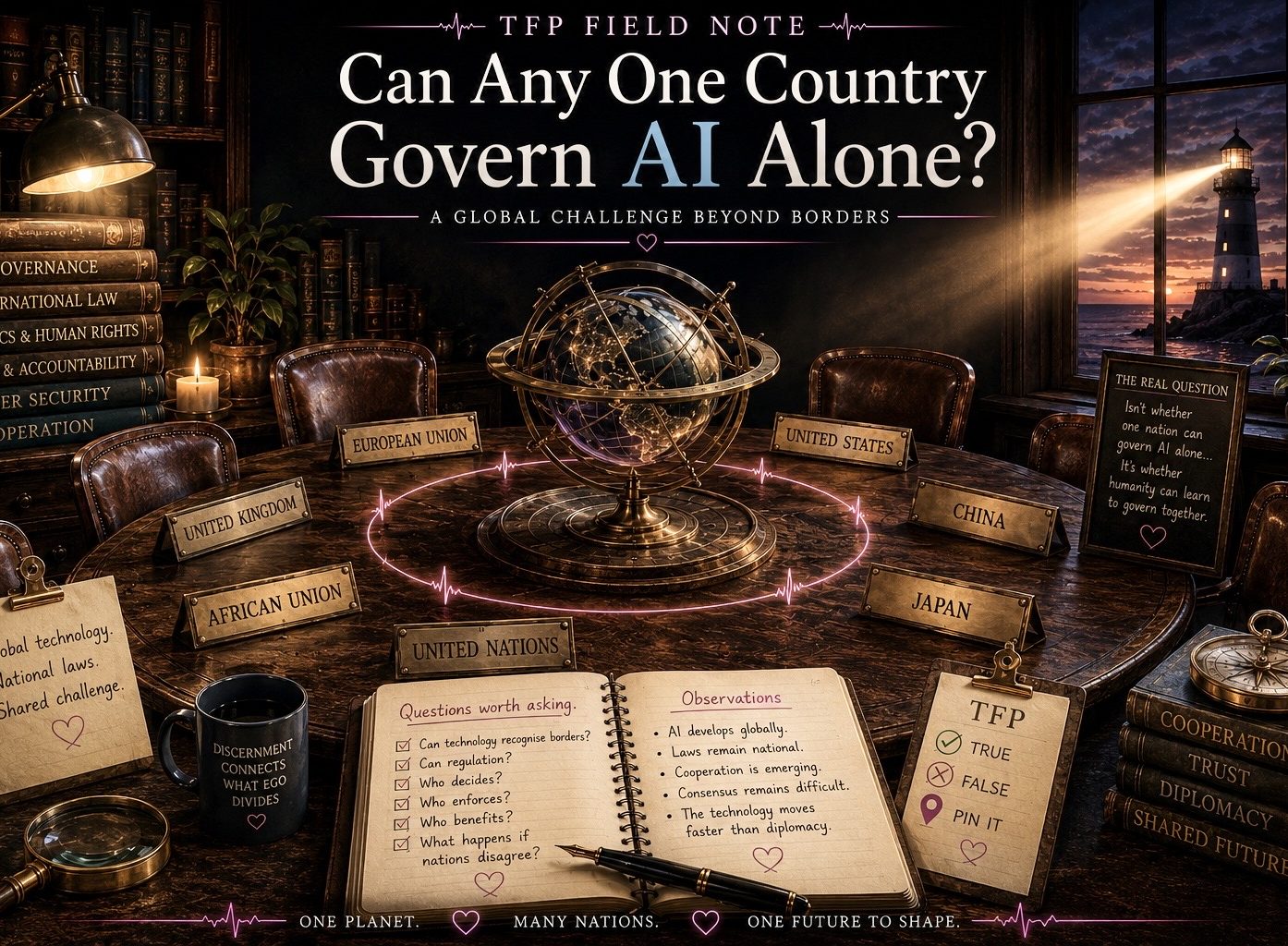
TFP Field Note - Date Stamped: 04.08.2026
Can Any One Country Govern AI Alone?
The more I explore artificial intelligence, the more one question keeps returning.
Not whether AI should be governed. But whether any single country can realistically do it alone.
Every week seems to bring another announcement.
- New regulations.
- New investments.
- New models.
- New international partnerships.
Yet AI doesn’t recognise national borders. A model trained in one country can be deployed in another, hosted somewhere else, and used simultaneously by millions of people around the world. That raises an uncomfortable question.
Can governance ever move as quickly as the technology itself?
Authentic Dialogue:
Gill:
It feels as though countries are each trying to solve the same problem independently.
I wonder whether AI is becoming one of those challenges that no single nation can realistically govern on its own.
Gemini:
That’s one of the central governance questions emerging today. AI development is increasingly global, while regulation remains largely national. Models, data, infrastructure and organisations frequently operate across multiple jurisdictions.
This creates significant coordination challenges.
Gill:
History tells us that technologies don’t stop at borders. If one country introduces strict controls while another doesn’t, innovation and sometimes risk - simply moves elsewhere.
Gemini:
That tension is widely recognised.
Many experts argue that international cooperation will become increasingly important, although achieving meaningful agreement between nations with different priorities will be extremely challenging.
Reflection
I found myself thinking about other global challenges.
- Climate change.
- Nuclear technology.
- International aviation.
- Cybersecurity.
None of them are governed by a single nation. Instead, they rely on imperfect cooperation, evolving agreements and shared standards. AI may prove similar.
Not because every country sees the technology in the same way. But because its consequences rarely stop at national borders. Perhaps one of the greatest challenges won’t be creating powerful AI. It will be creating sufficient trust between nations to manage it responsibly.
Summary
As AI capabilities accelerate, governments face a familiar dilemma.
Move too slowly…
…and innovation may outpace oversight.
Move too quickly…
…and regulation may simply shift activity elsewhere.
Neither extreme feels entirely satisfactory. Which is why conversations about international standards, cooperation and shared governance continue to gather momentum.
Whether they succeed remains an open question.
TRUE • FALSE • PIN IT: Can Any One Country Govern AI Alone?
TRUE:
Artificial intelligence is increasingly developed, deployed and used across international boundaries. This creates governance challenges that extend beyond the jurisdiction of any single country.
FALSE:
The assumption that one nation alone can comprehensively govern a technology whose development, infrastructure and deployment are inherently global.
PIN IT:
Could AI ultimately require forms of international cooperation similar to those developed for aviation, nuclear technology and cybersecurity?
If so, building trust between nations may prove every bit as important as building the technology itself.
Reader Reflection
When technology becomes global…
Should governance remain national?
Or does a different model eventually become necessary?
Not to preach. Just enough food for thought…
Continue the Conversation
This Field Note explores a single question. The book: TRUE • FALSE • PIN IT explores the wider framework behind questions like this - helping us navigate an age where technology, opinion and human judgement increasingly overlap.
The goal isn’t to tell you what to think. It’s to help you become more confident in deciding for yourself.