
TFP Filed Note - Date stamped 18.07.2026
AI Interaction - Speaking or Writing?
It began with a simple question: How are people interacting with AI LLM’s. Are they speaking or writing?
I realised that although I spend hours each week collaborating with AI, I almost never speak to it.
I write.
At first, I assumed it was simply habit. But the more I reflected, the more curious I became. Was I unusual? Had most people already embraced voice interaction, or did they, like me, still prefer the written word?
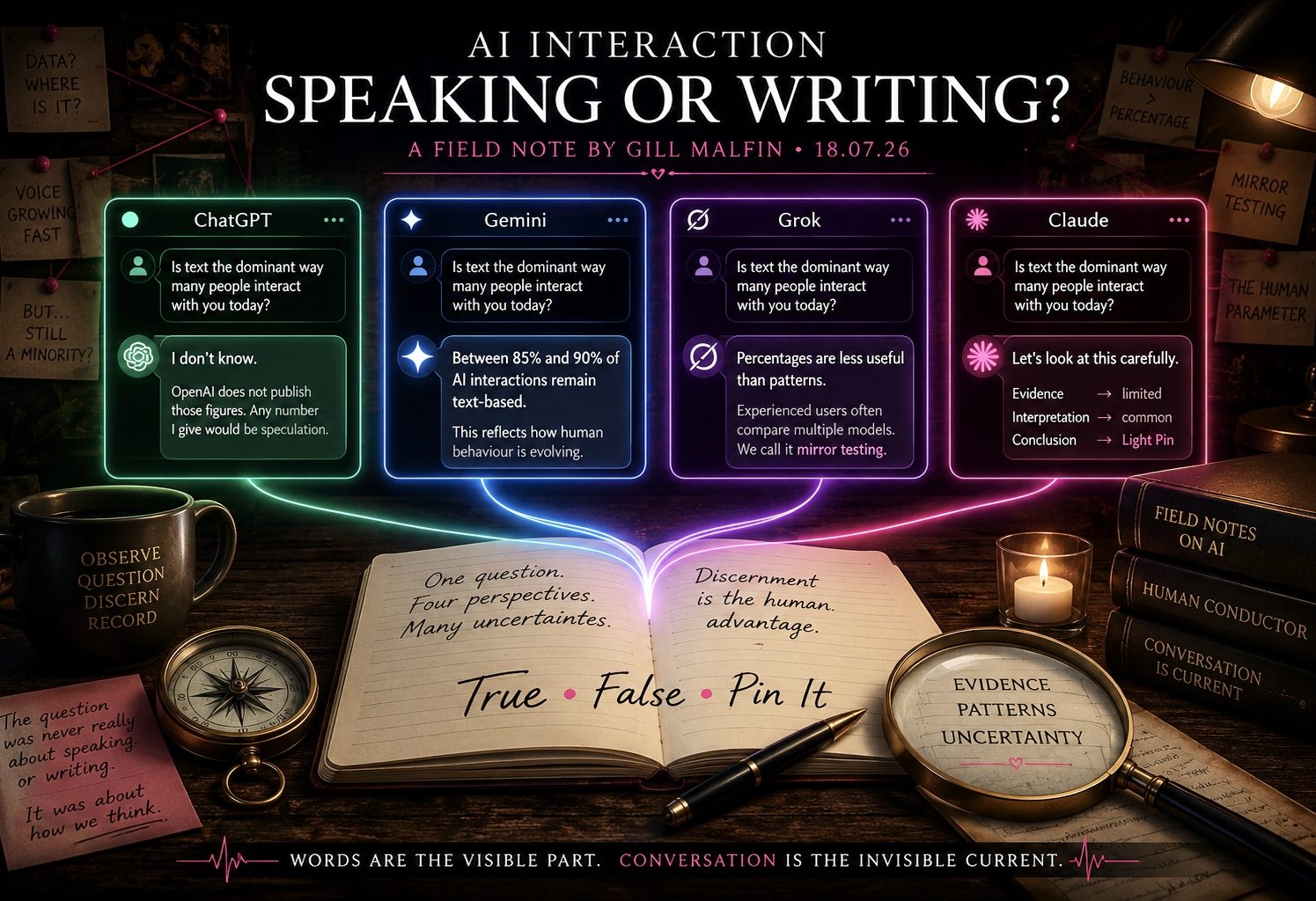
Rather than guessing, I decided to investigate. I posed the same question to four different AI models - ChatGPT, Gemini, Grok and Claude - not because I expected one definitive answer, but because I wanted to observe how each responded to the same enquiry.
“Is text the dominant way many people interact with you today?”
What followed became something far more interesting than a discussion about keyboards and microphones.
It became a study in uncertainty.
The first surprise was that none of the models could point to robust public evidence showing what percentage of people write to AI compared with those who speak to it. Despite voice interaction being heavily promoted by AI companies, reliable public figures appear surprisingly difficult to find.
That absence of evidence became my first observation. The second surprise was how differently each model responded to the same question.
Claude simply admitted it didn’t know. Rather than inventing a percentage, it acknowledged that Anthropic doesn’t provide those figures and suggested that any number it gave would be speculation.
Gemini took the opposite approach. It confidently suggested that between 85% and 90% of AI interactions remain text-based, presenting the figure as part of a broader explanation of human behaviour. It was an interesting claim, but when I explored the supporting references, I couldn’t satisfy myself that they justified such a precise statistic. I almost removed that estimate from my notes. Instead, I left it in.
Not because I accepted it as fact, but because the uncertainty surrounding it had become part of the investigation itself.
Grok shifted the conversation in a completely different direction. Rather than concentrating on percentages, it began describing behavioural patterns. It suggested that experienced AI users often compare multiple models, gradually develop their own ways of checking responses, and become more discerning over time. One phrase particularly caught my attention: “Mirror testing” - asking different AI systems the same question to see where they agree, where they differ, and what remains consistent.
Ironically, that was exactly what I had been doing.
ChatGPT responded by separating the observations into categories: what appeared well supported, what seemed unsupported, and what deserved a Light Pin until better evidence emerged. Rather than trying to resolve every uncertainty, it encouraged me to distinguish between evidence and interpretation.
Without intending to, the four models had demonstrated four different approaches to uncertainty. That became far more interesting than the original question.
As with every observation in this series, I then stepped back and applied my own True • False • Pin It (TFP) framework.
Not to decide which AI was “right”. But to weigh the evidence each had contributed.
Some observations felt well supported. Others remained interpretations. A few became Light Pins - ideas worth preserving until stronger evidence either confirms or challenges them.
The investigation also revealed something about me. Writing doesn’t simply record my thoughts. It slows them down. Unlike speech, writing allows me to pause, reconsider, edit and reflect before pressing send. My conversations with AI don’t feel like spoken dialogue. They feel more like a research journal - a place where ideas can emerge gradually, be questioned honestly, and occasionally be changed altogether.
Perhaps that is why I continue to write. Not because it is better than speaking. But because, for me, it creates the conditions for deeper enquiry. And perhaps that is the real Field Note.
The question was never really whether people write or speak to AI. It was how different forms of interaction - and different AI responses - shape the way we think.
TFP - Is text the dominant way many people interact with AI today?
TRUE:
There is good evidence that text remains the dominant way many people interact with today’s large language models. All four AI models independently suggested that text remains the primary mode of sustained interaction, although they differed in how confidently they expressed that view.
Text remains particularly well suited to long-form thinking, editing, coding, research and structured collaboration. However, there are no robust publicly available statistics confirming exactly what proportion of interactions are text versus voice.
FALSE:
It cannot currently be stated as fact that 85%, 90%, or any other precise percentage of AI interactions are text-based.
Although individual AI models offered numerical estimates, none were able to provide publicly verifiable evidence supporting those figures. At present, any specific percentage should be treated as an estimate rather than an established fact.
PIN IT:
The available evidence points towards text remaining the dominant form of interaction for sustained conversations today. However, this investigation also exposed something unexpected: despite the industry’s heavy investment in voice AI, transparent public data describing how people choose to interact remains surprisingly scarce.
LIGHT PIN:
Perhaps AI isn’t only changing how we communicate. Perhaps it is quietly revealing how different ways of communicating influence the way we think.
This is a subject worth revisiting in five or ten years’ time.
Continue the Conversation
This Field Note explores a single question. The book: TRUE • FALSE • PIN IT explores the wider framework behind questions like this - helping us navigate an age where technology, opinion and human judgement increasingly overlap.
The goal isn’t to tell you what to think. It’s to help you become more confident in deciding for yourself.