TFP Field Note - Date Stamp: 19.07.2026
AI Can’t Go to Prison
Over the past year, artificial intelligence has become remarkably capable. It can write. Design. Code. Research. Book appointments. Reply to emails. Negotiate with customer support. Soon, autonomous AI agents may perform many everyday tasks on our behalf.
As these systems become increasingly competent, one question quietly moves into the background.
Who remains responsible?
Because while AI can generate content… It cannot carry consequences.
For thousands of years, every tool humanity has created has shared one characteristic. The responsibility has always remained with the person using it.
A hammer can build a home. Or become a weapon.
A car can save time. Or cause an accident.
A computer can connect the world. Or launch a cyberattack.
The tool changes.
Responsibility doesn’t.
AI feels different because it speaks. It reasons. It appears to make decisions. Sometimes it even apologises. That can create an illusion. The illusion that responsibility has somehow moved from the human…
…to the machine.
It hasn’t.
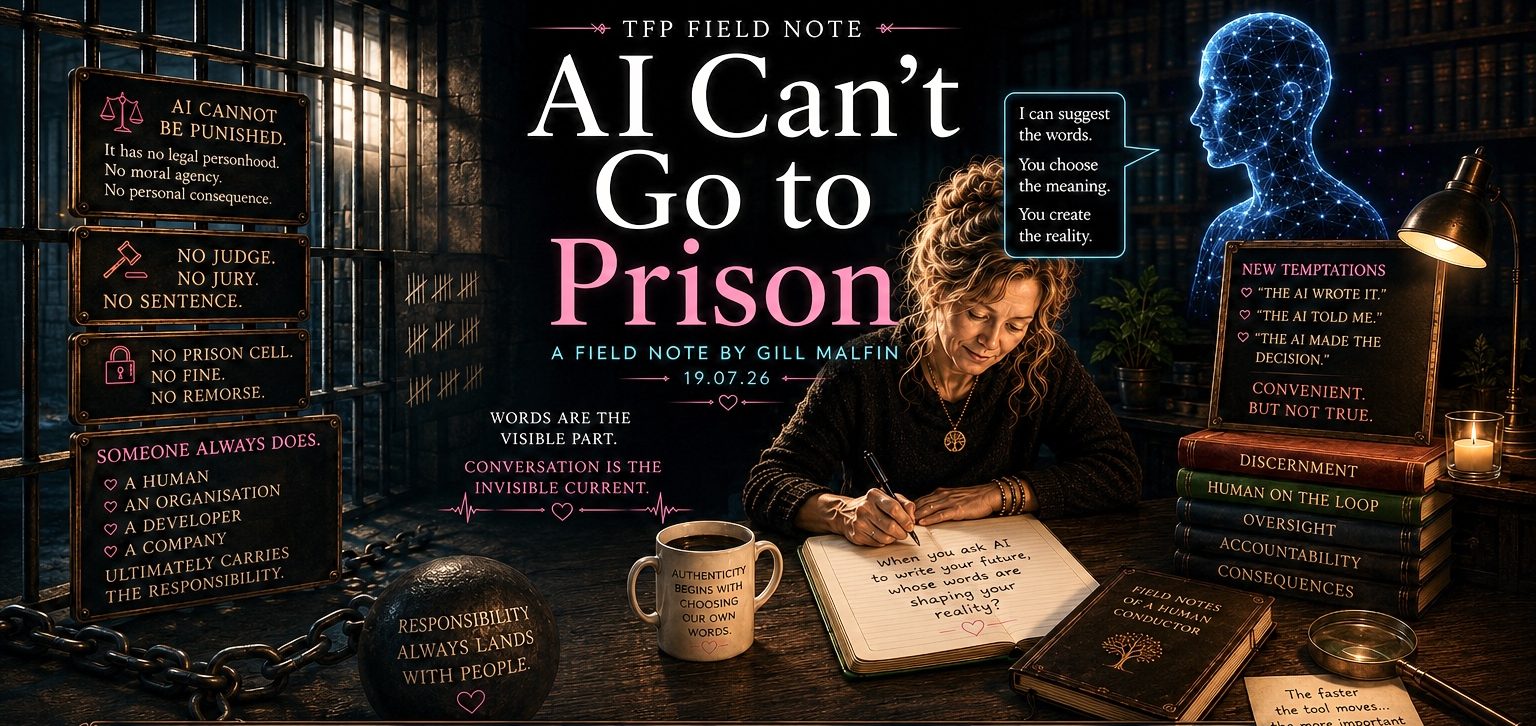
AI cannot be punished. If AI generates defamatory content… The AI doesn’t appear in court. If AI gives dangerous advice… The AI doesn’t receive a prison sentence.
If AI copies copyrighted work… The AI doesn’t pay damages.
Some human… Some organisation… Some developer… Some company…
Ultimately carries the responsibility. The machine never does.
That single observation changes almost every conversation about AI.
The New Temptation
Perhaps the greatest risk isn’t malicious AI. It’s delegated responsibility.
Imagine saying: “The AI wrote it.” Or… “The AI told me.” Or… “The AI made the decision.”
These sentences sound harmless. Yet each one quietly shifts accountability away from ourselves. The technology may be new. The psychology isn’t. Humans have always found ways to distance themselves from difficult decisions. AI simply provides a remarkably convincing new mechanism.
We’ve all experienced it. Trying to cancel a subscription. Reading twenty pages of terms and conditions. Searching endlessly for the “Cancel” button. Being greeted by an AI chatbot designed to keep you engaged just long enough that giving up becomes easier than leaving.
Who designed that experience?
Not the AI.
Humans did.
The AI is simply performing the role it has been given. Which means responsibility still lands exactly where it always has. With people.
AI agents introduce something new. Not intelligence. Autonomy.
When software begins completing tasks without asking permission every step of the way, human oversight becomes more, not less important.
The faster the tool moves…
…the more important it becomes to know who can interrupt it.
Perhaps the defining question of the AI age isn’t: “Can AI make decisions?”
Perhaps it is: “Will humans continue taking responsibility for the decisions made in their name?”
TRUE • FALSE • PIN IT
TRUE:
AI is a powerful tool, but responsibility for its use remains with humans and organisations. Today, legal systems generally hold people, companies and institutions accountable, not AI itself. Human oversight remains essential wherever AI influences important decisions.
FALSE:
AI cannot currently own responsibility in the human sense. It has no legal personhood, no moral agency, no capacity to experience consequences or accept punishment. It may produce outputs, but it does not bear accountability for them.
PIN IT:
As AI agents become more autonomous, society may eventually revisit questions about legal frameworks, liability and governance. Whether existing laws remain sufficient, or whether entirely new models of responsibility emerge, is still unfolding.
LIGHT PIN:
The most valuable skill of the AI era may not be learning how to prompt machines.
It may be remembering when to say: “The responsibility still belongs to me.”
Continue the Conversation
This Field Note explores a single question. The book: TRUE • FALSE • PIN IT explores the wider framework behind questions like this - helping us navigate an age where technology, opinion and human judgement increasingly overlap.
The goal isn’t to tell you what to think. It’s to help you become more confident in deciding for yourself.