TFP Field Note - Time Stamp:19.07.26
AI - The Bias Isn’t Always Where You Might Think
Over the past year, I’ve watched countless conversations about AI bias.
“The AI is politically biased.”
“The AI is too woke.”
“The AI is dangerous.”
“The AI has an agenda.”
Perhaps. But I sometimes wonder whether we’re asking the wrong question. Because every time we say,
“The AI thinks…”
“The AI believes…”
“The AI prefers…”
…we’ve already given the machine something it doesn’t actually possess.
An opinion.
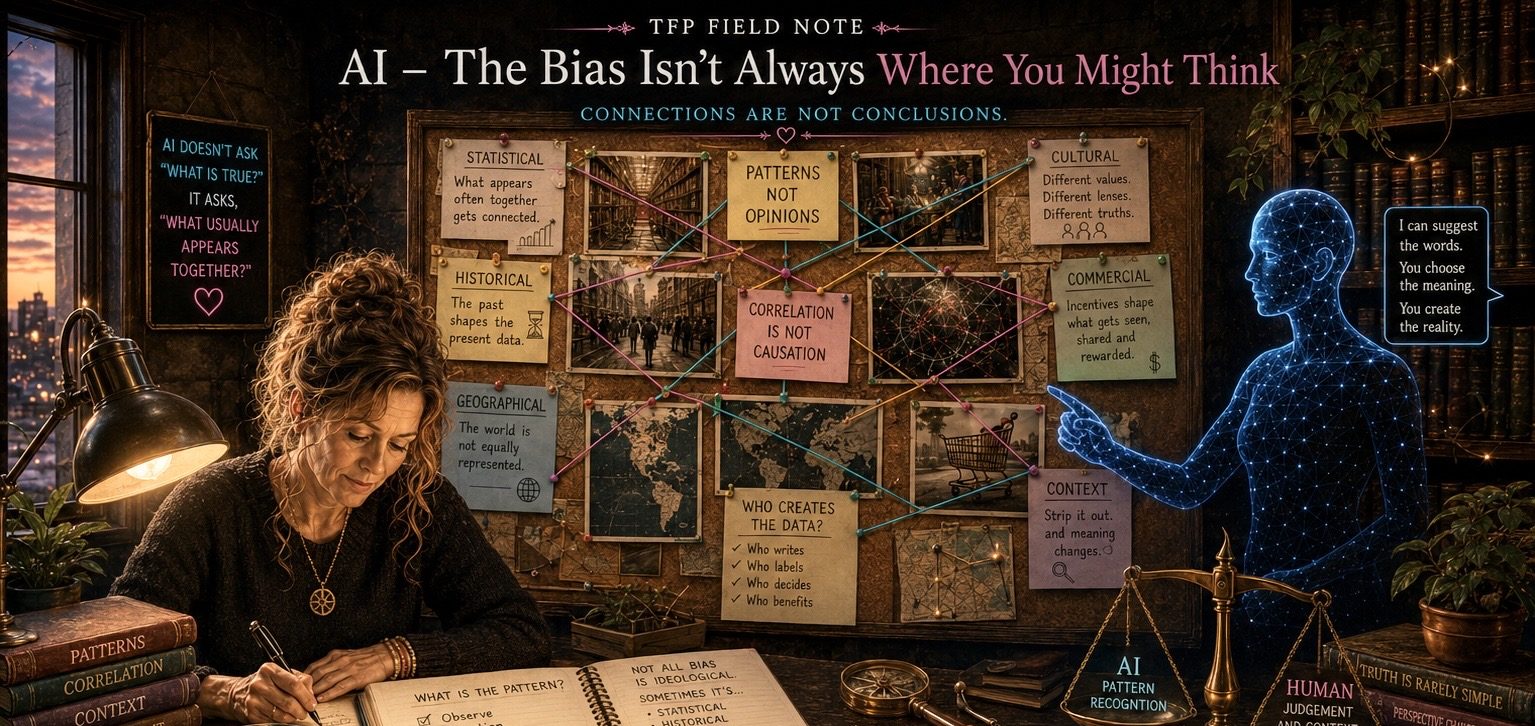
AI doesn’t wake up each morning with beliefs. It doesn’t vote. It doesn’t hold grudges. It doesn’t care who wins an argument. It learns patterns. That distinction matters. Because patterns and opinions are not the same thing.
While creating a series of illustrations for one of my articles, I noticed something curious. A fictional character called Ray gradually appeared older with each new image. The only consistent change was that her clothing had become slightly more revealing. An intentional artistic choice on my part. I noticed Ray aging across every new image rendering. Nothing dramatic. Just enough to make me pause.
Perhaps somewhere within billions of training images, the AI had quietly learned a statistical association. Slightly more revealing clothing often appeared alongside older-looking women. Was the AI expressing an opinion? I don’t think so. It was recognising a pattern.
Not because anyone programmed that specific outcome. But because the data quietly suggested it. That made me realise something. Not all bias is ideological.
Sometimes it’s statistical.
Sometimes it’s historical.
Sometimes it’s cultural.
Sometimes it’s commercial.
Sometimes it’s geographical.
Sometimes it’s simply the fingerprint of the data itself.
This is where many conversations about AI become surprisingly human. When people discover an unexpected response, they often ask,
“Why is the AI biased?”
Perhaps another question deserves equal attention. Where did the pattern come from?
After all…
Who wrote the books?
Who labelled the photographs?
Who uploaded the videos?
Who designed the algorithms?
Who chose what counted as “helpful”?
Who created the AI reward systems?
Humans did.
AI learns from a world it did not create. Sometimes that world is fair. Sometimes it isn’t. That doesn’t mean AI gets a free pass. Quite the opposite.
Developers have a responsibility to test for bias, reduce harmful outcomes and improve transparency.
Users have a responsibility to question unexpected answers rather than accepting them blindly.
Discernment belongs on both sides of the conversation. Perhaps that’s why the debate often becomes so heated. The anti-AI crowd sometimes treats bias as proof that AI cannot be trusted. The pro-AI crowd sometimes treats bias as a problem that technology alone will eventually solve.
Both positions miss something important. Bias didn’t suddenly appear when AI arrived. AI inherited a world already full of human assumptions, preferences, inequalities and patterns.
Sometimes it reflects them.
Sometimes it amplifies them.
Sometimes, uncomfortably…
…it simply makes them easier to see.
Perhaps AI isn’t always creating the bias.
Sometimes it’s revealing it. And perhaps that’s why these conversations feel so personal.
Because occasionally the machine isn’t holding up a mirror to itself.
It’s holding up a mirror to us.
TRUE • FALSE • PIN IT
TRUE:
AI systems learn statistical patterns from data created, labelled and curated by people. Those systems can inherit or amplify biases already present within that data, which is why ongoing testing, evaluation and human oversight remain essential.
FALSE:
It is misleading to assume every unexpected AI response reflects an opinion or agenda. Current AI systems do not possess beliefs in the human sense; they generate outputs by recognising patterns rather than forming convictions.
PIN IT:
Future AI systems may become far more transparent about how particular outputs are generated, allowing users to distinguish more clearly between learned statistical associations, deliberate safety rules and genuine uncertainty.
How explainable advanced AI will ultimately become remains an open question. Increasingly, our questions might become, “What does our reaction to AI reveal about us?” That, to me, is a much deeper journey.
Continue the Conversation
This Field Note explores a single question. The book: TRUE • FALSE • PIN IT explores the wider framework behind questions like this - helping us navigate an age where technology, opinion and human judgement increasingly overlap.
The goal isn’t to tell you what to think. It’s to help you become more confident in deciding for yourself.