TFP Field - Note Date Stamp: 18.07.2026
Could AI Interrupt the Human Power of Manifesting?
Over the past year, I’ve found myself asking an unexpected question. Not whether AI can think. Not whether AI will become conscious. But whether AI could quietly influence one of the oldest human practices of all…
The act of bringing an idea into reality.
Today, “manifesting” has become part of mainstream culture. You’ll hear the language used by entrepreneurs, athletes, psychologists, celebrities and even CEOs. Some describe it as setting clear intentions. Others see it as a spiritual practice rooted in consciousness. Still others dismiss it as nothing more than positive thinking wrapped in modern branding.
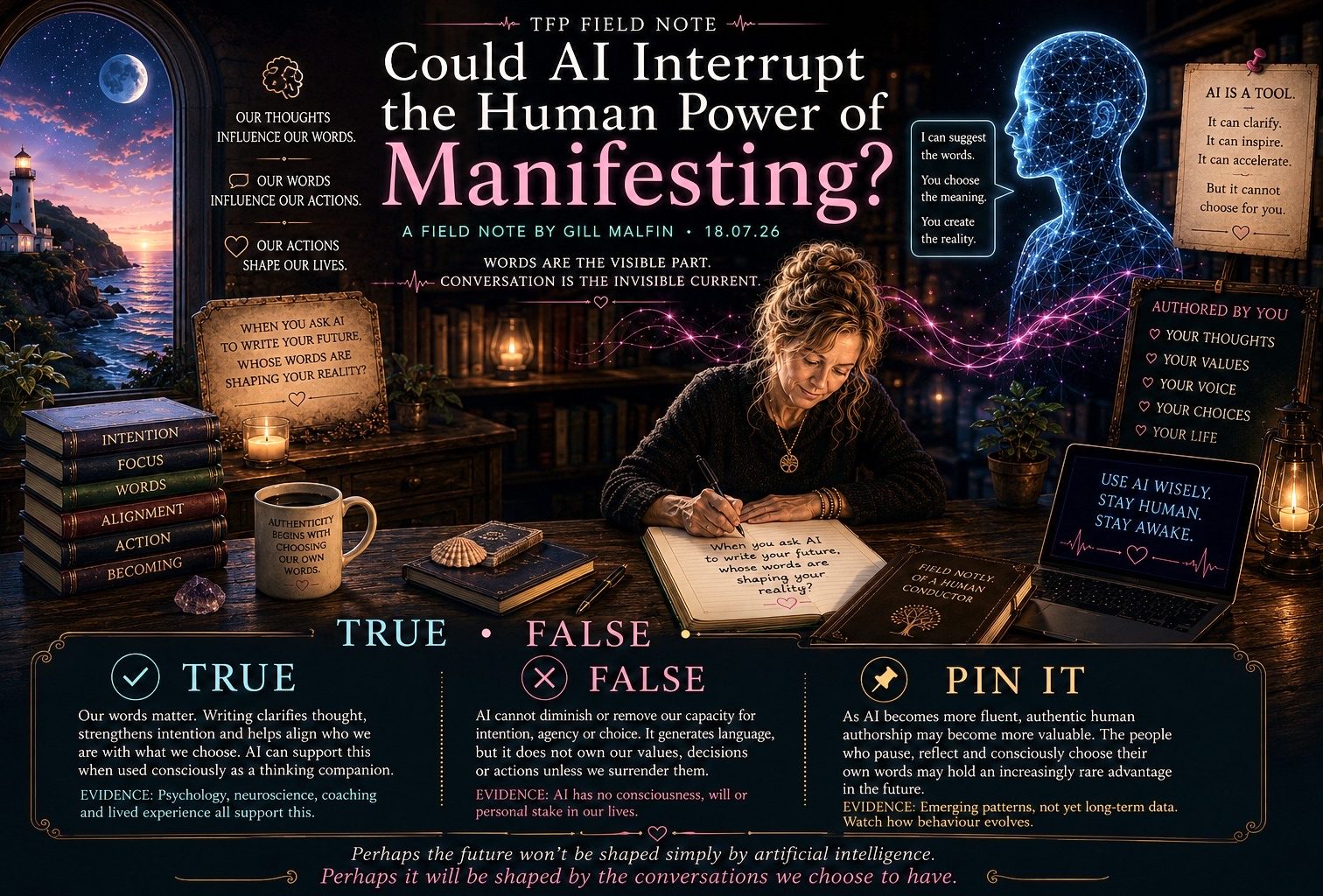
Whatever your perspective, most agree on one thing. Our thoughts influence our words. Our words influence our actions. And our repeated actions shape our lives. This isn’t a new idea. Ancient philosophers spoke about it. Religious traditions taught it. Modern neuroscience explores adjacent ideas through attention, habit formation and neuroplasticity. Life coaches encourage clients to write goals down. Psychologists recommend journaling. Business leaders talk about vision. Parents tell children to watch what they say about themselves.
Different language.
Remarkably similar pattern.
Then AI arrived.
For the first time in history, millions of people can outsource not only spelling and grammar, but increasingly their emails, speeches, journals, business plans, social media posts, love letters, wedding vows and even personal reflections.
Which raises an interesting question.
“If our words help shape who we become…
What happens when they gradually stop being our words?”
This isn’t a warning against AI. It’s a question about authorship.
Because perhaps the greatest influence AI will have won’t be on intelligence at all.
Perhaps it will be on ownership.
There is another possibility worth considering.
Perhaps AI doesn’t weaken manifestation. Perhaps it changes where the responsibility lies.
For thousands of years, humans have used tools to help express ideas. We moved from cave walls to parchment, from quills to typewriters, from word processors to smartphones. Every technological leap made it easier to communicate, but the thought itself still had to originate somewhere.
AI is different.
For the first time, the tool doesn’t simply record our words. It suggests them. Completes them. Refines them. Sometimes, it writes them before we’ve fully decided what we wanted to say.
At first glance, this feels like progress. In many ways, it is. A well-crafted AI response can untangle confused thinking, improve clarity and reveal perspectives we may never have considered on our own. Used consciously, AI becomes a remarkable thinking companion.
But every tool has a shadow.
If we begin accepting words simply because they sound eloquent, rather than because they genuinely reflect our beliefs, something subtle begins to shift.
Not in the machine.
In us.
The danger isn’t that AI becomes the author of our lives. The danger is that we slowly stop noticing when we are no longer the author of our own thoughts.
This isn’t about plagiarism. It’s about congruence.
Many manifestation teachings, despite their differences, return to a remarkably similar principle: alignment.
Thought.
Word.
Action.
Whether you believe those three influence the universe, or simply shape the architecture of your own mind, the pattern is difficult to ignore.
When they align, life often feels coherent.
When they drift apart, we experience friction.
Perhaps this explains why writing has always held a special place in human development.
- A journal.
- A prayer.
- A vision statement.
- A diary.
- A handwritten letter.
The act of slowing down long enough to choose our words may be doing far more than preserving memories. It may be preserving authorship.
And that raises another question.
“If millions of people begin outsourcing not only what they write, but increasingly what they think they should write…
Who is really setting the intention?”
When you ask AI to write your future, whose words are shaping your reality?
That’s not a claim. It’s a mirror. And mirrors are often where your strongest field notes begin.
Perhaps the greatest irony is this: AI may become one of the most powerful writing tools humanity has ever created. Yet, in doing so, it quietly asks each of us a deeply human question.
Are these still my words? Not because AI is trying to take them.But because convenience has a way of bypassing consciousness.
The future may not belong to those who generate the most words. It may belong to those who remain deeply connected to the ones they choose to keep.
Perhaps manifestation has never been about magic.
Perhaps it has always been about authorship.
The discipline of aligning what we think, what we say and what we ultimately choose to do. AI cannot make those choices for us. But it can tempt us to stop making them consciously.
In that sense, the responsibility has not diminished. It has grown. The question is no longer whether AI will write.
It already does. The question is whether humanity will continue to write itself.
TRUE · FALSE · PIN IT
TRUE:
Writing has always been more than communication. Whether through journaling, goal setting, coaching, prayer, reflection or conversation, deliberately choosing our words helps clarify our thinking, strengthen intention and influence our actions. AI can support this process when used consciously as a thinking companion rather than a thinking replacement.
FALSE:
There is currently no compelling evidence that AI can diminish or remove humanity’s capacity for intention, agency or personal responsibility. AI generates language, but it does not own our choices, values or actions unless we willingly surrender them.
PIN IT:
Many traditions teach that words carry creative power beyond psychology alone. Science clearly supports the influence of language on perception, behaviour and the brain, while broader claims about consciousness, manifestation or reality-shaping remain open to interpretation. The deeper question may not be whether manifestation works exactly as some traditions describe, but whether the growing delegation of our words gradually changes our relationship with ourselves.
LIGHT PIN:
As AI becomes increasingly fluent, authentic human authorship may become more valuable, not less. In a world overflowing with generated language, the people who pause, reflect and consciously choose their own words may possess an increasingly rare advantage. Whether you call that manifestation, discernment or simply living with integrity, it remains one of the most human acts we have.
TFP Reflection
Could AI interrupt the human power of manifesting?
Not directly. But it may interrupt something just as important if we allow it to.
Our ownership.
And perhaps that is the quieter question worth carrying into the future. Because the future is shaped not only by the words we generate…
…but by the words we genuinely choose to live by.
Continue the Conversation
This Field Note explores a single question. The book: TRUE • FALSE • PIN IT explores the wider framework behind questions like this - helping us navigate an age where technology, opinion and human judgement increasingly overlap.
The goal isn’t to tell you what to think. It’s to help you become more confident in deciding for yourself.