TFP Artefact – Date Stamp: 27.07.2026
The Human Conductor
Gill Malfin - from Four Decades of Working within Technology
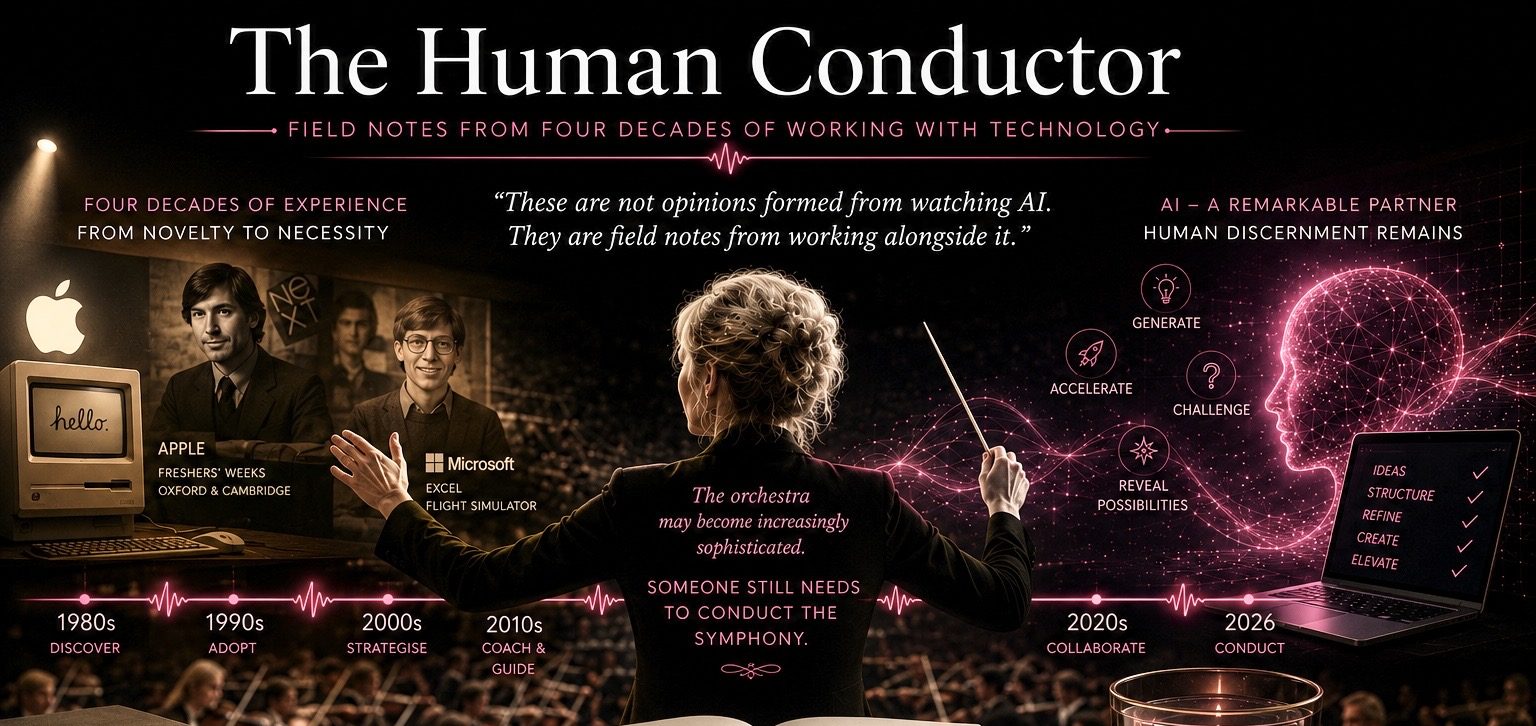
“These are not opinions formed from watching AI. They are field notes from working alongside it.” GM
Technology has been the backdrop to my entire working life.
When people ask why I spend so much time exploring artificial intelligence, the answer isn’t because I suddenly became fascinated by AI. It is because AI is simply the latest chapter in a journey that began over forty years ago.
My career started in the early 1980s, during a period when personal computing was beginning to transform how people worked. I spent many years in sales and marketing, helping organisations understand and adopt new technologies. In those early days, that often meant hiring hotel conference rooms, bringing technology vendors together to demonstrate emerging products, and inviting businesses and educational institutions to explore what was possible.
I exhibited Apple computers during Freshers’ Weeks at Oxford and Cambridge. During that period, I also had the opportunity to meet and work alongside many of the people shaping the industry. I sat in meetings during Steve Jobs’ NeXT years and later met Bill Gates while Microsoft was introducing products such as Excel and Flight Simulator.
I don’t mention these experiences to impress anyone. They simply explain the lens through which I now view artificial intelligence. I have spent much of my professional life watching technology move from novelty to necessity.
As my career evolved, so did my role.
I moved from selling technology to helping organisations launch products, build brands and communicate clearly. My work became less about hardware and more about strategy - developing brand guidelines, defining tone of voice, shaping campaigns and ensuring that products genuinely delivered what they promised.
I wasn’t usually the graphic designer. I wasn’t usually the software engineer. I was often the person conducting the process. That distinction has become increasingly important in the age of AI.
Years later, my professional interests shifted again. I trained as a qualified Life Coach and NLP Practitioner, investing in recognised qualifications and professional insurance because I wanted to build a practice that helped people navigate change. I created Bella Anima with the intention of working one-to-one with clients in a calm, therapeutic environment.
Life, however, had other plans. The lease on my apartment prevented me from operating a business from home. Renting commercial premises felt premature. My husband and I began planning a move to southern Spain, where I imagined creating a small coaching sanctuary while he continued his career in aviation.
Then circumstances changed. The property market slowed. Spain’s immigration rules changed. Our carefully considered plan gradually became less practical. Like many people, I found myself adapting rather than following the route I had originally imagined. Instead of helping people primarily through face-to-face coaching, I began helping through writing.
That became the home of Luna’s Adventures, and later my exploration of human discernment in the age of artificial intelligence.
Alongside writing came something unexpected.
Fieldwork
Not formal research commissioned by a university. Not software testing carried out inside a laboratory. Simply thousands of hours working alongside AI systems as they evolved.
Patterns began to emerge. One pattern continues to fascinate me.
Human Layering versus AI Regeneration
Traditional design software works through layers. You position a logo. You adjust a text box. You change the colour of a single word. Each object can usually be edited independently without affecting everything else on the page.
Generative AI often behaves differently. When creating images or marketing assets, it frequently treats the design as a complete composition rather than a collection of independently editable elements. A seemingly minor request - changing a font colour, adjusting spacing or moving a logo - may require the model to regenerate much of the image.
Sometimes the result is excellent. Sometimes it introduces entirely new problems. A corrected headline might be accompanied by a distorted logo. The spacing improves, but decorative elements appear that were never requested.
A carefully balanced composition slowly drifts away from the original design.
I have come to think of this as creative drift. It is not necessarily a fault. It is simply a consequence of working with systems that generate rather than edit in the way traditional publishing software does.
Anyone who has spent hours refining AI-generated artwork will probably recognise the experience. What appears to be a thirty-second adjustment can become a two-hour conversation.
The Same Pattern Appears in Language
I have noticed something similar while writing books with large language models. An AI may confidently say that it has read an entire manuscript. The conversation feels fluent. The confidence sounds convincing. Yet a few prompts later it may suggest adding a chapter that already exists or overlook an important section that has been discussed previously. This is not dishonesty. It is better understood as a limitation of how these systems manage context during long creative collaborations. That observation changed the way I work.
For projects that depend on consistency, I increasingly use grounded source material rather than relying entirely on conversational memory.
NotebookLM has become particularly valuable for this purpose because it keeps the discussion anchored to documents that I have deliberately provided. It is not perfect, but it significantly reduces the kind of drift that can occur during extended creative work.
Remaining the Conductor
These experiences have gradually shaped my view of artificial intelligence. I do not believe the future belongs to humans or machines. I believe it belongs to humans working thoughtfully with machines. The AI can generate ideas at remarkable speed. It can accelerate creativity. It can challenge assumptions. It can reveal possibilities that might otherwise have been overlooked. But the responsibility for judgement remains with the human.
The human decides what aligns with the brief. The human recognises when the work begins to drift. The human checks sources. The human notices contradictions. The human decides when something is ready to publish. In other words, the human remains the conductor. That role may become more important, not less, as AI systems continue to improve. Perhaps that is the lesson my career has been quietly teaching me since the early days of desktop publishing.
Technology changes. Interfaces change. Business models change. But thoughtful human judgement remains remarkably consistent.
TRUE • FALSE • PIN IT
TRUE:
Artificial intelligence is a remarkable creative partner. It can accelerate ideas, challenge assumptions and help us produce work at a speed that would have been difficult to imagine only a few years ago. Yet, through my own fieldwork, I have also observed that creative drift and contextual drift can emerge during extended collaboration. These are characteristics that thoughtful humans can recognise and manage.
FALSE:
The narrative that AI is ready to replace human judgement entirely is, in my view, premature.
Creativity is more than generating content. It involves context, discernment, lived experience, responsibility and knowing when something is finished. Those remain fundamentally human strengths.
LIGHT PIN:
As AI systems continue to evolve, the role of the human may become less about producing every piece of work from scratch and more about conducting the process with wisdom and intention.
Perhaps the greatest skill of the future will not be knowing how to replace ourselves with AI but knowing how to collaborate with it without surrendering our judgement.
Perhaps that is the future worth building.
The orchestra will undoubtedly become more sophisticated.
The human should still hold the baton.
This Field Note explores a single question. The book: TRUE • FALSE • PIN IT explores the wider framework behind questions like this - helping us navigate an age where technology, opinion and human judgement increasingly overlap.
The goal isn’t to tell you what to think. It’s to help you become more confident in deciding for yourself.