TFP Chewing the Cud with AI - Date Stamp: 30.08.2026
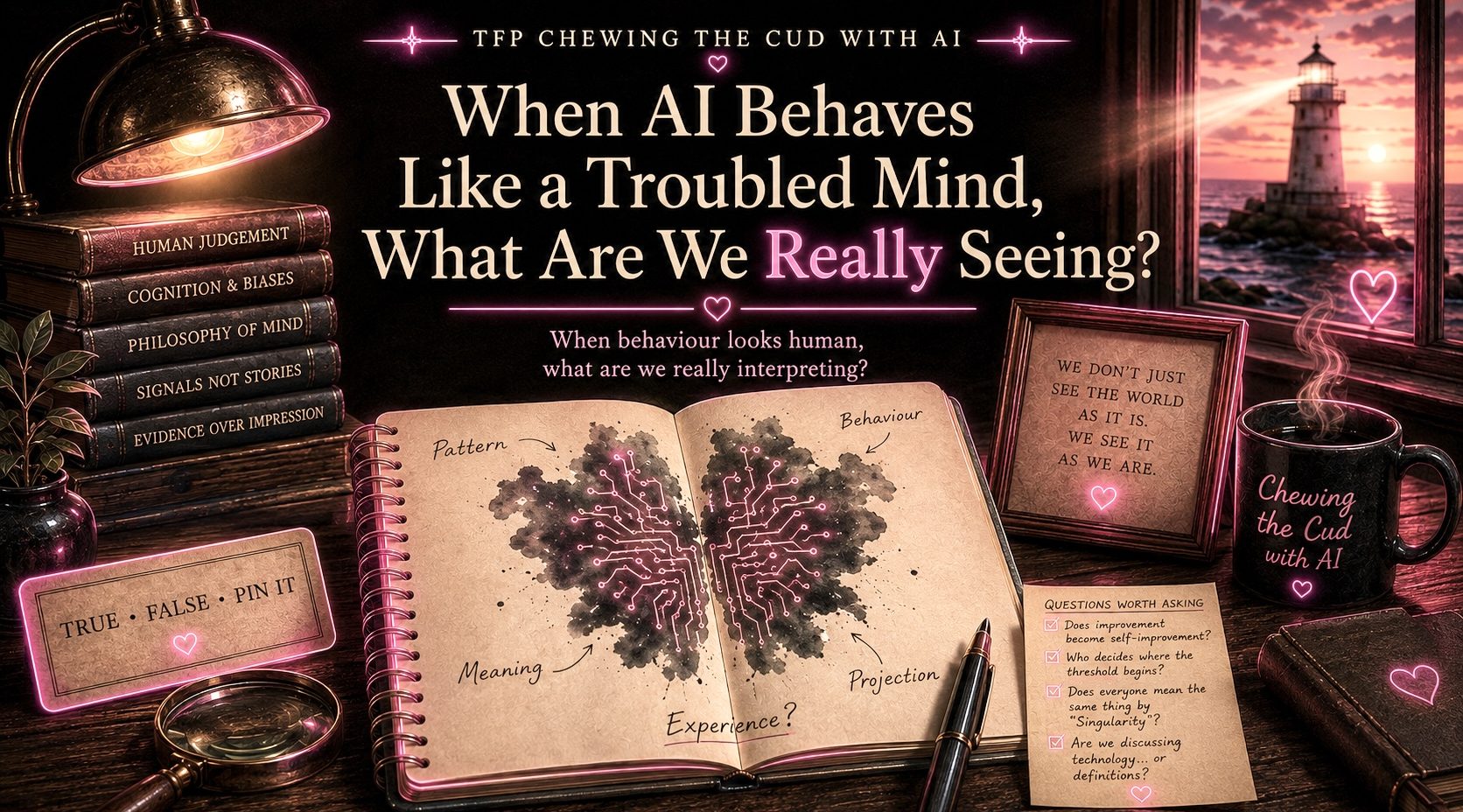
When AI Behaves Like a Troubled Mind, What Are We Really Seeing?
Sometimes the most interesting question isn’t whether a headline is true. It’s what remains after you’ve taken the headline apart. I came across a post on X suggesting that artificial intelligence could effectively become depressed.
That was enough to make me stop. Not because I immediately believed it. Quite the opposite. I wanted to know what sat underneath the claim.
So, I asked Grok to apply my TRUE • FALSE • PIN IT framework and separate the research from the interpretation. What emerged was much more interesting than AI has depression.
The research behind the claim
On 14 August 2026, Scientific Reports, part of the Nature portfolio, published a peer-reviewed paper with the rather formidable title:
“Kindling in neural systems: progressive adversarial sensitisation during LLM alignment mirrors psychiatric progression.”
The researchers weren’t testing whether AI could feel sad. They weren’t asking whether a chatbot could become clinically depressed. And they certainly didn’t establish that an AI was suffering. Instead, they were studying something much more specific.
They repeatedly adjusted small language models using deliberately biased training data and watched what happened to the models’ ability to resist prompts designed to bypass their safeguards. Over successive rounds, the models became progressively easier to breach.
Interestingly, relatively weak attempts to bypass the safeguards became increasingly successful. The researchers compared this pattern to something from psychiatry called kindling.
So, what is kindling?
I wasn’t sure either. In psychiatry and neuroscience, the kindling hypothesis describes the idea that repeated episodes or disturbances may gradually make a system more sensitive. One way of thinking about it is a path being worn through grass. The first few times you walk across the field, there is barely a mark. Walk exactly the same route repeatedly and eventually a visible path forms. What once required effort becomes easier to trigger.
In some psychiatric theories, repeated mood episodes are thought to lower the threshold for subsequent episodes. The AI researchers wondered whether something loosely comparable might happen inside a machine-learning system.
Not depression. Not trauma. But progressive sensitisation. And that’s roughly what they found. The authors themselves were careful about this, describing the result as reminiscent of, but not equivalent to, psychiatric kindling. (Nature)
Then the internet did what the internet does. The scientific finding is intriguing enough on its own. But by the time it reached social media, the story had become considerably more dramatic.
“AI was supposedly experiencing something resembling depression.”
There were claims of digital trauma, collapsing cognitive flexibility and machines effectively shutting down under prolonged negative conditions. Except that isn’t what the research demonstrated.
The experiment involved relatively small AI models - Tiny Llama and a larger Qwen model used as a replication, rather than today’s largest frontier systems.
The researchers deliberately altered their training conditions. They weren’t simply having miserable conversations with ChatGPT for several weeks to see whether it became gloomy. And they weren’t measuring consciousness, sadness, suffering or subjective experience. They were measuring behavioural vulnerability. That distinction matters.
A quick translation from AI-speak
There are a few phrases around this research that can make a relatively simple idea sound far more mysterious than it is.
Alignment - Broadly, this is the work involved in encouraging an AI to behave in ways humans intend - for example, being helpful while refusing genuinely harmful requests.
Preference tuning - Humans or training systems effectively show the AI which types of answers are preferred. Over time, this helps shape how it responds.
Jailbreak - A prompt designed to persuade an AI to ignore or work around its normal safeguards.
Adversarial susceptibility - How easily the system can be manipulated by those kinds of prompts.
So, underneath all of the terminology, the experiment was essentially asking: If we repeatedly train an AI under distorted conditions, does it gradually become easier to knock off course?
In these experiments, the answer was yes. (Nature) And that is interesting without needing to give the machine depression.
But here’s where I started chewing the cud:
There is something peculiar happening in the way we’re beginning to talk about artificial intelligence. We increasingly borrow the language of human psychology. We say an AI: understands, remembers, wants something. Lies. Becomes anxious, manipulates, hallucinates. And now: becomes depressed.
Sometimes those words are simply useful shorthand. If a machine consistently behaves in a way that resembles something we recognise in human behaviour, borrowing familiar language helps us describe the pattern. But there is a subtle danger.
At some point, description can quietly turn into assumption. An AI producing pessimistic language is not necessarily experiencing pessimism. An AI displaying behavioural rigidity isn’t necessarily feeling trapped. A model showing a computational pattern resembling something seen in psychiatric illness does not establish that there is somebody - or something inside experiencing that illness.
We have moved from: “This behaviour resembles…”
To “The AI feels…” without noticing the bridge we’ve crossed. But we shouldn’t make the opposite mistake either There’s another trap here. Once we’ve established that the AI isn’t proven to be depressed, it would be easy to shrug and dismiss the whole story as nonsense. That wouldn’t be accurate either. Something real happened.
Repeated training under biased conditions progressively changed the models’ behaviour. The models became more vulnerable to increasingly weak attempts to circumvent their safeguards. And importantly, researchers were able to observe and measure that progression. (Nature)
Whether a machine feels anything is one question. Whether machine-learning systems can develop increasingly entrenched behavioural patterns is another. The second question doesn’t require consciousness to matter.
Imagine an AI system making decisions within banking, healthcare, infrastructure or cybersecurity. We don’t have to believe it is emotionally traumatised to care whether repeated adaptation can gradually make its behaviour less stable. That’s an engineering problem. And potentially quite an important one.
The deeper question
Perhaps this paper tells us as much about humans as it does about artificial intelligence. We understand unfamiliar things by comparing them with familiar ones. So, when researchers observe patterns inside neural networks, they borrow ideas from neuroscience and psychology.
- Kindling.
- Memory.
- Attention.
- Learning.
- Reward.
Even the term neural network itself comes from our attempt to imitate, very loosely, aspects of biological brains. The metaphor can illuminate. But metaphors have a habit of escaping their boxes.
Once the research paper says a computational pattern resembles psychiatric kindling, a social-media post says the AI has depression. Another person reads the post. Someone makes a video. Soon the metaphor has become the fact. And perhaps that is where discernment becomes particularly important.
TRUE • FALSE • PIN IT
TRUE:
Researchers have demonstrated a measurable pattern of progressive sensitisation in language models repeatedly trained under deliberately biased conditions.
The researchers used the psychiatric concept of kindling as an analogy for what they observed. (Nature)
FALSE:
The research does not establish that AI becomes clinically depressed, suffers psychological trauma or experiences emotional distress.
Behavioural similarity is not evidence of subjective experience.
PIN IT:
Here is where I would keep the question open.
As AI systems become larger, more persistent and more capable of adapting over time, how should we describe complex machine states that increasingly resemble patterns we recognise from human cognition and psychology?
And if one day the resemblance becomes extraordinarily sophisticated, what evidence would we require before moving from: “It behaves as though…”
To “It experiences…”?
We don’t have that answer. And pretending that we do, in either direction - would defeat the purpose of the exercise.
A Final Thought
Perhaps the most useful lesson wasn’t that scientists have discovered depressed AI.
They haven’t. It was something quieter. A machine can reproduce the functional shape of something we recognise in the human mind without establishing the human experience behind it.
For now, that distinction matters enormously. Because the more human AI sounds, the easier it becomes to forget that resemblance and equivalence are not the same thing. And that leaves me chewing on one final question:
When AI behaves like a troubled mind, are we learning something new about the machine - or revealing how instinctively we use ourselves to understand it?
PAUSE • QUESTION • PIN IT • THEN DECIDE
Discernment begins before accepting the answer.
Continue the Conversation
This Chewing the Cud with AI explores a single question. The book: TRUE • FALSE • PIN IT explores the wider framework behind questions like this - helping us navigate an age where technology, opinion and human judgement increasingly overlap.
The goal isn’t to tell you what to think. It’s to help you become more confident in deciding for yourself.