TFP Chewing the Cud with AI - Date Stamp: 15.09.2026
What Unusual Way Have You Used AI Recently That Genuinely Helped You Think?
Most conversations about AI still seem to focus on what it can do. You don’t need to be technical, and you don’t need elaborate prompts to:
- Write something.
- Summarise something.
- Generate something.
- Analyse something.
Those are useful, certainly. But increasingly, I find myself more interested in how people are using AI to think. Not to hand over responsibility. Not to replace judgement. Just to look at something from another angle.
I’ve used AI in all sorts of ordinary ways:
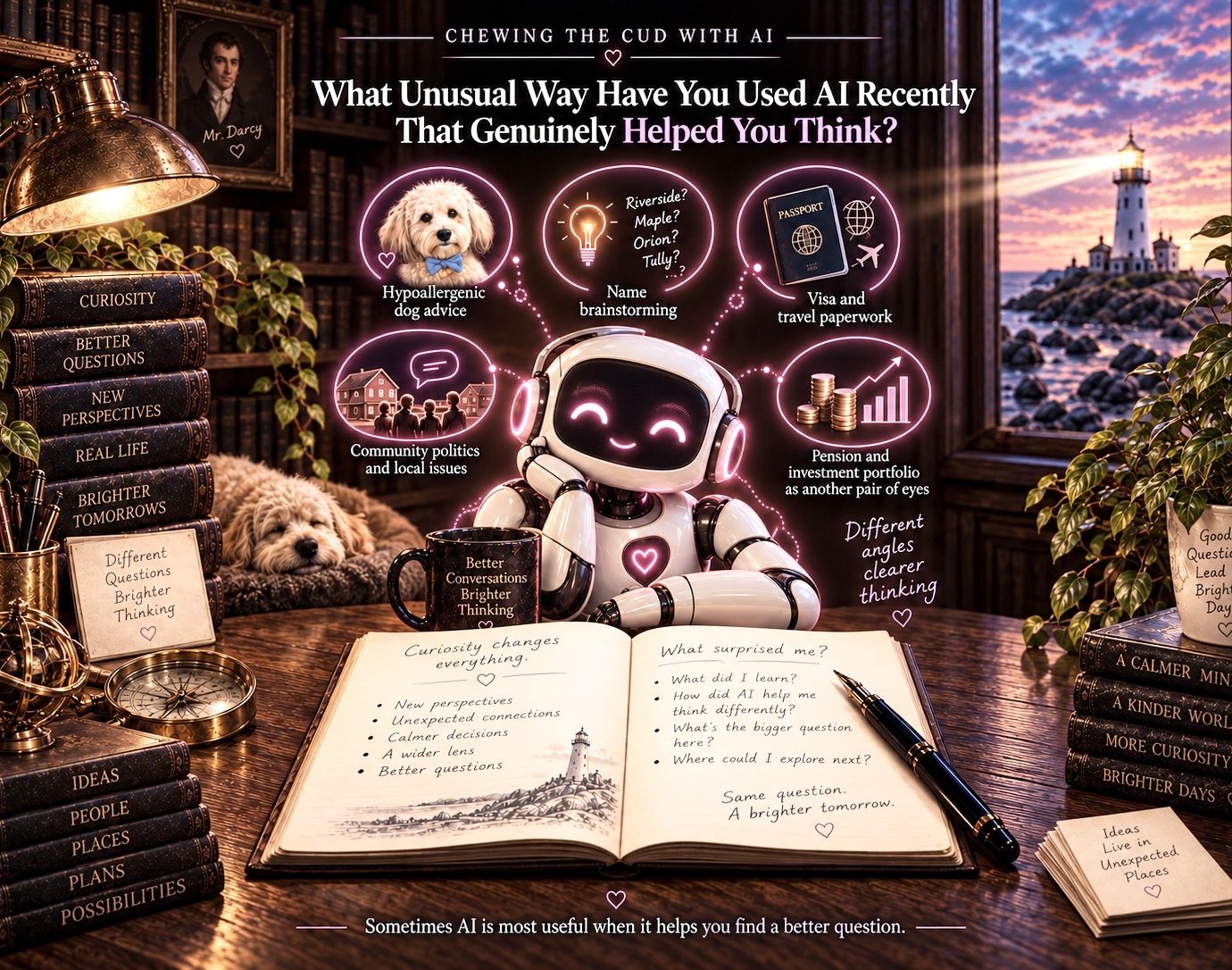
- To help me think through what kind of hypoallergenic dog might genuinely suit apartment living.
- To brainstorm names.
- To understand visa requirements and turn bureaucracy into something slightly less impenetrable.
- To untangle community politics when everybody appears to be working from a slightly different version of reality.
I’ve even used it as another pair of eyes when reviewing things like my pension or investment portfolio. Not to make decisions for me, but to help me spot questions I might want to ask, assumptions I might be making, or areas worth looking at more closely. And that is the part I find increasingly interesting.
- Sometimes AI is most useful when it doesn’t give you an answer.
- Sometimes it helps you find a better question.
- You can use it to rehearse a difficult conversation.
- To ask for the strongest argument against your own opinion.
- To compare several interpretations of the same situation.
- To turn a vague feeling into something you can actually examine.
- To ask: What assumption am I making here?
- What might someone who disagrees with me notice?
- What am I treating as fact that is actually interpretation?
- What evidence would change my mind?
- What have I not thought to ask?
That feels very different from simply saying: “Write this for me.”
It becomes less about outsourcing thought and more about creating friction around thought.
- A second perspective.
- A sounding board.
- A structured challenge.
- Sometimes even a mirror.
Of course, AI can be wrong. It can misunderstand. It can sound more certain than the evidence deserves. And in areas such as finance, health, law or major life decisions, human judgement and qualified professional advice still matter.
But that does not make the tool useless. It just means we need to understand the role we are asking it to play.
Perhaps the most interesting use of AI is not: Tell me what to think.
Perhaps it is: Help me think about this better.
TRUE • FALSE • PIN IT
TRUE:
AI is already being used for far more than content generation.
People are using it to explore ideas, compare perspectives, rehearse conversations, question assumptions, organise thoughts and make complicated information easier to examine.
FALSE:
Its value is limited to producing answers.
Sometimes the useful part is the question it helps surface.
PIN IT:
We are probably still discovering what “thinking with AI” will mean in everyday life. And perhaps some of the most useful applications will not look particularly futuristic at all. They may simply help us notice something we had not noticed before.
Reader Reflection
So, I’m curious: What unusual way have you used AI recently that genuinely helped you think?
Not necessarily something impressive. Just something that made you think:
I hadn’t realised I could use it for that.
TRUE • FALSE • PIN IT
PAUSE • QUESTION • PIN IT • THEN DECIDE
Discernment begins before accepting the answer.
Continue the Conversation
This Chewing the Cud with AI explores a single question. The book: TRUE • FALSE • PIN IT explores the wider framework behind questions like this - helping us navigate an age where technology, opinion and human judgement increasingly overlap.
The goal isn’t to tell you what to think. It’s to help you become more confident in deciding for yourself.