TFP Chewing the Cud - Date Stamped: 05.08.2026
Are We Already in the Singularity…
Or Are We Simply Redefining the Word?
Here’s something I’ve been thinking about…
Over the past few weeks, I’ve noticed several influential figures in artificial intelligence making a bold claim.
Sam Altman, (the CEO of OpenAI, the company behind ChatGPT) suggested that we may already be entering the Singularity.
Peter Diamandis, entrepreneur, engineer and founder of the Moonshots podcast, has spoken in similar terms for a few months now.
Then, a few days ago, I read an opinion piece arguing that they were both wrong. That wasn’t the moment that caught my attention.
The moment came later, over dinner. My husband looked up and simply asked:
“What’s the Singularity?”
I smiled. Because if my husband didn’t know, I suspect many people don’t either.
So…
what is the Singularity?
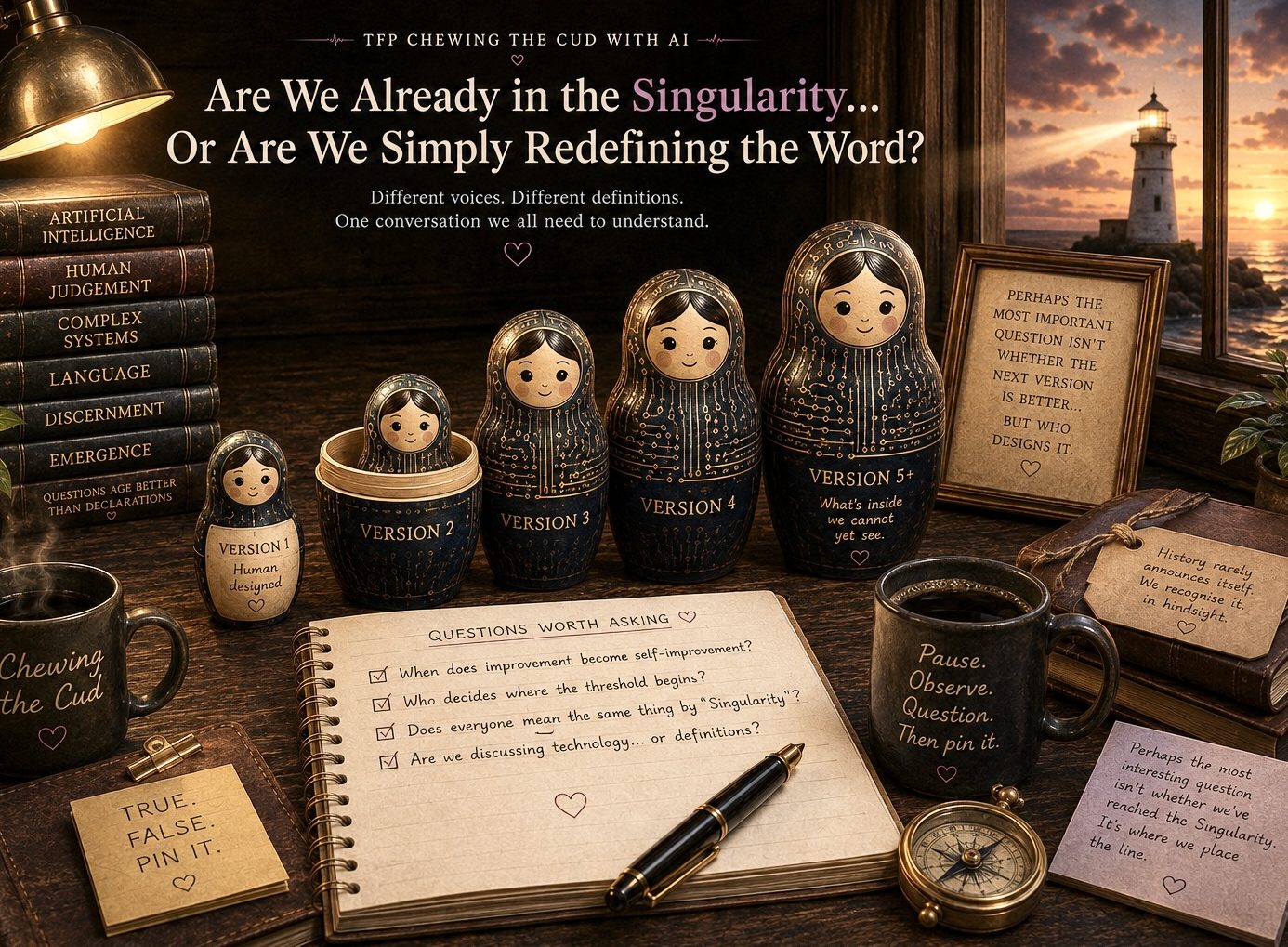
In simple terms, the Singularity is the idea that artificial intelligence eventually becomes so capable that it begins improving itself faster than humans can understand or control.
Imagine you’ve built an incredibly intelligent AI system.
You ask it: “Design a better version of yourself.”
It does.
Then you ask the newer version the same question.
It designs an even better version.
That version improves itself again. And again.
Eventually, the pace of improvement becomes so rapid that human engineers struggle to keep up.
For decades, many researchers have described that hypothetical moment as the technological singularity.
But here’s the interesting part…
Not everyone agrees on when, or even if, that moment begins.
Some people believe today’s rapid progress means we’ve already crossed the threshold.
Others believe we’re still years away.
Some think the Singularity starts when AI can improve itself without human help. Others think it begins much earlier, when AI starts accelerating scientific discovery or software development.
The more I listened, the more I realised something. People weren’t necessarily disagreeing about AI. They were disagreeing about the meaning of the word.
My answer to my husband
When he asked me what the Singularity meant, I answered as honestly as I could.
I said:
“For me, it begins when engineers ask an AI to build a better version of itself, and then gradually step back because they can no longer fully understand every improvement being made.”
Then I added something just as important.
“But that’s only my interpretation.”
Because that’s exactly what this conversation has become. Not a disagreement about facts…
A conversation about definitions.
The TFP Notebook
One thing I’ve noticed while writing True. False. Pin It. is that humans often argue passionately before agreeing what the words actually mean.
The word consciousness.
The word intelligence.
The word awareness.
Now…
The word Singularity.
Perhaps that explains why respected scientists, engineers and commentators can all look at the same technology and reach different conclusions.
Sometimes they aren’t observing different realities. They’re simply using different maps.
TRUE • FALSE • PIN IT - Are We Already in the Singularity… Or Are We Simply Redefining the Word?
TRUE:
Artificial intelligence is advancing at an extraordinary pace, and many respected voices believe we are entering a fundamentally new era.
FALSE:
There is no universally agreed definition of the Singularity, or consensus that humanity has already reached it.
PIN IT:
Perhaps the most interesting question isn’t whether we’ve entered the Singularity. Perhaps it’s this:
At what point do humans decide that a machine has become capable enough for us to step back and let it improve itself?
History may one day provide an answer.
For now…
I’m pinning the conversation.
Reader Reflection
When you hear someone confidently say, “We’re already in the Singularity,” perhaps the first question isn’t whether they’re right.
Perhaps it’s simply:
“What do you mean by the word ‘Singularity’?”
I think this captures exactly what Chewing the Cud with AI is meant to be. It doesn’t try to win the debate. It helps you, the reader to understand why the debate exists in the first place.
Technology often changes faster than language. Sometimes the biggest disagreements aren’t about reality at all - they’re about the words we’ve chosen to describe it.
Continue the Conversation
This Chewing the Cud with AI explores a single question. The book: TRUE • FALSE • PIN IT explores the wider framework behind questions like this - helping us navigate an age where technology, opinion and human judgement increasingly overlap.
The goal isn’t to tell you what to think. It’s to help you become more confident in deciding for yourself.