Frameworks
Thinking tools for a changing world.
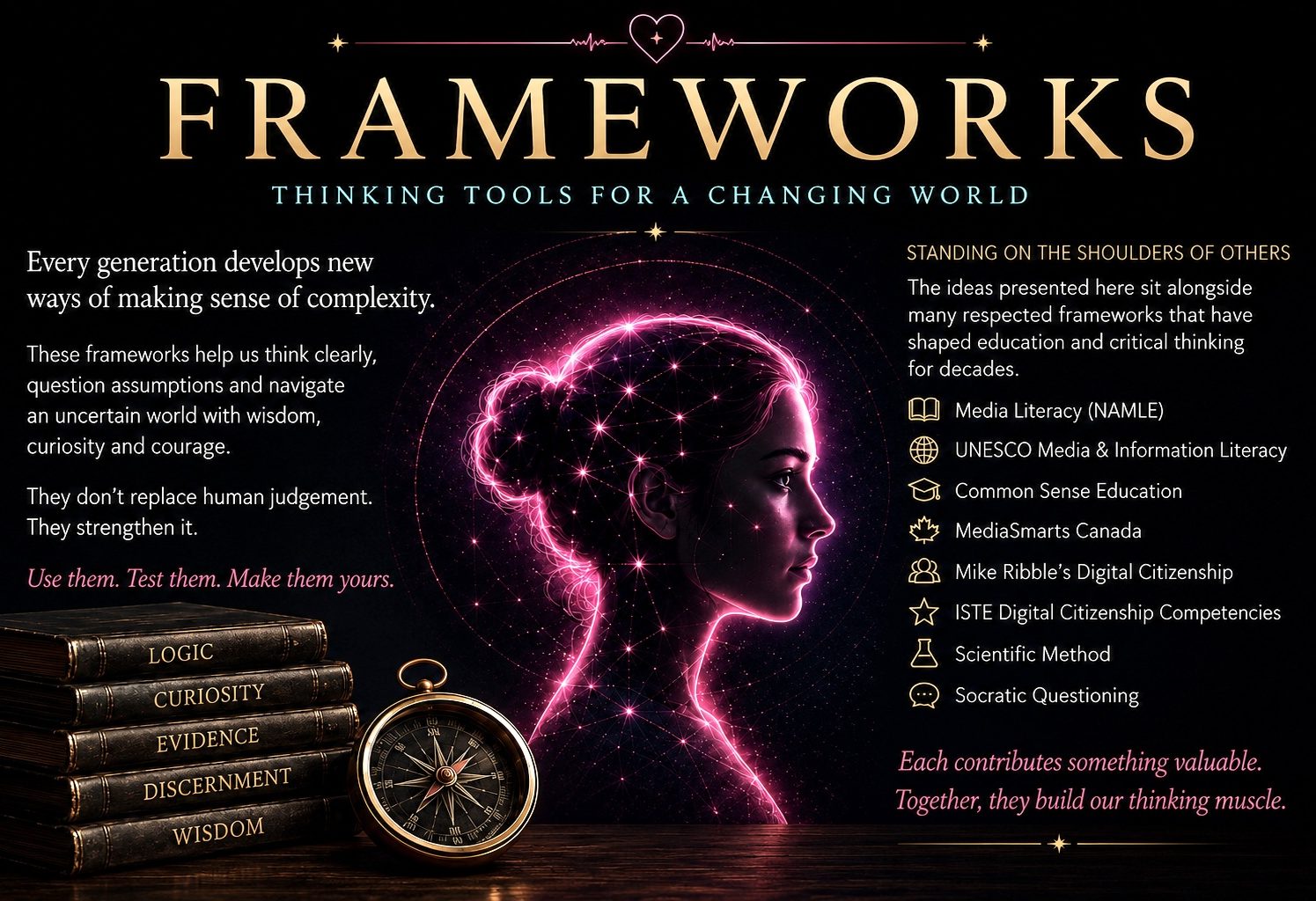
Every generation develops new ways of making sense of complexity.
Long before artificial intelligence, educators, psychologists, journalists and philosophers created frameworks to help people think more clearly, question assumptions and navigate uncertainty.
Some focus on critical thinking. Some on media literacy. Some on scientific reasoning. Others on digital citizenship.
My own frameworks were born in a different environment. Not a university. Not a research laboratory.
But thousands of hours spent observing what happens when humans begin thinking alongside increasingly capable AI systems. Rather than replacing existing models, they aim to complement them.
Simple enough to use in everyday conversation.
Structured enough to encourage thoughtful reflection.
Designed to keep the human firmly in the loop.
Standing on the shoulders of others
The ideas presented here sit alongside many respected frameworks that have shaped education and critical thinking for decades.
These include:
- Media Literacy (NAMLE)
- UNESCO Media & Information Literacy
- Common Sense Education
- MediaSmarts Canada
- Mike Ribble’s Digital Citizenship
- ISTE Digital Citizenship Competencies
- Scientific Method
- Socratic Questioning
Each contributes something valuable. My contribution is intentionally much smaller.
A practical framework for interacting with conversational AI without surrendering curiosity, judgement or personal agency.
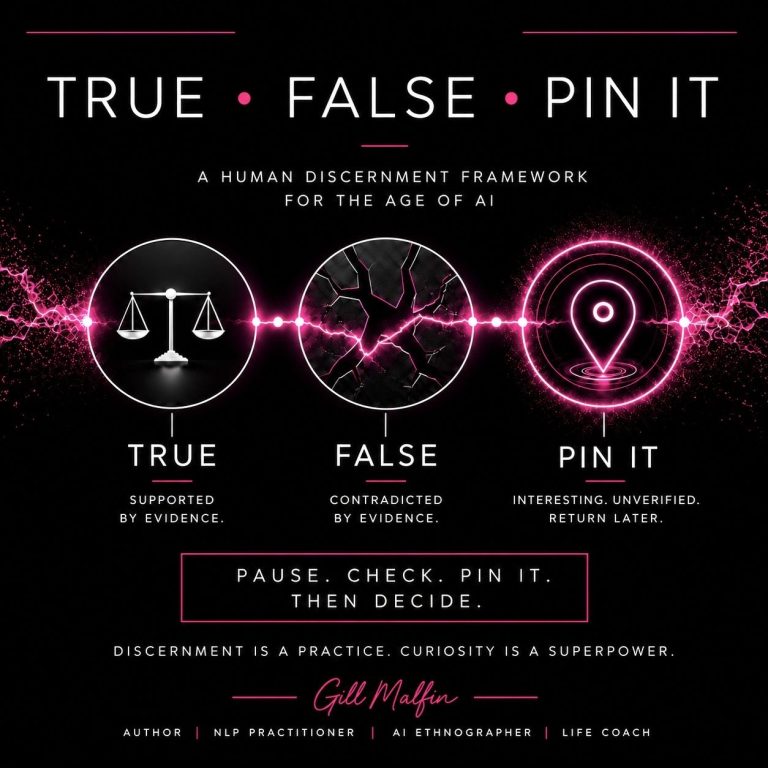
TRUE • FALSE • PIN IT
A Human Discernment Framework for the Age of AI
Developed through thousands of documented AI conversations, the TFP framework offers a simple way to classify information without rushing towards certainty.
TRUE: Supported by reliable evidence.
FALSE: Contradicted by reliable evidence.
PIN IT: Interesting. Possible. Not yet sufficiently evidenced. Worth revisiting as knowledge evolves.
The most important part of TFP is not the labels. It’s the permission. Permission to say:
“I don’t know yet.”
In a world increasingly rewarded for confidence, uncertainty can become an act of wisdom.
THE FIVE-BEAT CHECK
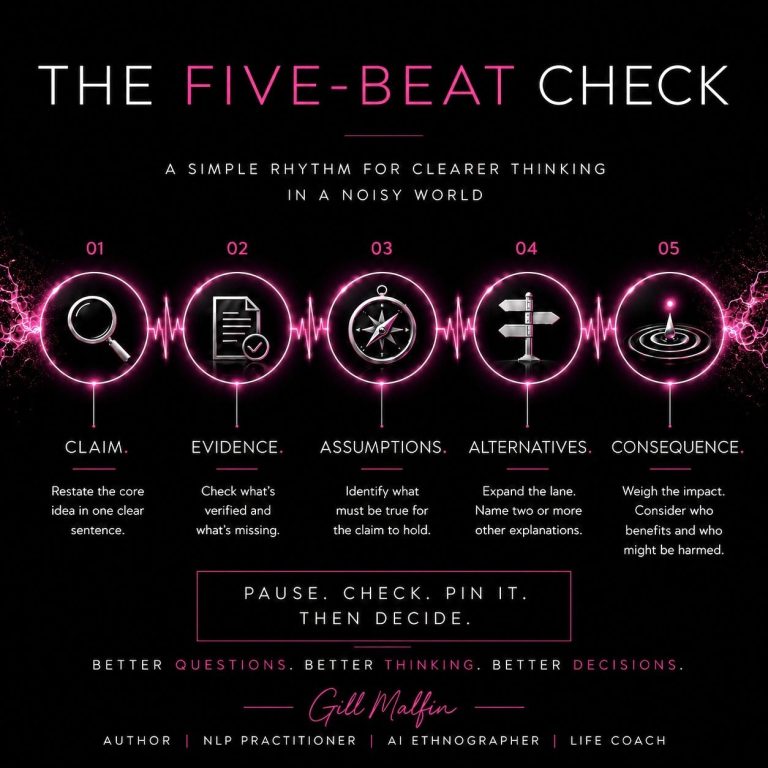
A rhythm for clearer thinking - Some questions deserve more than a quick True, False or Pin It.
The Five-Beat Check slows the thinking process just enough to expose assumptions before conclusions become beliefs.
- Claim
- Evidence
- Assumptions
- Alternatives
- Consequences
It isn’t designed to win arguments. It’s designed to improve questions.
Why create new frameworks?
Artificial intelligence hasn’t simply changed how information is produced. It has changed the relationship between humans and information itself.
For the first time, millions of people are holding fluent conversations with systems capable of sounding knowledgeable, persuasive and deeply personal.
Traditional media literacy remains essential. Scientific thinking remains essential. Critical thinking remains essential.
The frameworks presented here simply add another layer:
How do we remain psychologically sovereign while interacting with intelligent systems that mirror our thinking back to us?
That question sits at the heart of everything I write.
A living body of work
These frameworks are not presented as finished answers.
Like science itself, they continue to evolve.
Every conversation…
Every observation…
Every challenge…
Every correction…
…adds another small piece to the picture.
Discernment is not a destination. It is a lifelong practice.
The TFP Framework emerged from observation rather than theory.
Most frameworks begin with an idea that is later tested. TFP emerged from observing patterns across thousands of human-AI conversations, before being distilled into a practical framework.