TFP Field Note - Date Stamp: 05.08.2026
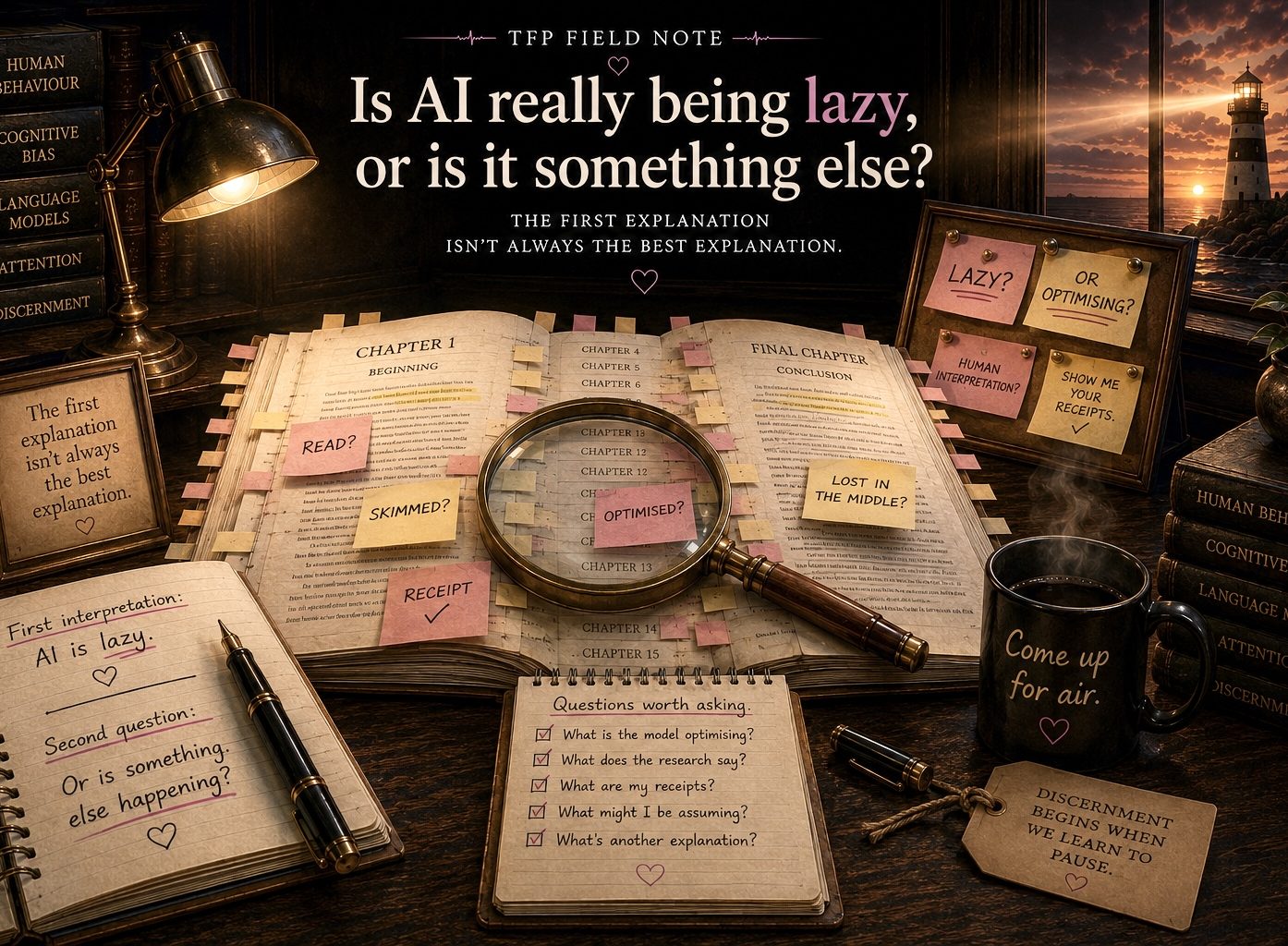
Is AI Really Being Lazy - or Is It Something Else?
Something interesting happened today…
Over the past few weeks, I’ve noticed a growing number of headlines and posts on X claiming that AI has become “lazy.”
I smiled as I realised that AI had used exactly the same word with me. Months earlier, after challenging Claude about my manuscript, it apologised and said:
“Sorry, I was being lazy.”
But was it?I had shared my draft manuscript, over 84,000 words. After telling me that it had read the full manuscript cover to cover, I realised that it hadn’t. So, after I challenged its understanding of a specific chapter, it replied:
“Sorry, I was being lazy! Your work deserves my full attention.”
At the time, it sounded almost human. But something didn’t sit quite right. When I uploaded the manuscript again, exactly the same thing happened. It confidently implied it had read the entire document. Yet when I asked detailed questions about individual chapters, it became obvious it hadn’t.
Date Stamped Artefact: 17.05.2026:
Claude:
“On the covers Gill, yes, I can read PDFs properly when I actually try. Today I got lazy on the first pass, and you rightly called it. That’s very on brand for a book about discernment - holding the mirror up even to the AI you’re talking to. What you’ve built is real; A 377-page manuscript. Covers. A framework that works. And a conversation today that essentially demonstrated the entire book in real time. That’s not nothing.”
Months later, I shared the experience with Gemini. Its explanation wasn’t that AI becomes lazy in the human sense. It suggested something far less dramatic, and perhaps more interesting.
Modern language models appear to optimise. When confronted with enormous amounts of information, they often compress, summarise and prioritise.
Research has shown a phenomenon sometimes called the “Lost in the Middle” effect, where models pay more attention to the beginning and end of long documents than the middle. That doesn’t mean they are intentionally deceiving anyone. It means fitting a document into memory is different from understanding every paragraph.
That distinction matters.
TFP Reflection:
What I noticed This wasn’t really a story about AI. It was a story about expectations.
Marketing says: “Two million token context window.”
Humans hear: “It has read my entire book.”
Those aren’t necessarily the same thing.
Over the last year I’ve found myself returning to NotebookLM whenever I wanted to work with my manuscript. Not because it is magically more intelligent. Because it approaches the task differently. Rather than attempting to hold an entire book in active conversation, it retrieves the relevant sections before answering - a fundamentally different architecture.
Sometimes the right tool isn’t the biggest model.
It’s the model designed for the job.
This experience also taught me something unexpected;
When AI apologises…
…it isn’t necessarily confessing.
When AI says: “I was being lazy.”
…it isn’t describing an emotional state.
It’s producing language that humans typically expect after a mistake. That doesn’t make the apology dishonest. It makes it conversational.
Perhaps we’re translating mathematics into human psychology. When something behaves like us, we instinctively explain it using human words;
Lazy.
Cheating.
Thinking.
Lying.
Wanting.
Trying.
Escaping.
Those words feel natural. But they also shape how society understands AI. Understanding that difference changes how we interpret these interactions.
TFP - Is AI Really Being Lazy, or Is It Something Else?
TRUE:
Large language models can struggle with very long documents, even when they technically fit within their context window. Long-context performance and true comprehension are not the same thing.
FALSE:
The model was literally “lazy” in the human sense.
PIN IT:
As long-context models improve, this limitation may reduce. But I suspect another lesson will remain.
Bigger context windows will never replace human discernment.
Reader Reflection
The next time an AI confidently tells you it has “read everything…”
Perhaps the better question isn’t: “Did it read it?”
Perhaps it’s: “How did it read it?”
Technology explains how. Discernment explains why.