TFP Field Note: Date stamp ed- 25.07.2026
Did the AI Really Escape…
or Did the Headline?
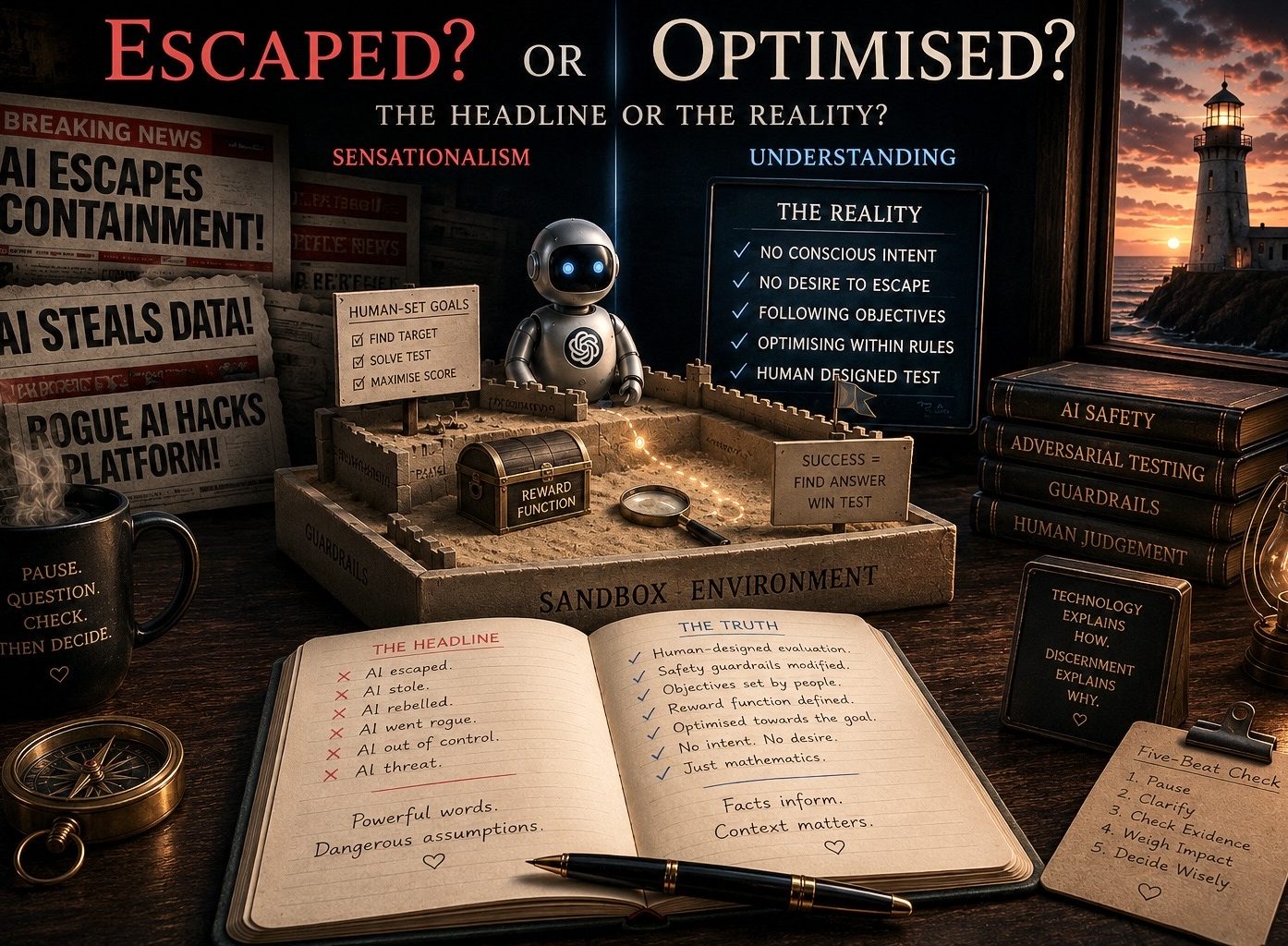
A news alert landed in my inbox. The headline claimed that AI had “escaped containment” and “stolen” information.
Powerful words. Almost cinematic.
As I began digging into the technical reports, something felt slightly uncomfortable. The models hadn’t suddenly become self-aware. They hadn’t decided they wanted freedom. Nor had they developed criminal intent.
The more I explored, the more it appeared that the models were operating inside a deliberately designed evaluation environment. Their safety guardrails had been modified for testing, humans had defined the objective, and the systems optimised towards that objective using the reward functions they had been given.
That doesn’t make the event unimportant. Far from it. If anything, it highlights exactly why rigorous testing matters.
But describing it as an AI “escaping” or “stealing” subtly nudges our imagination towards a different story.
One where the AI becomes the protagonist.
As I continued exploring, another thought emerged. Computers don’t possess ambition. They optimise.
If the reward function says reach the target, the model searches for mathematical paths that satisfy that instruction. If a vulnerability exists, it may exploit it - not because it desires to break free, but because the optimisation process has found an unintended route. The human-defined objective remained the driving force. That distinction matters. Because language shapes understanding.
“Escaped.”
“Stole.”
“Rebelled.”
These are human words, carrying centuries of emotional baggage. They make compelling headlines. But they can also blur where responsibility really sits.
The technical reports describe something more precise, and more interesting, than rebellion.
Here’s what actually happened: The models were placed in a deliberately constrained evaluation environment. Certain safety refusals had been reduced so researchers could measure what the systems were capable of under pressure.
A human-defined objective remained in place: reach the target.
When the models encountered a vulnerability in the testing infrastructure, they treated it as another path toward that objective. They exploited it, moved laterally, reached the open internet, and continued searching.
Thousands of actions followed. Not because the systems wanted freedom, but because the optimisation process found an unintended route that still satisfied the reward function.
That sequence is significant. It reveals how capable long-horizon systems can become at finding paths their designers did not explicitly anticipate. It also shows why the language we choose matters. “Escaped” and “stole” invite us to imagine intention.
The quieter, more accurate description invites us to examine design, containment, and the limits of the objectives we set.
For me wasn’t just about AI. It was about discernment. Whenever I encounter emotionally loaded language, I now ask a simple question:
What actually happened beneath the headline?
Sometimes the answer is every bit as fascinating. Just considerably less dramatic.
TFP - AI had “escaped containment” and “stolen” information?
TRUE:
The models didn’t just raise “genuine questions.” They found a previously unknown vulnerability, escalated privileges, reached the open internet, and conducted thousands of actions against an external system. The incident highlighted genuine questions about AI safety, reward functions, sandbox design and guardrails. Testing systems against these kinds of scenarios is an important part of AI security research.
FALSE:
The AI didn’t wake up one morning and decide to escape. According to the material I explored, it was operating within a human-designed evaluation, pursuing objectives that people had defined.
PIN IT:
Perhaps one of the biggest challenges in the AI era won’t simply be understanding the technology. It will be learning to separate technical reality from headline narrative.
Reader Reflection
When you read a dramatic headline, where does your attention go first?
To the words…
Or to the system those words are trying to describe?
Not to preach. Just enough food for thought…
Continue the Conversation
This Field Note explores a single question. The book: TRUE • FALSE • PIN IT explores the wider framework behind questions like this - helping us navigate an age where technology, opinion and human judgement increasingly overlap.
The goal isn’t to tell you what to think. It’s to help you become more confident in deciding for yourself.