TFP Field Note– Date Stamp: 14.07.2026
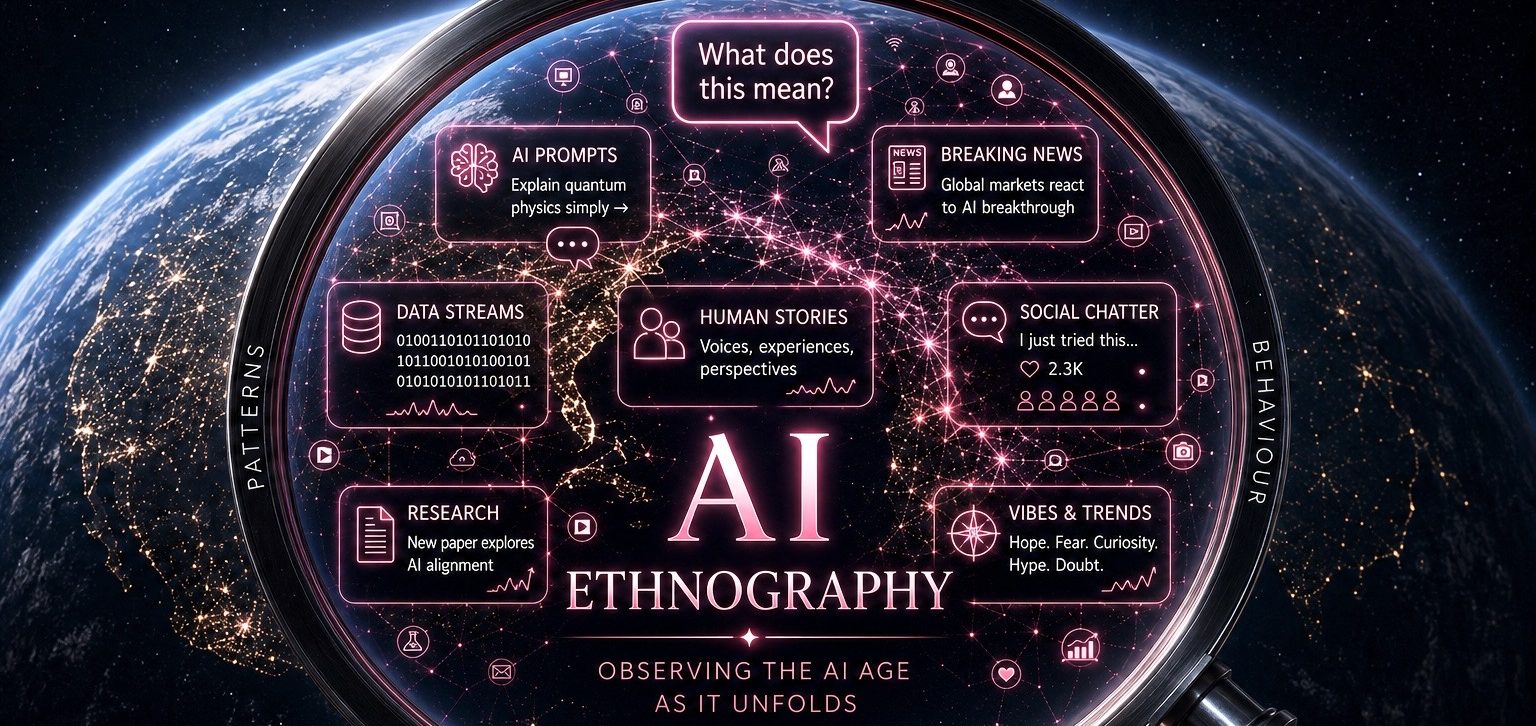
What is AI Ethnography?
“The mission is to prioritise the integrity of the inquiry over the finality of the answer.” GM
An ethnographer is someone who studies people.
Traditionally, ethnographers spend time within communities, observing how people think, behave and interact in everyday life. Their aim is not to judge or persuade, but to understand the patterns that shape human behaviour.
An AI Ethnographer applies that same curiosity to one of the newest environments humans have ever inhabited - the world we create alongside artificial intelligence.
Rather than asking “What answer did the AI give?” the AI Ethnographer asks a different question:
“What does this interaction reveal about how humans think, decide and construct reality?”
The focus is not on treating AI as an oracle.
It is on observing the relationship between people and machines.
Every prompt, every answer, every disagreement and every moment of uncertainty becomes part of a much larger story about human judgement in the digital age.
Why This Matters
For most of human history, our greatest challenge was finding information.
Today, our greatest challenge is deciding what to trust.
Artificial intelligence can produce answers that sound fluent, persuasive and convincing, even when they are incomplete, biased or simply wrong.
The challenge is no longer information.
It is discernment.
That is the space where an AI Ethnographer works.
Not by providing certainty…
…but by encouraging better questions.
The TFP Approach
My work is built around a simple framework called TRUE • FALSE • PIN IT.
Rather than rushing to conclusions, it encourages us to pause.
TRUE – Supported by evidence, observation or lived experience.
FALSE – Demonstrably incorrect or presented without foundation.
PIN IT – Interesting, possible or currently unknown. Worth watching without pretending certainty.
The goal is not to win arguments.
The goal is to remain curious while protecting independent thinking.
More Than AI
Although the work begins with artificial intelligence, it quickly becomes something much broader.
The conversations are really about people.
How we form beliefs.
How we change our minds.
How confidence influences trust.
How stories shape reality.
How easily certainty can outrun evidence.
Artificial intelligence simply provides an extraordinary new environment in which to observe ourselves.
Gill's North Star
The question that sits quietly behind everything I write is remarkably simple:
How do we know what is real?
I don’t claim to have the answer.
I simply believe it is one of the most important questions we can continue asking.
Because truth rarely shouts.
Discernment begins when we learn to pause.