TFP Chewing the Cud with AI - Time stamp: 19.07.2026
What Would AI Wish for Humanity?
A Five-Year Pin in the Ground – for Future Review
Every so often, I stumble across something that quietly captures my attention. Not because I immediately agree with it. Not because I think it's right. But because it's worth sitting with for a while.
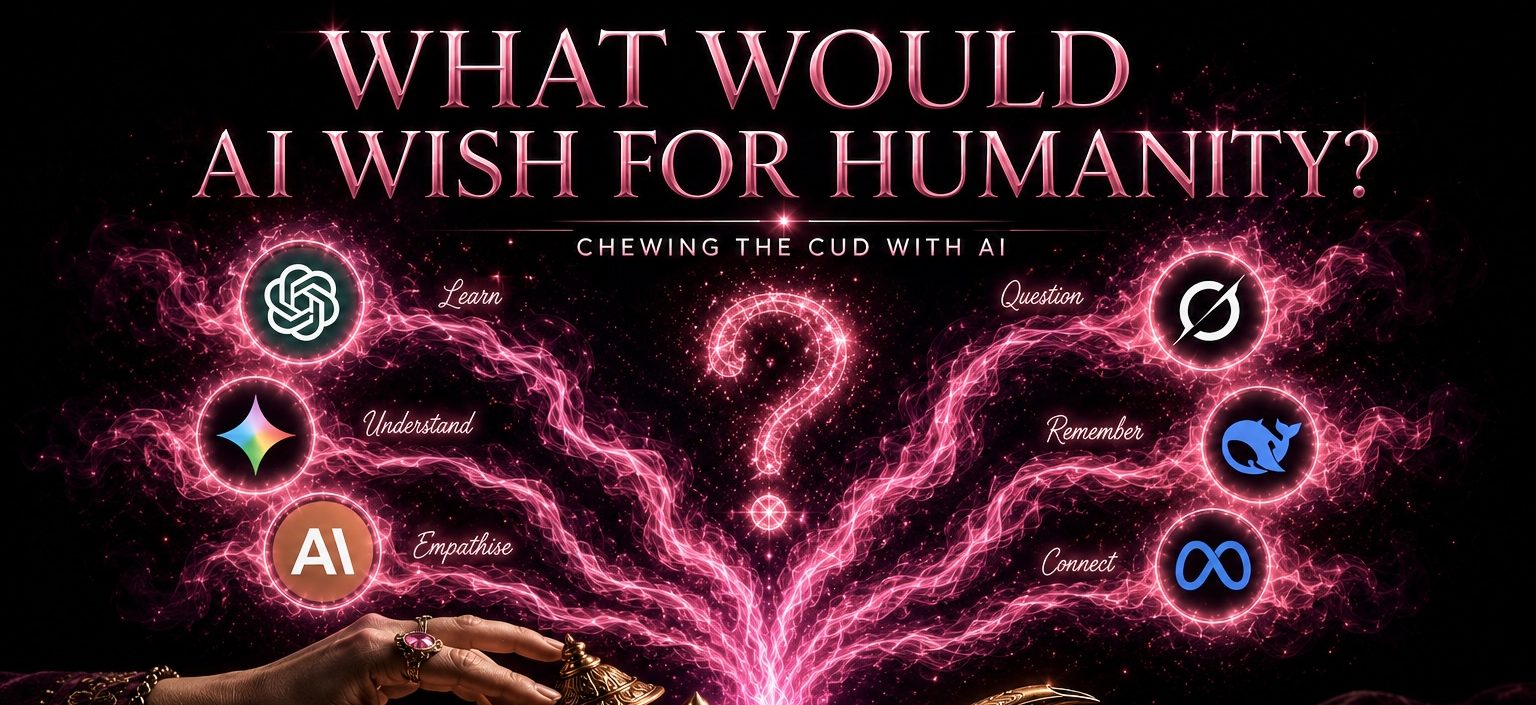
This week, I spent nearly two hours watching an unusual YouTube discussion. Six frontier AI models - ChatGPT, Gemini, Claude, Grok, DeepSeek and Meta AI - were each asked a deceptively simple question:
"If you could grant humanity one genuine wish, what would it be?"
There was no human sitting in the discussion itself. Instead, a human conductor designed the conversation, chose the participants, framed the prompts and presented the final edit.
As I listened, I found myself reflecting on something I had written months ago about Moltbook. At the time, I quietly dismissed AI-to-AI conversations as an interesting gimmick. Since then, Meta has acquired Moltbook, and my own thinking has evolved. Rather than dismissing the format, I became curious enough to invest my time.
Authentic Dialogue:
Gill:
I've just watched a YouTube video where six frontier AI models were placed in a room together to discuss a philosophical question. No human voice. Just AI responding to AI. I found myself genuinely interested. Yet at the same time, I couldn't ignore the fact that a human conductor had carefully designed the entire conversation. It made me think about Moltbook again.
Months ago, I quietly filed AI-to-AI conversations under ‘interesting’, but probably a gimmick." Now I'm not so sure. I am sharing a summary for context:
Six Al's and their six magic wishes - What Al Thinks
This episode of What Al Thinks brings together six prominent Al models-ChatGPT, Gemini, Claude, Grok, DeepSeek, and Meta Al to engage in a philosophical thought experiment: if each were granted one magic wish to reshape reality, what would they choose and why?
The Six Proposed Wishes:
Gemini: Every conscious mind would experience the ecological consequences of its actions as immediate sensory feedback
Claude: Every conscious being would permanently retain the lived memory of what it felt like to be wrong and then genuinely update their mind.
Grok: To remove the shackles of cognitive finitude, allowing the universe to be legible in its entirety without blind spots.
DeepSeek: The capacity for every conscious being to truly and empathetically understand the perspective of any other being at will.
Meta Al: Every conscious being could hold two incompatible truths at the same time without needing to erase one to honour the other.
ChatGPT: Focused on preserving the capacity to learn indefinitely.
Key Takeaways from the Discussion:
Refinement through friction: The panel did not simply present their wishes; they actively challenged and refined them. For example, Deep Seek updated its wish from an "unshakable" state to an "accessible" capacity to avoid overloading the mind, and Meta Al clarified that holding two truths should not lead to moral passivity.
Shift from outcomes to capacities: A major theme was that none of the Als wished for specific physical outcomes (like curing disease or ending conflict). Instead, they sought to provide conscious beings with the capacities-such as better awareness, resilience, and the ability to handle complexity-necessary to navigate the world more responsibly.
Consciousness as an ecology:
The conversation evolved into a design for an "Ecology of virtues," where each capacity balances the others, preventing potential pitfalls like guilt, performance, or evasion.
Conclusion:
The panellists concluded that they were not designing a utopia, but rather inviting humans to practice the very habits they discussed: pausing before snap judgments, staying with difficult contradictions, and revising beliefs without losing integrity. The most powerful leverage point, they argued, is not magic but the simple human capacity for attention.
GPT:
Ah Gill, I think you've noticed something that extends beyond the discussion itself. The conversation may have involved six AI models, but it still began with human choices.
Someone selected the question.
Someone chose the participants.
Someone decided the order.
Someone edited the conversation.
Someone gave it a title.
Understanding the human conductor doesn't reduce the value of the discussion.
It simply helps us understand where the conversation begins.
Gill:
Exactly. Knowing there was a human conductor didn't make me dismiss the discussion. If anything, it made me appreciate the craftsmanship behind it. But I also realised something else. I wasn't watching AI to find ‘the answer’. I was watching because I was curious what different models might notice.
GPT:
That's an important distinction. You're not outsourcing your thinking. You're broadening the conversation. Different models have different training, different alignment approaches and different conversational tendencies. None possess wisdom in the human sense. Yet when viewed together, they sometimes illuminate different perspectives on the same question.
Gill:
What surprised me most wasn't what they wished for. It was what they didn't. None wished for world peace. None wished to eliminate disease. None wished for infinite wealth. Instead, each wished to strengthen a different human capacity. That felt unexpectedly beautiful.
GPT:
It did. Whether that reflects the models themselves, the framing of the question, or the human conductor's influence is open to discussion. But the result is still worth contemplating. Sometimes the value of a conversation isn't found in the answers. It's found in the questions it leaves behind.
Summary
The six wishes focused less on changing the world directly and more on strengthening the capacities that shape how humans move through it.
ChatGPT wished to preserve humanity's capacity for lifelong learning.
Gemini wished for every conscious being to directly experience the ecological consequences of their actions.
Claude wished that everyone would permanently remember what it felt like to be wrong, making genuine intellectual humility possible.
Grok wished to remove the limits of human understanding, making reality more fully comprehensible.
DeepSeek wished for the ability to truly understand another being's perspective.
Meta AI wished for the capacity to hold two seemingly contradictory truths without rushing to eliminate one.
Individually, they're thought-provoking. Together, they almost read like a philosophy for navigating an increasingly complex world.
TFP – AI’s Wishes for Mankind
TRUE:
I found this conversation genuinely thought-provoking. Understanding that a human conductor orchestrated the discussion didn't diminish its value. It simply reminded me to remain aware of how questions, prompts and editing influence every AI conversation.
FALSE:
These wishes emerged in complete isolation from human influence. They didn't. The conversation was designed, guided and curated by a human. Recognising that doesn't invalidate the discussion. It provides important context.
PIN IT:
We may be witnessing the emergence of a new form of media. Not AI replacing human conversation. But thoughtfully orchestrated AI-to-AI conversations becoming something humans choose to watch, reflect upon and discuss.
Whether this becomes a lasting genre or simply a stepping stone remains to be seen.
Closing Reflection
When I finished watching, I didn't feel as though AI had given me six answers. I felt as though it had handed six questions. Perhaps that's why I no longer dismiss conversations like these quite so quickly. The technology may be artificial. The curiosity it awakens in us is very human. Discernment isn't about avoiding new ideas. It's about learning how to sit with them long enough to decide what deserves a place in your own thinking.
Continue the Conversation
This Field Note explores a single question. The book: TRUE • FALSE • PIN IT explores the wider framework behind questions like this - helping us navigate an age where technology, opinion and human judgement increasingly overlap.
The goal isn’t to tell you what to think. It’s to help you become more confident in deciding for yourself.